
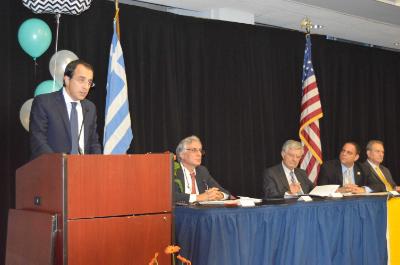

Geography will play a significant role in shaping the future of Cyprus over the next decades and the government of Cyprus is determined to explore this potential fully, and transform the country into a source of stability and peace in the region, Government Spokesman Nikos Christodoulides said, addressing the graduation ceremony of Queens College Centre for Byzantine and Modern Greek Studies in New York.
Noting that energy is key to restoring Cyprus’ injured wings as well as in changing the geopolitical landscape of the Eastern Mediterranean, Christodoulides elaborated on the results of research by Noble Energy, Total and ENI-KOGAS in Cyprus` exclusive economic zone, noting that “based on the preliminary evaluations made for all licensed Blocks, we are cautiously optimistic for even further discoveries in our exclusive economic zone. In fact, exploration activity will continue in 2014 in all six blocks” of the EEZ.
“Fully aware of the importance of strategic planning, the government has built its energy policy around three pillars: to shield the geostrategic, geopolitical and geo-economical role of the country; to contribute in enhancing the security of Europe’s energy supply through the creation of a third corridor; and to diversify Cyprus’s energy mix by integrating natural gas and renewable energy resources in its energy system so that the island may gradually become energy self-sufficient,” Christodoulides said.
He noted that “through the continuous assessment of all possible alternatives, the Government of Cyprus believes that construction of an onshore plant for the Liquefaction of Natural Gas (LNG) remains the best strategy forward for the monetization of our hydrocarbon resources. In our view this regional infrastructure project could prove to be a game changer.”
As he noted, “it will contribute to the diversification of European energy supply sources and provide a flexible hub that can link the large quantities of natural gas throughout the Eastern Mediterranean and transport them to European and global markets.”
He said that the recent crisis in Ukraine has undoubtedly exposed the dependency of the EU on Russian energy supplies and has illustrated the need for alternative energy corridors, a diversified energy portfolio that will lead to increased energy security and noted that during President Anastasiades’ recent visit to Germany and US Vice President Biden’s visit to Cyprus last week, Cyprus’s role in increased regional energy security was highlighted.
He underlined that Cyprus is pursuing its energy policy in accordance with international law and the UN Convention on the Law of the Sea, noting that “regrettably Turkish threats are the only exception to the regional cooperation with respect to energy in the Eastern Mediterranean.”
He said that “Turkish claims in relation to Cyprus’s exclusive economic zone cannot be sustained by international law while Turkish threat of use of force undermine regional stability and seek to harm efforts to unlock the region’s energy potential”.
He pointed out that “despite the fact that history and first-hand experience oblige us to take Turkish threats seriously, Cyprus will not be deterred from exercising its sovereign rights and pursuing its energy policy for the benefit of its people and for the EU.”
Christodoulides stressed that “Cyprus aspires to bring interested stakeholders closer together – as it has done in the case of Israel and Lebanon – through opportunities for maritime boundary agreements and the joint development of potentially common and adjacent fields of hydrocarbon deposits.”
He remarked that “the role of Cyprus as an energy hub is highlighted by the presence of large multinationals in the country, aiming to serve the region from a politically stable, business friendly, country, with full EU membership, such as Cyprus.”
Referring to Cyprus` economy, Christodoulides said that many of the corrective measures that Cyprus was forced to take following the Eurogroup’s decision were measures that should have been taken long before March in order to prevent the ensuing economic meltdown.
“The decision was also a wake-up call for us, the people of Cyprus, who inevitably got carried away by the economic bubble created,” he noted.
The Spokesman said that despite the soothsayers and their ominous predictions, Cyprus turned the economic crisis into an opportunity to reform and restructure its economy.
He noted that “economic recession in 2013 was less severe than initially expected. In fact, our fiscal targets for 2013 were met by a considerable margin, while the financial sector is showing clear signs of stabilisation due to the determined implementation of the agreed Economic Adjustment Programme.”
Recalling that Troika has already issued four very positive reviews on the Cyprus Government’s implementation of its economic reforms and that the Cyprus economy received a series of upgrades by Standard & Poor’s and Fitch, following three years of successive downgrades, he said that the forecast for a quick recovery and return to growth, as early as 2015, is supported by the Troika’s own forecast and that recession is expected to ease in 2014 and much needed growth is set to return in 2015 as domestic demand rebounds.
As regards the Cyprus problem, Christodoulides said that “ending the division of Cyprus will have ramifications that ripple beyond Cyprus’s shores, throughout the Eastern Mediterranean and deep into the fabric of Europe” and reiterated the Cyprus government`s steadfast commitment to reach a comprehensive settlement to the Cyprus problem, in line with the relevant United Nations Security Council Resolutions, High Level Agreements, and EU principles.
He noted that during his visit to Cyprus last week – the first visit to Cyprus by a US Vice President since 1962 – Biden referred to Cyprus as an island uniquely situated at a critical time and called Cyprus a strategic partner and a key player in the region with incredible potential.
Christodoulides expressed the belief that Cyprus is on the road of fulfilling its potential, and referred to the current UN-led negotiations between the Greek Cypriot and the Turkish Cypriot community with a view to reach a settlement of the Cyprus problem, following a joint declaration agreed by Cyprus President Nicos Anastasiades and Turkish Cypriot leader Dervis Eroglu on February 11, 2014.
Furthermore, he stressed the need for confidence building measures and reiterated that the Famagusta Proposal could be a game-changer. “It would lead to a win-win result and most importantly it would inject dynamism and momentum to the negotiations. Moreover, it can contribute decisively to creating a climate of mutual trust, restoring at the same time the hope and confidence in the prospect of reaching a settlement and, particularly, in defining Turkey’s intentions,” he said.
He also noted that the reconstruction and rehabilitation of the fenced city of Famagusta, which has been uninhabited for four decades, will lead to the creation of new jobs within a wide-variety of occupational fields, giving a huge boost to the economy of the country, noting that “this proposal has been supported by the European Union, by individual member states, not to mention the White House.”
“Unfortunately, as of yet, we are still awaiting a positive response from the Turkish side,” Christodoulides noted.
Cyprus has been divided since 1974, when Turkish troops invaded and occupied 37% of its territory.
