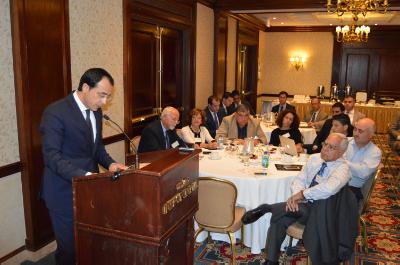
Through the proposals submitted at the negotiating table by the two sides in Cyprus convergences have to be created, Government Spokesman Nikos Christodoulides said addressing the 30th PSEKA Cyprus Conference in Washington, noting that “we cannot continue the endless discussions of the past, concentrating solely on chapters that interest the Turkish Cypriot side, such as power sharing, without discussing inter-dependently – as called for by the Joint Declaration – all chapters, including territory, security guarantees, citizenship and settlers.”
Christodoulides said that “the proposals submitted by the Turkish Cypriot side, unfortunately, reveal a vision that contradicts the agreed UN framework of negotiations. This is not acceptable to us, it is not acceptable to the United Nations, and it is not acceptable to the United States or the European Union,” adding that this is “a clear message we should all continue to send.”
Noting that the Turkish side is using the so called ‘convergences’ from the past round of negotiations between 2008-2012 to avoid substantive discussions on all core issues, when they themselves have in the past repeatedly rejected these convergences. In fact, many of the proposals submitted contradict past convergences, Christodoulides said that “our position is that we have started a new round of negotiations, and through the proposals submitted by the two sides, we need to create ‘Anastasiades – Eroglu’ convergences.”
He noted that “in order to avoid an impasse, President Anastasiades has proposed a methodology to address the issue of convergences and the help negotiations advance. The proposal involves each side preparing a table clearly outlining what it considers to be convergences, issues where there is a small distance between the two sides, and core issues where there is a substantial gap. This methodology aims to bring clarity on where we are in the negotiations, and to help the process move along by allowing us to concentrate on core issues where significant distance separates the two sides.”
Christodoulides expressed hope for a positive reaction from the Turkish Cypriot side in order to be able to move forward, noting that “we have informed the United Nations that we are ready to submit our table on convergences by September so as to inject dynamism in the negotiations.”
He recalled that President Anastasiades has proposed a bold package of confidence building measures that includes the fenced area of Varosha, the port of Famagusta, Turkey’s EU accession negotiations and the full implementation of the Ankara Protocol vis-à-vis the Republic of Cyprus.
He said that this proposal would be a game-changer and would lead to a win-win result and most importantly it would inject much needed dynamism and momentum to the negotiations, noting that even though during his visit to Cyprus Vice President Biden exerted enormous efforts to convince the Turkish side to agree on the implementation of confidence building measures, regrettably the Turkish side proved intransigent once again.
Christodoulides stressed that “we are committed to continuing our efforts, in parallel with the negotiations, and with the support of the United States, to reach an agreement on confidence building measures because we believe they will have a catalytic effect,” noting that “the US Government is showing great understanding and respect for our positions, and this was proven tangible during the Vice President’s visit. We know that the United States impresses upon Turkey that the status quo does not benefit Turkey militarily, politically, or economically, and that there is significant potential benefit for Turkey in a bi-communal, bi-zonal federation.”
“We continue to ask for your assistance in getting this message through to Ankara, where the decision-making power ultimately lies,” he noted.
Cyprus was divided in 1974 when Turkey invaded the island and occupied its northern third. UN-backed talks resumed in February this year, following an agreed Joint Declaration, reached by President Anastasiades and the Turkish Cypriot leader Dervis Eroglu.
As regards Cyprus economy, he said that economic recession in 2013 was less severe than initially expected, noting that the Troika has issued four positive reviews, we have received upgrades by Standard and Poor and Fitch following three years of consecutive downgrades, and we have managed to get back into the financial markets.
“The forecasts are for a return to growth as early as 2015. Is this a small miracle, as some have said? Not quite. The government of Cyprus and its people have made difficult decisions and even more difficult and painful sacrifices in order to make our economic turnaround possible. What is miraculous – and I continue to see it every day – is the resilience and resolve of the Cypriot people, which is fully and justifiably recognised at international level as the core of the current progress,” he noted.
He stressed that Cyprus is a reliable partner to entrepreneurs and investors interested in using Cyprus as a base to access key markets in Europe, Russia, the Middle East and Asia. We count on you to continue passing this message here, in the United States.
“We still have a long way to go. But we are without a doubt on the path to recovery, without mortgaging our children’s future,” he noted.
As regards the energy sector, Christodoulides said that Cyprus could be the first EU member state to become an exporter of liquefied natural gas.
He noted that the involvement of energy giants such as the French company Total, the US company Noble, and the Italian-Korean consortium ENI-KOGAS – who have been granted hydrocarbon exploration licences in five additional offshore blacks – provides evidence of great potential waiting to be tapped. Exciting discoveries have also been made in the exclusive economic zone of Israel, while there are potential discoveries offshore Greece, Egypt and Lebanon, he noted.
He stressed that “we are proving to be a stable partner that through regional cooperation provides a predictable corridor of access to the region and a visible role in European energy diversification. No other country is in a position to successfully negotiate the exclusive economic zones among Israel, Egypt, and Lebanon.”
“Cyprus is without a doubt the key with regards to cooperation between Israel and Egypt. Vice-President Biden was very clear about that during his meeting with President Anastasiades in Cyprus,” he noted.
He said that Cyprus’ flourishing cooperation with Israel, which does not limit itself to the exploration and exploitation of natural resources, is redrawing the geopolitical map of the eastern Mediterranean and drawing us closer into partnership with America, a strong ally able to exert pressure on Turkey.
Christodoulides noted that President Anastasiades has briefed the US administration – and will continue to do so – on Turkey’s persistent threats to our exclusive economic zone rights, adding that the United States, and the rest of the international community, have been crystal clear on Cyprus’ right to pursue exploration and exploitation activities in its exclusive economic zone. “Your role in this respect is also crucial: Turkey needs to receive clear and unequivocal messages, particularly from allies such as the United States, to refrain from such actions,” he stressed.
Referring to relations between Cyprus and the US, Christodoulides said that “we have entered a new and unprecedented era in these relations”, adding that the US Vice President’s historic visit in May – followed by visits only last week at Deputy Under Secretary level – provides ample proof of this new phase in bilateral relations.
He said that during his visit, the Vice President, “a true friend of Cyprus – whom you know very well from your own contacts here in Washington – sent clear messages to the Turkish side on the Cyprus problem and stressed the importance of the strategic partnership between our two countries.”
Christodoulides conveyed President Anastasiades’ deepest gratitude and appreciation for the invaluable work that Cypriots living in the US do for Cyprus.
Opening the conference, PSEKA President Philip Christopher expressed reserved optimism for a Cyprus settlement and described as encouraging the approach between Cyprus and Israel.
The opening ceremony was also addressed among others by the President of the National Coordinated Effort of Hellenes Andy Manatos and the Ambassadors of Greece and Cyprus to the US Christos Panagopoulos and George Shiakkali, respectively.