
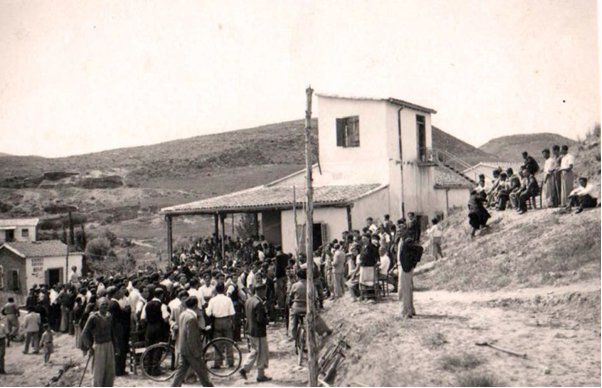

Meeting in the Turkish Trade Unions building in Mavrovouni village
“The spilled blood on the asphalt of Mavrovouni is a witness to a drama. Here in this place, from which our underground wealth comes from and flows into foreign and ungrateful pockets, the blood of hungry striking miners has been shed here, whatever blood has been left from those bodies, which have been drained in the black tank of the mine. Here workers blood was shed by the hands of the police. This blood will be an indelible stain on the history of the foreign company and colonial government.”
This is what the press report of the newspaper “Democrat”, organ of the C.C. of AKEL, wrote the day after the bloody events of 3rd March 1948, when police fired shots against striking miners injuring many of them. Similar bloody events were to be repeated on 8th March in the village of Xero.
Fierce class struggle
The strikes of the miners, asbestos workers and construction and building workers throughout 1948 were the culmination of the class struggle of the Cypriot working class in the years of British colonialism.
The main characteristic of that struggle was the sharpness which the struggle assumed. This ferocity was due to various domestic conditions, but also to external factors. Capital, both local and foreign, feeling the support and protection of the British colonial government, refused to make the smallest amount concession from its privileges so as to improve even just a little working people´s lives. The colonial government, the American mining company, the leadership of the “New Trade Unions” (SEK), the leadership of the right-wing parties and organizations and Archbishop Makarios B rallied their forces by forging an unholy alliance against the working class and its class conscious trade union movement. One shouldn’t forget that in 1948 the “X” ultra-right organization of Grivas was also active in Cyprus. The successes of the Left in the municipal elections of 1943 and 1946 alarmed the colonial government and local reaction. On the other hand, the civil war in Greece and the Cold War worldwide had a catalytic effect on the class conflict of 1948 assuming fierce dimensions.

The editor of “Democrat” G. Lerni addressing miners in Mavrovouni
Another very important feature of that strike was the fact that Greek Cypriot and Turkish Cypriot workers fought together as children of the same class, overcoming any ethnic divisions. The class-based Pancyprian Federation of Labour (PEO) had within its ranks a large number of Turkish Cypriot workers. At the same time, a very good cooperation existed with the Turkish Cypriot trade union KTIBK, which together with PEO guided the great strike struggles of 1948.
The newspaper column “90th anniversary of the Communist Party of Cyprus-AKEL” will not deal with the full range of strikes waged in 1948. Besides, this glorious history is recorded in the books “The History of the PSE-PEO 1941-1981”, “The strike struggles of the miners and the asbestos workers in 1948” and in many other books and articles written by the late Pantelis Varnavas, one of the leaders of the miners and PEO during these struggles. In today´s article, and the one to follow, will deal, paying due tribute, with the bloody events that marked the development of the strike of the miners.
The events

The strike was declared on 13th January 1948. The just and reasonable demands of the strikers were rejected in their entirety by the Cyprus Mining Company (CMC), an American company that was plundering the underground wealth of Cyprus and brutally exploiting Cypriot miners. The CMC management, with the cover of the colonial government, not only refused to discuss the demands of the strikers, but also tried to crush the strike by using strike-breakers and scabs which the “New Trade Unions” willingly recruited.
Appeal of “Democrat” for milk for striking miner´s children
Let’s see how the newspaper “Democrat” describes the bloody events of Mavrovouni. On the morning of 3rd March, 12 strike-breakers escorted by policemen were taken to a makeshift doctor’s office to be examined in order to get a work permit. The strikers found out about it. They also learned that “they were being taking to their jobs by force, that they wanted to leave and go to the Trade Union, but the company agents and the police wouldn’t let them.” The surrounding streets were filled with strikers, who heard from the strike-breaker´s mouths of their refusal to go to work. Some strikers rushed to break free the scabs from the hands of the police. The policemen began to beat them from the beginning with batons. The strikers in defence threw stones at the police. Then the officers pulled their guns and on the command of a police officer began shooting at the crowd.
As a result of the shots fired, Sakir Izzet from Kato Horio village, Ahmet Netziati from Antrolykou, Georgios Georgiades from Ktima, Izet Ali Hajiali from Lefka, Mehmet Palaz from Lefka and Andreas Charalambous from Mavrovouni were injured. Four of the injured, due to the severity of their condition, were transferred to Nicosia Hospital.
Popular protests
The bloody events of Mavrovouni provoked a storm of protests and mobilizations which culminated in the nation-wide strike which PEO organized throughout Cyprus on 6th March. The “Democrat” writes about the national strike in Nicosia: “Every movement had stopped. The nation-wide strike was universal. The Construction and building sites are deserted. And if there was a shadow of any contractor or employer among half-built walls, it had a sullen expression. The owners of the workshops were left as voiceless owls, guarding what they could not work with their own hands. Government jobs had literally paralyzed. But even the market too appeared to be quiet.”
On the day of the nation-wide mobilization tremendous mass workers’ meetings were held all over Cyprus, which approved resolutions towards the government. The mass meeting in Nicosia was addressed by the General Secretary of PEO Andreas Ziartides, who referred to the lessons to be drawn from the events of Mavrovouni, stating the following: “First and above all we highlight the need for unity. And this unity was forged when confronting the police bullets, which were fired without distinction against Greeks and Turks. The Greek and Turkish blood spilled in Mavrovouni sealed forever the unbroken cooperation between the two fraternal elements”.
The miners themselves caused great excitement among the workers of the cities when they came to organize picket marches. The following slogans were inscribed in both Greek and Turkish, slogans such as “Bread and not bullets,” “Down with the guns shooting hungry strikers”, “Double your contributions to the strikers.” The last slogan reflected the wave of solidarity with the strikers which was generously expressed by the whole people.
The injured strikers Mehmet Palaz, Georgios Georgiades and Siakir Izzet sent a letter to their comrades in which, among other things, they stressed the following: “We are proud that the Company’s allies were attacking us because we sought to safeguard our just struggle, to earn some bread for our children. Our enemies should know that their bullets have made us even stronger and our fighting power has multiplied. Brothers and colleagues, join the struggle with sacrifice and self-denial. United and inseparable, we will win! Long live our struggle! Long live the Cypriot people struggling alongside us! Long live our leaders, Turks and Greeks “!
AKEL
The Plenum of the C.C. of AKEL convened in an extraordinary plenary meeting on 4th March and issued a declaration. The declaration denounced the armed attacks on the striking workers. It stressed that such attacks “should have had very little relationship with the so-called “socialist” government of England and its representatives here in Cyprus.” The question is put whether Cyprus is actually run by Lord Winster or by monopoly capital of the Americans financers CMC and Mr. Hendrix “(who was the CMC Director). AKEL denounced the stand of the leadership of the New Trade Union and certain newspapers, “who either through their guilty silence or their hypocrisy and submissiveness, are trying to stab the struggling strikers in the back.”
The C.C. of AKEL addressed the strikers, welcoming their struggle and stressed the following:
“We stand on your side. Hold high the banner of the struggle of the working class. Victory is in front of you. You will be victorious regardless of what you and all of us will need to give together in your sacred struggle. We don’t underestimate our strength. Do not overestimate the power of the united reactionary alliance which is using all lawful and unlawful means to crush the heroic march of the strikers to fulfil their aspirations. We have the just cause and the strength, as well as one steadfast objective: To prevail and victory! “
Finally, AKEL´s proclamation was addressed to the whole people:
“Workers, peasants, working people, honest middle-class and intellectuals, Greeks and Turks, wherever you may be, protest about the workers blood that was shed yesterday in Mavrovouni. Organize meetings all over the country to put pressure on the foreign American company… Increase your extraordinary financial contributions to the strike fund. To the bloody sacrifice our brothers were called on to make and have made in the front line of the strike struggle in the mines, we too have to make our own economic sacrifice.”
Article by Yiannakis Colocasides

