
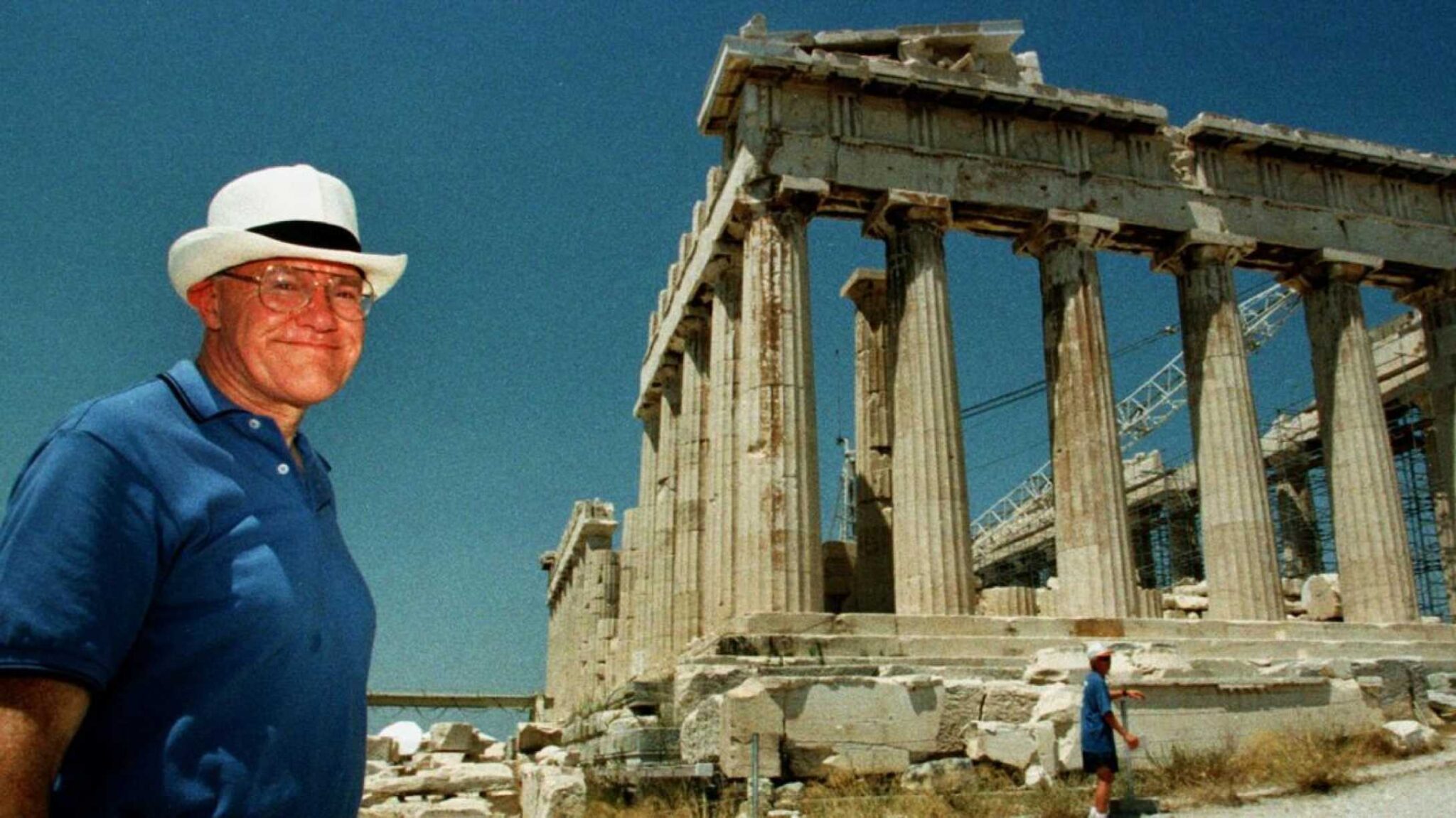

The Parthenon
The Parthenon is a former temple on the Athenian Acropolis, Greece and dedicated to the Goddess Athena, whom the people of Athens considered their patroness. Construction started in 447 BC when the Athenian Empire was at the peak of its power. It was completed in 438 BC, although decoration of the building continued until 432 BC. It is the most important surviving building of Classical Greece, generally considered the zenith of the Doric order. Its decorative sculptures are considered some of the high points of Greek art. The Parthenon is regarded as an enduring symbol of Ancient Greece, democracy and Western civilization, and one of the world’s greatest cultural monuments. To the Athenians who built it, the Parthenon, and other Periclean monuments of the Acropolis, were seen fundamentally as a celebration of Hellenic victory over the Persian invaders and as a thanksgiving to the gods for that victory.
Importance of the Parthenon
The Parthenon was the centre of religious life in the powerful Greek City-State of Athens, the head of the Delian League. Built in the 5 century BC, it was a symbol of the power, wealth and elevated culture of Athens. It was the largest and most lavish temple the Greek mainland had ever seen. Today, it is one of the most recognised buildings in the world and an enduring symbol of Ancient Greece.
Who built the Parthenon?
The celebrated Greek statesman Pericles is credited with ordering the design and construction of the Parthenon as a temple for Athena – the goddess of wisdom, arts and literature and war – but it may not have been the first attempt to house the deity.
An earlier structure known as the Older Parthenon or Pre-Parthenon once existed on the site of the current Parthenon. Many historians believe the Older Parthenon was under construction in 480 BC when the Persian Empire attacked Athens and destroyed the Acropolis, although some experts dispute this theory.
Doric Columns
Pericles commissioned the renowned Greek architects Ictinus and Callicrates and the sculptor Phidias to design the Parthenon, which became the largest Doric-style temple of its time.
The structure has a rectangular floor plan and is built on a 23,000-square foot base, part of which was the limestone foundation of the Old Parthenon.
Low steps surrounded each side of the building, and a portico of Doric columns standing on a platform create a border around it. There are 46 outer columns and 19 inner columns.
The columns are slightly tapered to give the temple a symmetrical appearance. The corner columns are larger in diameter than the other columns. Incredibly, the Parthenon contains no straight lines and no right angles, a true feat of Greek architecture.
Athena
A shrine within the Parthenon housed an extraordinary statue of Athena, known as Athena Parthenos, which was sculpted by Phidias. The statue no longer exists but is thought to have stood 12 meters high (39 feet).
It was carved of wood and covered in ivory and gold. Historians know what the statue looked like thanks to surviving Roman reproductions.
The Athena statue depicted a fully armed woman wearing a goatskin shield known as an aegis. She held a six-foot tall statue of the Greek goddess Nike in her right hand and a shield in her left hand that illustrated various battle scenes. Two griffins and a sphinx stood on her helmet and a large snake behind her shield.
It’s unclear if the Parthenon served solely as a home for Athena or also as a treasury. It was undoubtedly an awe – inspiring sight for anyone who gazed upon it. Ancient spectators weren’t allowed inside the structure but viewed its splendour from the outside.
Parthenon changes hands
In the sixth century AD, the Christian Byzantines conquered Greece. They outlawed pagan worship of the Greek Gods and converted the Parthenon to a Christian church. They blocked the East side entrance and, following the custom of Christianity, forced worshipers to enter the church on the West side.
The massive statue of Athena was gone before the Byzantines arrived. In her place, they put a pulpit and marble bishop’s chair.
The Parthenon remained a Christian church until 1458 AD, when the Muslim Ottoman Empire seized Athens. The Ottoman Turks converted the Parthenon into a mosque, yet kept many Christian paintings and artefacts intact.
In 1687, facing attack from the Christian Holy League, the Ottomans converted the Parthenon into an ammunitions depot and shelter, but it was anything but safe. The structure was bombarded with cannonballs and its ammunition stores exploded causing hundreds of deaths and massive structural damage.
Elgin Marbles
After the Holy League’s assault, the Parthenon sat in ruins and was at the mercy of looters. In the early 19th century, Thomas Bruce, the 7th Earl of Elgin, removed the marble friezes and several other sculptures and shipped them to London, England where they remain on public display in the British Museum today.
It’s unclear if Elgin had permission to remove the sculptures, and the Greek government has requested they be returned.
Time, weathering and cleaning has caused the Elgin Marbles and other Parthenon sculptures to look white, but there’s evidence they and other parts of the structure were once painted vivid colours such as red, blue and green.
Parthenon Restoration
After centuries of being ruled by the Turks, the Greeks fought for independence in the 1820s. The Acropolis became a combat zone and the Turkish Army removed hundreds of marble blocks from Parthenon ruins. They also used the lead-coated iron clamps which held the blocks together to make bullets.
Finally, in the 1970s, the Greek government got serious about restoring the rapidly deteriorating Acropolis and the Parthenon, which had become one of the country’s national treasures. They appointed an archaeological committee called the Acropolis Restoration Project.
With Greek architect Manolis Korres at its helm, the committee painstakingly charted every relic in the ruins and used computer technology to identify their original location.
The restoration team plans to supplement original Parthenon artefacts with modern materials that are weather – resistant and corrosion – resistant and that help support the integrity of the structure. Where needed, new marble from the quarry where the original marble was obtained will be used.
Still, the Parthenon will not be restored to its original glory. Instead, it will stay a partial ruin and will feature design elements and artefacts that reflect its rich, diverse history.
Acropolis Museum
Renovations are ongoing at the Parthenon and the entire Acropolis; however, tourists can still visit the historical site. Areas undergoing a makeover may be off-limits.
Some important artefacts and remaining Parthenon sculptures were moved to the nearby Acropolis Museum. To see many of the Parthenon’s original marble sculptors and other Acropolis artefacts, visitors are encouraged to see the museum.
William St Clair
William St Clair, author, was born on December 7, 1937. He died of a pulmonary embolism on June 30, 2021, aged 83.
If the new chapter in the third edition of his book Lord Elgin and the Marbles made William St Clair a hero in Greece, it certainly made him enemies at the British Museum.
St Clair, an academic, uncovered a scandal while looking through the museum’s records. In the late 1930s, the museum’s Parthenon marbles had been scrubbed using copper brushes and caustic materials, on the orders of the donor, Lord Duveen, whose name still graces the gallery. In typically robust style, St Clair wrote that the British Museum’s cleaning methods would have “disgraced a municipal cemetery,” adding that they “defied all notions of conservation, then as now.”
The first edition of the book (1967) came about after St Clair answered an advert in The Times. A certain Mrs AC Longland in Abingdon had inherited a stack of papers from her great-granduncle Philip Hunt, who accompanied Lord Elgin on the expedition to Greece. St Clair, then a young civil servant in the Admiralty, was looking for something to occupy his spare time.
St Clair’s passion for Greece, whatever the period, lasted a lifetime. He studied classics at Edinburgh Academy and St John’s College, Oxford. A drawing of Lord Byron, who opposed the removal of the marbles from the Parthenon, hung in his bedroom alongside four oars awarded in 1957 for four bumps (a form of race) in the college’s First VIII. And, thanks to Mrs Longland, the “firman”, an Ottoman warrant permitting Lord Elgin to remove the statues, was stored under his bed for years.
But it was only in 1984, when looking over the diaries of a curator, that he first suspected a cover-up. The British Museum refused for more than a decade to put the records of the time into the public domain, citing “security implications.” When the papers were finally released, St Clair found that in 1938 the head of the department had admitted to the museum’s trustees: “The damage is obvious and cannot be exaggerated.”
In 2001 he further undermined the British Museum’s legal claim to the Marbles with his discovery that Lord Elgin had paid huge bribes to Ottoman officials. Over the years, St Clair almost reluctantly became one of the most important proponents for the restoration of the Marbles to Greece.
William Linn St Clair was born in London in 1937 to Susan WS Bow, an English teacher and graduate of Glasgow University, and Joseph J St Clair, the London representative of a group of Scottish foundries. The family soon moved back to Scotland to escape wartime bombing. When he was ten his twin brothers David and John were born. His father died from cancer when he was 16. It was a difficult time, as his mother had asked him to keep the diagnosis from his father. Few knew about his subsequent bouts of gloom, with which he coped by reading Stoic philosophers.
He won a scholarship to Oxford University, then joined the civil service. After Lord Elgin and the Marbles his roving mind moved on to That Greece Might Still Be Free (1972), an account of the Romantic-era fight for Greek independence.
At the Treasury he felt his other interests meant he was not taken seriously, although he was often selected for tasks needing literary talent. In 1988 he wrote a manual for managers which turned out to be more entertaining than the subject implied, and was translated into several languages. St Clair’s next book, the expansive The Godwins and Shelleys (1991), cemented his reputation as a biographer. He spoke about Godwin, Shelley and Byron as if they were friends
Quadruple coronary bypass surgery in his early fifties spurred him to reconsider his life. He became a visiting fellow at All Souls during sabbatical and holidays, retiring from the civil service aged 55. After a full fellowship at All Souls, he went on to Trinity College, Cambridge, just as the third edition of the Lord Elgin book was published.
It included an image of the central scene of the Parthenon frieze taken by the photographer Inge Morath, Arthur Miller’s third wife. St Clair sent Miller his book on Godwin along with a request to write his biography. This sparked a longstanding friendship. He took Miller and Morath punting in Oxford and was invited on set when Miller’s play The Crucible was turned into a film with Daniel Day-Lewis and Winona Ryder. Miller called him his “favourite Scotsman” and quizzed him about the Greek tragedies. Yet the biography never materialised, even though Miller granted St Clair access to his diaries. St Clair always blamed this on rapacious literary executors.
Although known for his refreshingly forthright advice, St Clair helped numerous scholars, and was always keen to share his research, co-author papers, and travel to conferences all over the world. He was delighted when a young scholar referred to him as the “Nestor of Greek Studies,” Nestor being a mythical byword for wisdom and generosity.
From 2009, St Clair was chairman of Open Book Publishers. An expert in the history of copyright, he disapproved of academia’s recent enthusiasm for paywalls. He was open about his disdain for restraints, whether institutional, marital or religious. It was under the Open Books imprint that he planned to publish his new 500-page book on the Parthenon. One chapter is written in the style of a speech by the 5th century BC statesman Pericles. At the time of his death, St Clair was adding his finishing touches to the book.
Did you know?
A full-scale replica of The Parthenon was built in Centennial Park, Nashville in 1897 for the Tennessee Centennial Exposition.
Source: thetimes.co.uk, history.com and en.wikipedia.com
