

TUTU
How do you define a show that gives six male dancers – Marc Behra, David Guasgua, Kamil Pawel Jasinski, Julien Mercier, Vincent Simon and Vincenzo Veneruso – an opportunity to wear a mixture of camp and colourful costumes, demonstrate their dance skills with a pastiche of any and every dance genre and also occasionally indulge themselves. First you find a title, of course TUTU, then find an adventurous and creative choreographer, Philippe Lafeuille, and finally find a venue (Sadler’s Wells East) with a history of providing a home to the full array of choreographic expression. And so it was on Saturday afternoon. The show itself premiered in 2014 but now in its 2026 iteration retains all the crazy charm and artistic expression to delight. It is a number of dance skits which begin somewhere and end everywhere, their meaning and purpose to entertain although of course I could have been missing the “message”.
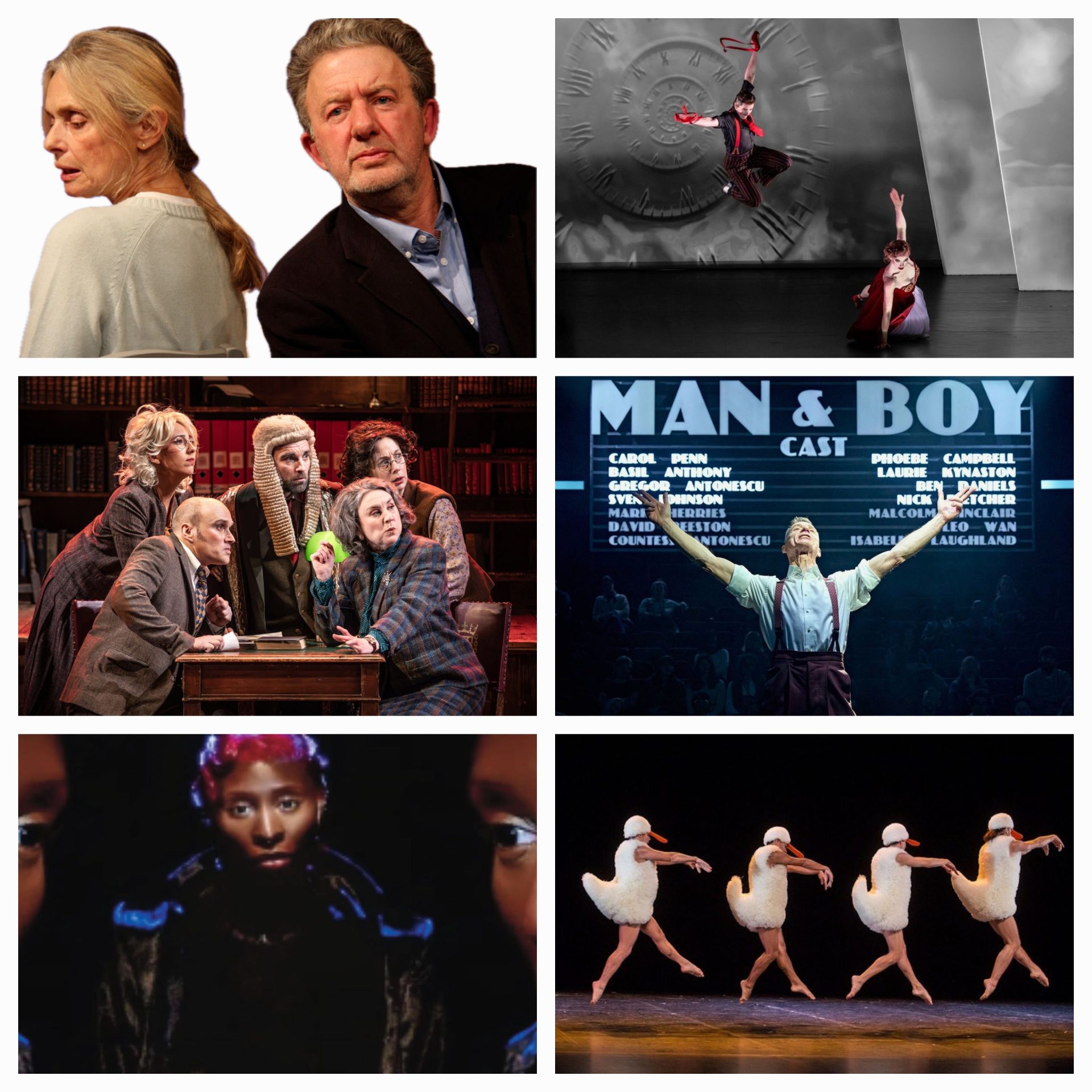
Men doing “female” dance is nothing new but when it is executed with such flair and joie de vivre you can’t help but be charmed and entertained. Imagine a sextet of Michelangelo torsos with muscular six pack and equally blessed legs going through their routines which are sometimes interrupted by comedic physical theatre cum slapstick which could feature anything from hip hop to ballroom. It is the a kind of production that young and old alike can enjoy as long as you don’t try and “understand” it. The best example of which has to be their version of Swan Lake which is nothing of the sort as it changes into Duck Lake and Flamingo Lake. The swans are all out of sorts but before you can say Tchaikovsky, they transform into a beautiful bevy that are a delight to behold even if the Dying Swan routine is somewhat anticlimactic. Therein lies one of the weaknesses of the show, the vignettes sometimes fizzle out as if they have run out of ideas.
The ‘Strictly’ routine had the audience in stitches. Although I have never seen the TV show, it was a sequence which includes a wonderful parody of Dirty Dancing, with faux outrage from the judges and lots of laissez faire moments where Lafeuille allows the troupe to go wild in bursts of surreal eccentricity. Strangely, for all the crowd-pleasing thrills and amusement, it is the pure balletic parts that had my attention, as each of the Ballerinos have their brief moment in the spotlight, demonstrating excellent technique and artistry. Soon we are back to the showmanship of Hip Hop and Disco and the audience lap it up. The mime sequences meanwhile are certainly not Marceau or Tati but more Buňuel meets Ionesco having a bad trip and as a result appear like they have been transplanted into Lafeuille’s production for a smidgeon of self indulgence. It’s excused but should be dropped.
And what are they searching for? Who knows? Who cares? Sit back and enjoy eighty minutes of cleverly devised light entertainment, performed with style and a smile.
TUTU – www.sadlerswells.com
Photo credit: Michel Cavalca
Spanish Oranges
It’s a bold move indeed to write a play that riffs on Who’s Afraid of Virginia Woolf. It’s an instantly recognisable and much-loved story, and if the play lulls in excitement for a second an audience could very quickly start wishing they were seeing Woolf instead.
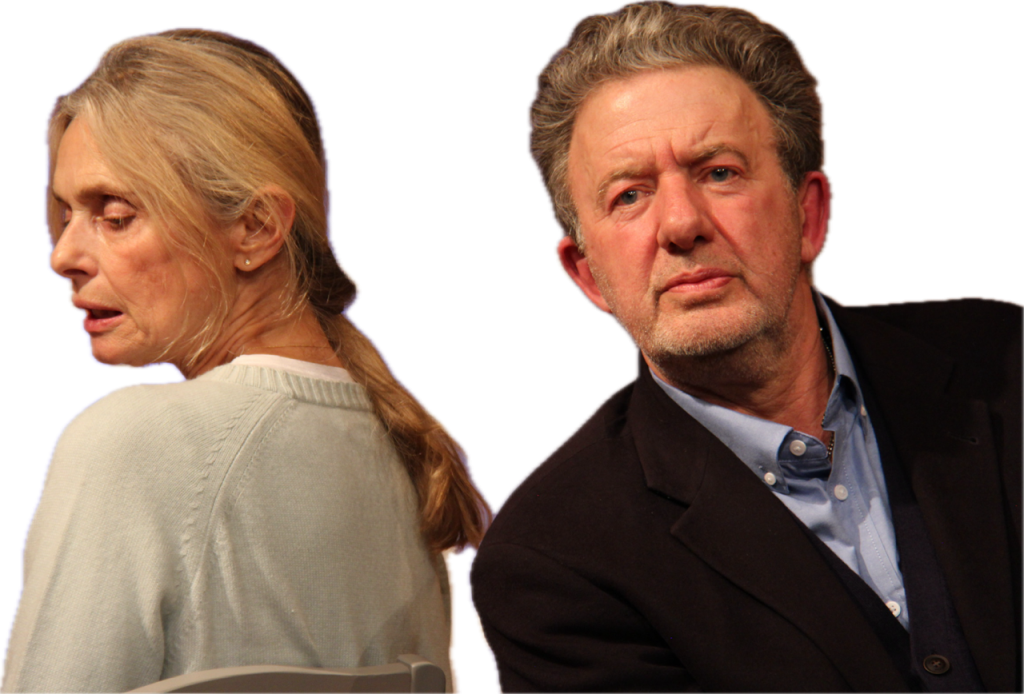
Fortunately, Alba Arikha’s debut play Spanish Oranges (Playhouse Theatre) starts as it means to go on, the pace is enough to keep the audience firmly in the room and glued to their seats. It’s an expertly plotted first third; an interview-cum-interrogation of Fiona (Maryam D’Abo), a novelist about to hit the big time with her new book Spanish Oranges, by a Times journalist, who she suspects is more interested in the scandals plaguing her husband Peter (Jay Villiers) than asking any questions about the book itself. The tension is palpable; Fiona sees every innocuous question as a possible angle of attack, but the coverage offered by the press means she’s never quite able to walk away.
The cosy North London flat (set design by Livi Carpenter) starts to take on an oppressive quality as the interview goes on. The house is full of moving-in boxes and books litter every surface; at first it looks scatterbrained and charming, but it becomes apparent that Fiona and Peter have had to significantly downsize because of the scandal, and they just have too much stuff for the place they’ve moved into. The interview builds to an astonishing reveal at about the half-hour mark, which I won’t spoil but had me lean sharply forward in my seat and audibly gasp (only to be shushed by the woman next to me, who turned out to be the author of the play).
Unfortunately, that’s where the play loses steam. The play can’t seem to commit to the domestic ugliness that the first third implies; Peter protests that his transgressions were a one-off lapse in control and astonishingly, considering this play was born out of something called the ‘Women’s Voices Festival’, the rest of the play all but agrees with him, downplaying a clear-cut case of domestic violence to make an incoherent point about ‘cancel culture’. The book that the play revolves around, Spanish Oranges, gives a few clues as to why the play backs down. From the description given, it sounds dreary; something about a man leaving his nagging wife to see the orange trees in Seville.
A cursory glance at the author’s novelistic output makes it clear that Spanish Oranges isn’t meant to be a parody of Guardian bestseller-core literary fiction and is fully within the bounds of something that she would publish. It’s clear from the description of the novel that Fiona sees herself as the man eager to see the orange trees, and Peter holding her back – it even ends up explicitly stating that later in the play, in case anyone wasn’t paying attention. The fact that Fiona’s resentment stems more from Peter stifling her than his obvious misogyny plants this firmly in a British tradition of bourgeois feminism. A sneering gag about a transgender lecturer at the daughter’s ‘woke’ university felt similarly dated and had me spending a tense half an hour after the play apologising to my plus one for the night.
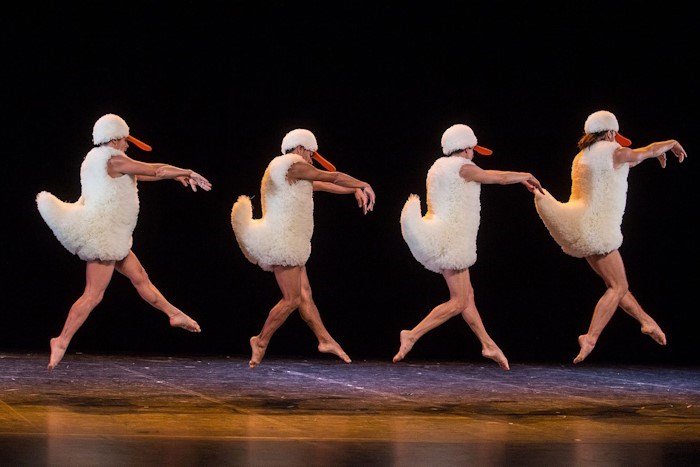
The structure of the play is good, and even as the dialogue drags and the plot itself feels like it’s presenting issues rather than taking any particular stance, the performance of the two leads is compelling enough to keep you hooked for 90 minutes. Despite my reservations there’s enough here for fun to be had.
Spanish Oranges – www.theplaygroundtheatre.org.uk
Red Shoes
Storytelling dance that thrills
One of the many joys of going to the theatre is sometimes seeing a show about which you know very little and await the production with intrigue and anticipation. Here’s what I did know about Matthew Bourne’s The Red Shows (New Victoria Woking). It is based on a fairytale by Hans Christian Andersonand the 1948 film by Michael Powell and EmericPressburger. It features ballerina Victoria Page (Cordelia Braithwaite) who is the chosen lead in a production of The Red Shoes by the admiring ballet impresario Boris Lermontov (Andy Monaghan). However, her heart is won by the show’s composer Julian Craster (Dominic North) which does not meet with Boris’s approval believing a distracted protégée is not good for her talent or the show. This being a fairytale magical things must happen and so it comes to pass that the red shoes are enchanted causing all sorts of problems for the poor girl, leading to obsession and ultimate downfall.
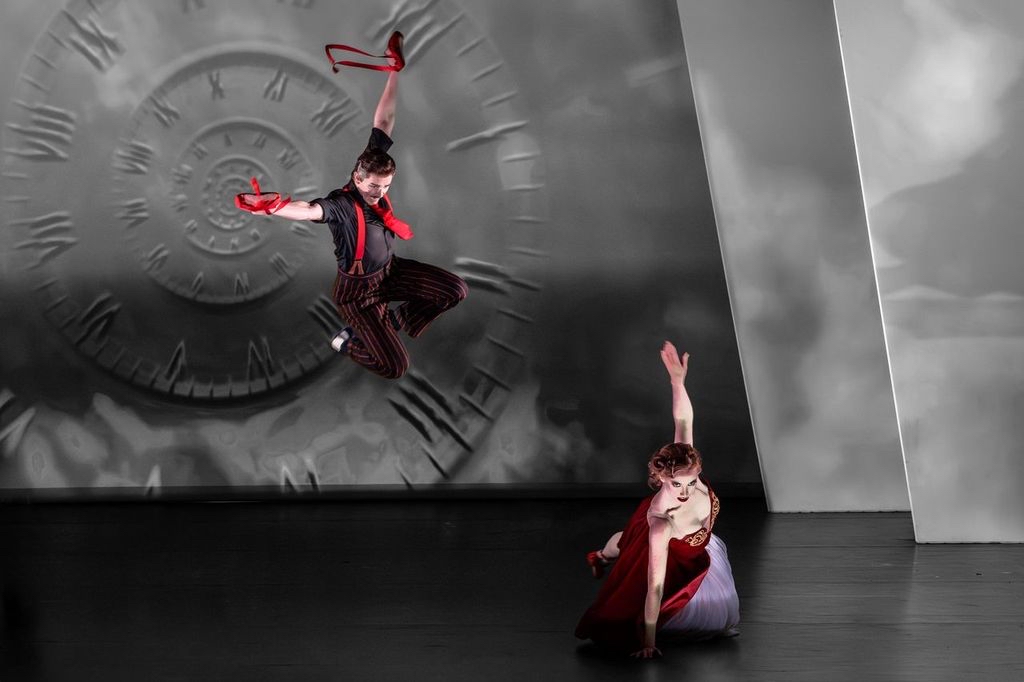
Bourne’s production (he is both director and choreographer), now in its tenth year, is quite a spectacle, with sparkling choreography and a design to match by Lez Brotherston which together create a technicolour special of days gone by. This story of ambition, obsession and love is turned into a sultry, intense yet uplifting show that makes this enchanting form of dance storytelling accessible to a wider audience including me as it is my first experience of dancers performing the narrative in such an innovative way. It combines ballet and contemporary dance techniques seamlessly and the company deliver en pointe performances that morph into something that is more akin to comedic physical theatre which sounds implausible and yet Bournemakes it work wonderfully.
The story is told as a show within a show and it is here that Brotherston’s set is so ingenious with the scene changes, as it were, each becoming a piece of theatrical magic though if I to go into too much detail it would spoil the fun. I can tell you that the ingenuity is such that he manages to evoke an eclectic mix of places which range from French seasides to the heady heights of Paris and the faded grandeur of an East End music hall. Such imagery is amplified by an equally evocative score by Bernard Herrman (arranged by Terry Davies) which is dreamy, dramatic and at times thrillingly pulsating.
In the key roles Monaghan has presence and charisma and is technically strong as Lermontov as is North who brings pathos and thrilling passages of dance to Craster and together they create an exciting frisson like two lions battling it out. Braithwaite is a delight as Page, the contrasting combination of inner strength and fragility portrayed with assurance and poignancy. However, it is the show stealing role of Irina Boronskaya, danced by Katrina Lyndon that thrilled the audience most. Here is a ballerina who cannot dance her leading role due to injury and she manages to bring out every aspect of that pain with an interpretation that brings tears to the eyes.
At the end of the performance I sat and took a few moments to think. I had been sceptical and now I wasdazzled, enthralled and moved. You could be too.
Red Shoes – www.atgtickets.com
Baldwin v Buckley
The american vicarious production of Debate: Baldwin vs Buckley (Wilton’s) is described as a “reimagined” and “radically staged” presentation of the 1965 Cambridge Union Debate with the motion, “The American dream is at the expense of the American Negro”. The two men chosen to propose and oppose the motion were writer and civil rights activist James Baldwin (Arnell Powell) and leading conservative intellectual William F. Buckley (Eric T. Miller). A stage with no set apart from four chairs is framed by a large white screen onto which the introduction from the original BBC TV footage is projected, Motion proposer, David Heycock (Christopher Wareham) gives an eloquent and ardent opening speech as does his opposer Tom Kiteley (Jeremy Burford).
Baldwin speaks first. His speech begins gently and assuredly, in sharp contrast to how negroes were then perceived, and openly described, as the “savage”. His thought process revealing an intellect that was far ahead of his time, so much so that years later several leaders of the African American community years confessed to their inability to understand what he was saying. Occasionally sentences sound as if they are abstract and intangible but this was all part of Baldwin’s deliberate attempt to make the speech more like a sermon building to a crescendo of thought, and challenge, on the dangers of white supremacy. Arnell Powell captures the essence of Baldwin’s being, what drives him on and the passion he has for understanding, empathy and justice. It is a compelling and elegant portrayal.
Conversely Miller’s depiction of Buckley, equally compelling, fizzes with arrogance and conceit, a narcissist who punctuates his case against the motion with lots of contradictory statistics which rather than strengthen his argument only go to prove Baldwin’s point that the system is stacked in every way against the ‘American Negro’. Miller’s playfulness, steeped in power and privilege, is encapsulated in his unrelenting passive aggressive behaviour. As he speaks and emotes patronisingly, Powell remains still and emotionless in his chair apart from an occasional look of barely disguised disdain.
Adaptor and director Christopher McElroen keeps it simple and the combination of brilliant oratory and the TV coverage works well. A one-hour production that persuasively demonstrates we still have a way to go in making society a level playing field (will it realistically ever happen?) for all. This is not “reimagined” or “radically staged” and it is precisely that lack of theatricality which makes it so captivating. I rarely want to see something twice, but this I would along with rereading some of the Baldwin brilliance.
Farah Najib’s Maggots (Bush Theatre) is an adaptation of a couple of real-life tragedies. A maggot infestation is spreading in a London tower block, and a stench is beginning to permeate the walls. It’s immediately obvious what has happened, so if there’s a tension, it’s seeing how long the tenants (Sam Baker Jones, Safiyya Ingar and Marcia Lecky playing various roles) are going to be stonewalled by the apathetic housing manager before the awful truth inevitably gets out. A neighbour has lain dead in her home for a year, decomposing. The cast do well with the material, which is mostly static monologues. Director Jess Barton, Lighting Designer Peter Small and Composer & Sound Designer Duramaney Kamara do a fantastic job building an oppressive, alien atmosphere which (with minimal set design) conveys just how much the tower block has atomised its residents and proven (to a fatal degree!) antithetical to human life.
However, I was left feeling a little short-changed at the end of it. The play points at two causes for the death and its aftermath, condemning the housing crisis on one hand, and the breakdown of social cohesion on the other. I just feel it didn’t do well at linking the two – the latter is inseparable from the former, you can’t lambast people for not getting to know their neighbours when housing is as precarious as it is, especially in London. On top of that, the ensemble cast works most of the time, but there are far too many characters for more than a few characters to resemble anything deeper than a quick sketch. That said, well worth seeing.
Debate: Baldwin vs Buckley – run complete
Maggots – www.bushtheatre.co.uk
Iolanthe
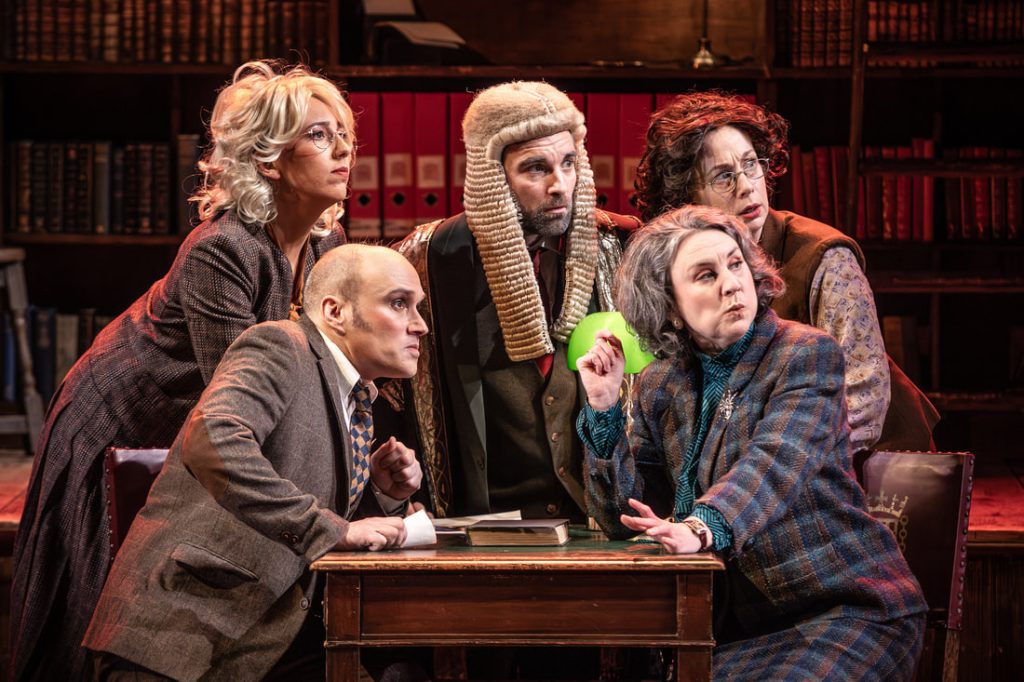
Charles Court Opera have triumphed again, binging Gilbert and Sullivan’s Iolanthe to Wilton’s Music Hall, a very fitting venue, as it is the best remaining example of a Victorian music hall.
This production has been judiciously updated, with Private Willis now a librarian, as well as various references to contemporary situations. Highlights include wonderful renditions of ‘Oh Foolish Fay’ and the wit-packed ‘Nightmare Song’. The trademark G and S combination of absurdity and hilarity comes to the fore, ensuring never a dull moment. As ever, Charles Court bring their hallmarks of high energy and campery to the production. At the same time, the operetta is made topical and full of sentiment, combining humour and satire with empathy and a fairy tale magic. In the end, there is a sense that this strange yet wonderful world has been put to rights when the fairy queen ultimately decides to change the rules so that fairies and humans can now mix and mingle as they wish.
Charles Court were prepared to premiere this production in early 2020, but the pandemic postponed it. It has been worth waiting for, with exuberant and hilarious characterisations being the highlight, as well as excellent costumes and optimum orchestration. The six musicians comprising the Charles Court orchestra are an enthusiastic ensemble, under the guidance of David Eaton.
One of the updates is to include lady peers, with Catrine Kirkman, a long-time favourite, once again showing her range and versatility, her obvious relishing of the role rubbing off on the audience. Matthew Palmer is equally effective as Willis, the elderly librarian, and Iolanthe’s son, Strephon, conveys his dilemma of being half fairy and half human most charmingly. Eleanor O’Driscoll’s Iolanthe is enchanting, whilst Meriel Cunningham’s Fairy Queen manages to be powerful and imposing yet lyrical and graceful – all the qualities a good leading fairy should have.
The production is also beautifully choreographed. Overall, a very entertaining evening of sparkle and cheer, a very fitting tribute to the Gilbert and Sullivan tradition.
– www.wiltons.org
Man and Boy
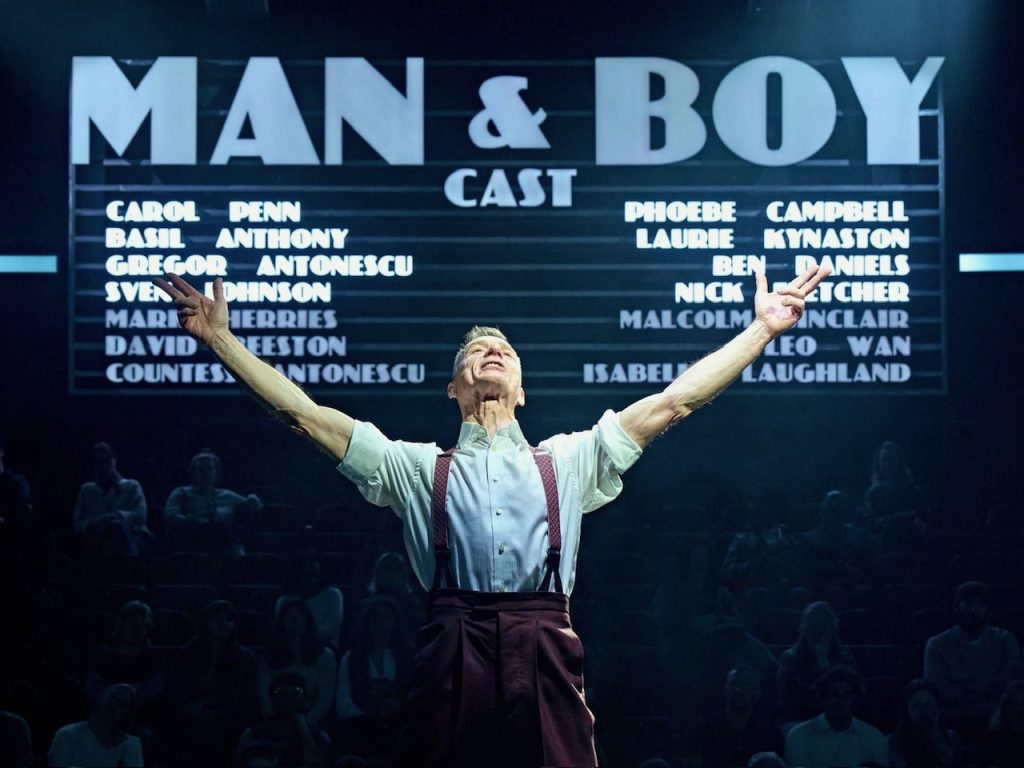
The sound of blackmail
I’ve long been a champion of the Dorfman Theatre, the National Theatre’s more intimate location where you see slightly greener, slightly riskier productions than the larger main houses. Funny, then, that its current offering is by mid-century theatrical powerhouse Terence Rattigan, although scratch the surface and you can see just how risky this production is.
Man and Boy follows Romanian financier Gregor Antonescu (Ben Daniels) on the cusp of losing everything as a deal goes south. Turning up unexpectedly at his estranged son Basil Anthony (Laurie Kynaston)’s basement apartment, he finagles, cajoles and improvises his way in and out of the good graces of everyone around him, in an attempt toclaw his way back on top. ‘High stakes’ doesn’t half cover it, the play is at its best when Antonescu is putting everything on the line, running around the green baize carpeted set, bouncing from opportunity to sucker like a human snooker ball. The momentum that builds up, especially in the first act, is incredible to see. The production takes a page out of the 2014’s (slightly overrated if you ask me) Birdman‘s book, whose soundtrack communicated the frantic, ‘anything can happen’ excitement of working in live theatre with an energetic jazz percussion accompaniment. The same trick is pulled here, with the snares and cymbals underlining the improvisatory nature of his con-artistry.
It’s a risky move – this theatricality flies in the face of conventional wisdom around staging Rattigan, and adding to the risk (see, I told you there’s a reason it suits the Dorfman), this is one of his lesser-known, lesser liked plays. Not only that, it’s about a sexually blackmailing financier, in New York. Rotten timing, but one has to assume that the crew haven’t been paying attention to the news; the play’s never sympathetic to Antonescu exactly, but it certainly invites you to share in his victories & failures, and to laugh at his jokes. Maybe it’s because of recent news that Antonescu comes across so favourably. His stock-market wrangling, the way he treats his son’s love with minor embarrassment, even his willingness to blackmail a business rival over their illicit lover: in 2026 these all look like relatively minor crimes compared to those of the spectre that haunts this production.
So, does the risk pay off? Mostly, yes, thanks to Daniels’ tour-de-force work. The play itself isn’t much more than a monologue with interruptions, which means no-one else in the cast has the chance to get out-acted too egregiously. It’s a little odd to see such a pathos-loaded performance of a character that Rattigan insisted was ‘as evil as Iago’, especially with global events being what they are, but what a performance it is.
Man and Boy – www.nationaltheatre.org.uk
Dracula
In 2024 I saw a production of Wilde’s The Picture of Dorian Gray, adapted and directed by Kip Williams, in which Sarah Snook played all 26 roles with a beguiling performance. Technolo-gy played a major part with cameras and previously shot footage integral to how she engaged with both the audience and her many personas.
Wind forward to last week and Williams has once again recruited an award-winning perfor-mer, Cynthia Erivo (most recently seen playing Elphaba in the two WICKED films opposite Ariana Grande), interpreting 23 charac-ters in another one woman undertaking, this time Bram Stoker’s 1897 Gothic novel Dracula (Noël Coward Theatre). Like Snook she is followed every step of the way by a posse of cameras (and ope-rators) – which are fast becoming a theatrical trope such is their ubi-quity. Both subject matters feature an egotistical narcissist with an insatiable lustful appetite but there the comparison ends and the challenge grows.
Erivo has huge charisma and presence. She even has the look of a would be twenty first century vampire, with those large expres-sive eyes capable of transforming from loving to minacious and her bony fingers recalling the threate-ning gesticulations of the hideous Nosferatu. Her passion and commitment to the venture are to be commended but Stoker’s themes of the undead curse and connections to sexual desire juxtaposed within the constraints of the draconian Victorian era, are nigh on impossible for any one individual to convey. It is a tale that leaves a lot to the imagination as so much of it is not, and cannot be explained, so that as she swaps accents, costumes and wigs to depict different characters I found myself unsure whether to be amused or confused. As a result what many have felt when first encountering the Dracula legend, the prototypical and archetypal vampire capable of savage acts, is dissipated and the show becomes something of a theatricalised media event with a glorified narrator.
Her narration is rapid and engaging but lacks peril and there is a distinct absence of the terrifying atmosphere expected while all around her, on film, there is far more interesting stuff to engage with. The choice of which charac-ters to portray is also strange with vampire slayer Van Helsing in particular ending up as an absurd parody with his long white hair and odd beard. These distractions, and Williams’ insistence in spinning it out for nigh on two hours make this an unnecessary test of endurance and concentration. At the end of which the technological gimmickry had conquered all leaving me with one abiding, and amusing image, of Erivo playing dullard doctor John Seward surrounded by bunches of garlic. Cliché or truth, Erivo had become a sacrificial lamb for a bloodless
www.draculawestend.com