


Debate: Baldwin vs Buckley – run complete
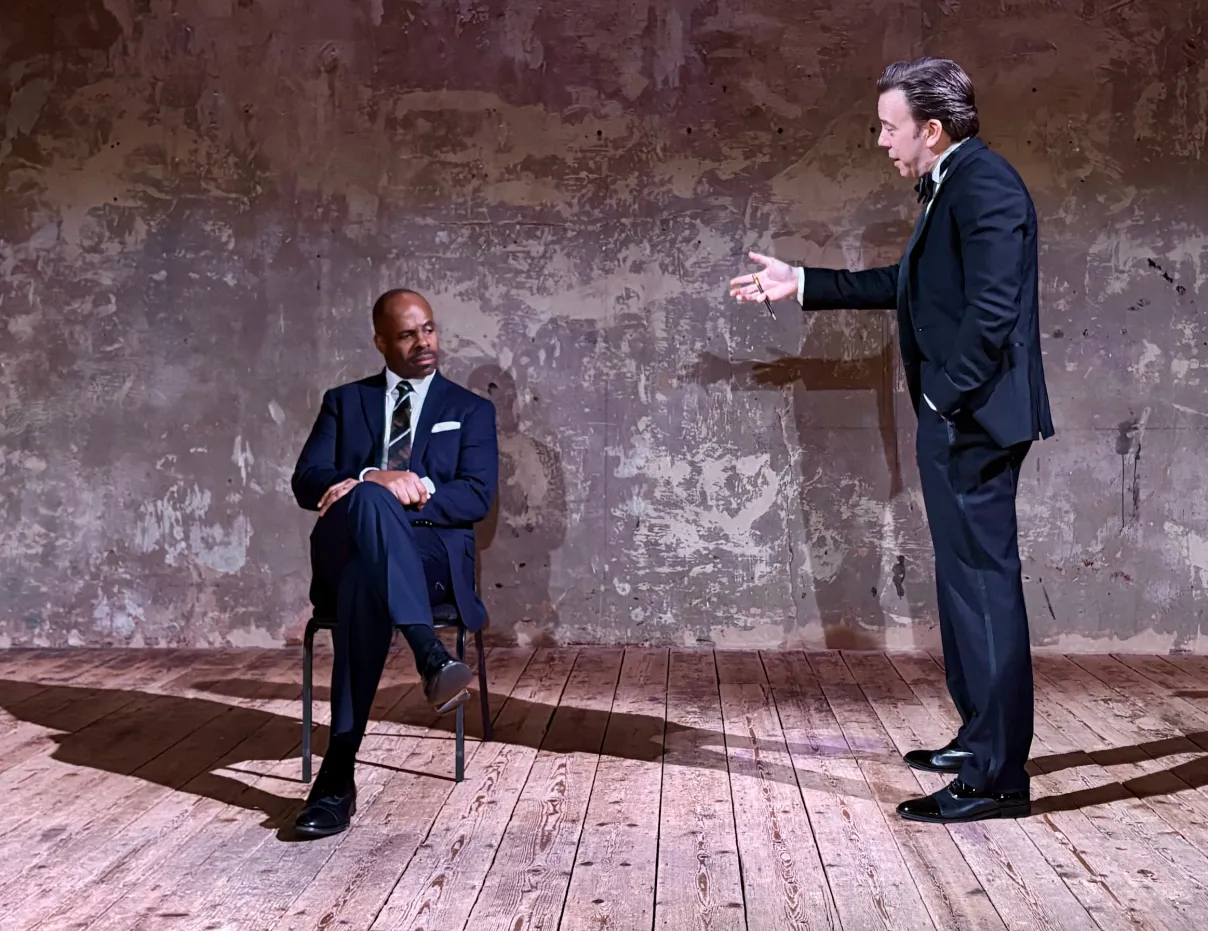
The american vicarious production of Debate: Baldwin vs Buckley (Wilton’s) is described as a “reimagined” and “radically staged” presentation of the 1965 Cambridge Union Debate with the motion, “The American dream is at the expense of the American Negro”. The two men chosen to propose and oppose the motion were writer and civil rights activist James Baldwin (Arnell Powell) and leading conservative intellectual William F. Buckley (Eric T. Miller). A stage with no set apart from four chairs is framed by a large white screen onto which the introduction from the original BBC TV footage is projected, Motion proposer, David Heycock (Christopher Wareham) gives an eloquent and ardent opening speech as does his opposer Tom Kiteley (Jeremy Burford),
Baldwin speaks first. His speech begins gently and assuredly, in sharp contrast to how negroes were then perceived, and openly described, as the “savage”. His thought process revealing an intellect that was far ahead of his time, so much so that years later several leaders of the African American community years confessed to their inability to understand what he was saying. Occasionally sentences sound as if they are abstract and intangible but this was all part of Baldwin’s deliberate attempt to make the speech more like a sermon building to a crescendo of thought, and challenge, on the dangers of white supremacy. Arnell Powell captures the essence of Baldwin’s being, what drives him on and the passion he has for understanding, empathy and justice. It is a compelling and elegant portrayal.
Conversely Miller’s depiction of Buckley, equally compelling, fizzes with arrogance and conceit, a narcissist who punctuates his case against the motion with lots of contradictory statistics which rather than strengthen his argument only go to prove Baldwin’s point that the system is stacked in every way against the ‘American Negro’. Miller’s playfulness, steeped in power and privilege, is encapsulated in his unrelenting passive aggressive behaviour. As he speaks and emotes patronisingly, Powell remains still and emotionless in his chair apart from an occasional look of barely disguised disdain.
Adaptor and director Christopher McElroen keeps it simple and the combination of brilliant oratory and the TV coverage works well. A one-hour production that persuasively demonstrates we still have a way to go in making society a level playing field (will it realistically ever happen?) for all. This is not “reimagined” or “radically staged” and it is precisely that lack of theatricality which makes it so captivating. I rarely want to see something twice, but this I would along with rereading some of the Baldwin brilliance.
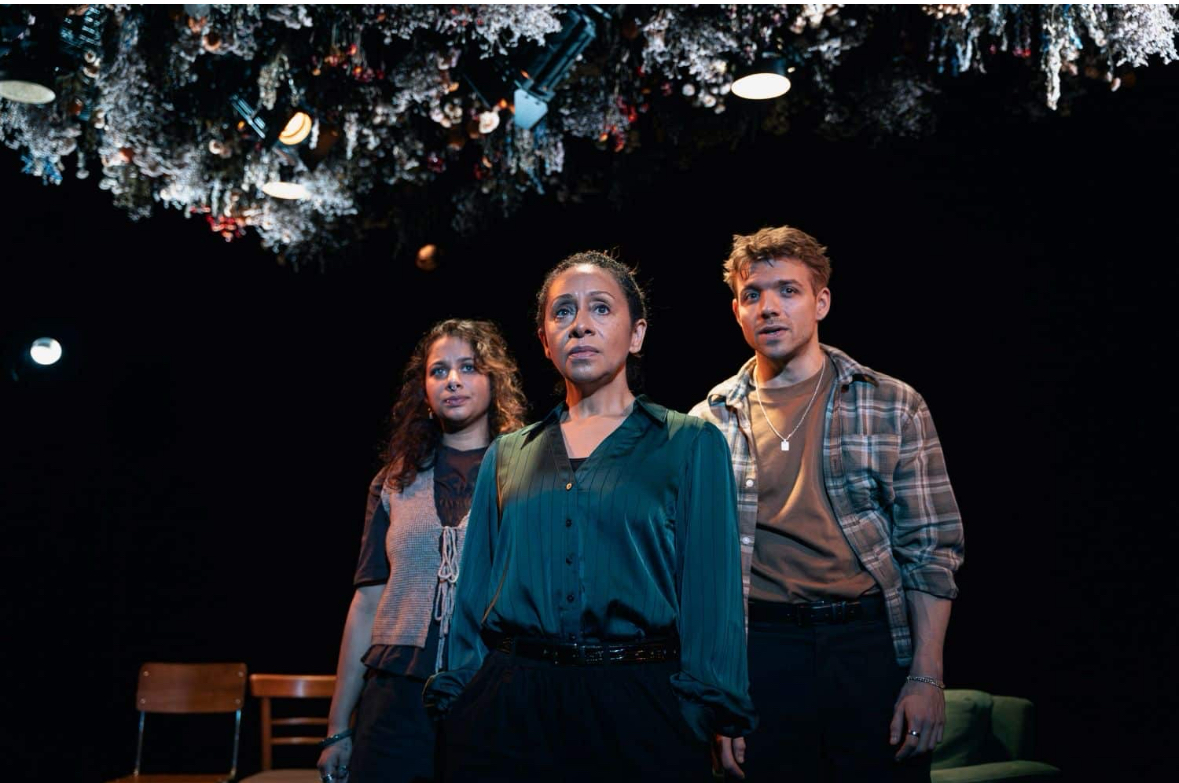
Farah Najib’s Maggots (Bush Theatre) is an adaptation of a couple of real-life tragedies. A maggot infestation is spreading in a London tower block, and a stench is beginning to permeate the walls. It’s immediately obvious what has happened, so if there’s a tension, it’s seeing how long the tenants (Sam Baker Jones, Safiyya Ingar and Marcia Lecky playing various roles) are going to be stonewalled by the apathetic housing manager before the awful truth inevitably gets out. A neighbour has lain dead in her home for a year, decomposing. The cast do well with the material, which is mostly static monologues. Director Jess Barton, Lighting Designer Peter Small and Composer & Sound Designer Duramaney Kamara do a fantastic job building an oppressive, alien atmosphere which (with minimal set design) conveys just how much the tower block has atomised its residents and proven (to a fatal degree!) antithetical to human life.
However, I was left feeling a little short-changed at the end of it. The play points at two causes for the death and its aftermath, condemning the housing crisis on one hand, and the breakdown of social cohesion on the other. I just feel it didn’t do well at linking the two – the latter is inseparable from the former, you can’t lambast people for not getting to know their neighbours when housing is as precarious as it is, especially in London. On top of that, the ensemble cast works most of the time, but there are far too many characters for more than a few characters to resemble anything deeper than a quick sketch. That said, well worth seeing.
Debate: Baldwin vs Buckley – run complete
Maggots – www.bushtheatre.co.uk
Maggots
I can’t think of a single play I’ve seen at the Bush Theatre which hasn’t in some way been what might be called an ‘issues play’. There could be any number of reasons for this – the theatre has always made a point of showcasing and supporting young talent. Could it be that this socially minded ethos has also, consciously, or unconsciously, also influenced the selection of which projects by young talent to fund? Or do a lot of young writers, conscious of the need to be taken seriously at such a foundational stage in their careers, naturally gravitate to the kind of heavy subjects that lend themselves naturally to didactic monologues
That sounds flippant, but I’m not complaining. Too much of London’s current theatrical output is a little facile. A decade ago, I remember asking myself“how many movies/real life events/whatever can be adapted into a nostalgic jukebox musical?” a trend that’s still ongoing!
Farah Najib’s Maggots is decidedly not a nostalgic jukebox musical, although it is an adaptation of a couple of real-life tragedies. A maggot infestation is spreading in a London tower block, and a stench is beginning to permeate the walls. It’s immediately obvious what has happened, so if there’s a tension, it’s seeing how long the tenants (Sam Baker Jones, Safiyya Ingar and Marcia Lecky playing various roles) are going to be stonewalled by the apathetic housing manager before the awful truth inevitably gets out. A neighbour has lain dead in her home for a year, decomposing. The cast do really well with the material, which is mostly static monologues. Director Jess Barton, Lighting Designer Peter Small and Composer & Sound Designer Duramaney Kamara do a fantastic job building an oppressive, alien atmosphere which (with minimal set design) conveys just how much the tower block has atomised its residents and proven (to a fatal degree!) antithetical to human life.
However, I was left feeling a little short-changed at the end of it. The play points at two causes for the death and its aftermath, condemning the housing crisis on one hand, and the breakdown of social cohesion on the other. I just feel it didn’t do well at linking the two – the latter is inseparable from the former, you can’t lambast people for not getting to know their neighbours when housing is as precarious as it is, especially in London. On top of that, the ensemble cast works most of the time, but there are far too many characters for more than a few characters to resemble anything deeper than a quick sketch. I think this is easily excused as a relatively new playwright finding her medium; Farah’s previous work, Credible Witnesses also featured a lot of characters, but that was based on actual people’s experience of discrimination, so it was important not to overlook anyone’s story – you don’t have to do the same with fictional characters.
Maggots – www.bushtheatre.co.uk
Dear England
Before I tell you how much fun I had last night at the New Victoria Theatre in Woking I have to confess to knowing as much about football as I do about the craters on the moon. There’s a ball and two goals and 22 people running around frantically and there it ends. But that mattered little because Dear England, written by James Graham, is more about football people than the game itself. And even I’ve heard of Gareth Southgate, one time England manager (men’s team), who was in charge for eight years. He took over at a time when the team were at a low ebb, which in plain English means they didn’t win many matches, and were apparently cursed by penalty shootouts. So up stepped Mr Southgate (now Sir Gareth) and slowly but surely he made them successful both on and off the pitch and Graham’s brilliant play is as much about the psychology of transformation as it is about winning matches.
The central characters, apart from Southgate, include captain, then and now, Harry Kane MBE (Oscar Gough), goalkeeper Jordan Pickford, also then and now, and several others from the squad who together create an atmosphere that is halfway between a football game and a therapy session, which may sound odd but is inspirational and immensely enjoyable. International football is not all glamour and glitz especially with the pressure of a whole nation on your shoulders and being constantly reminded about 1966 – the last time England won the World Cup. Even I remember that…just!
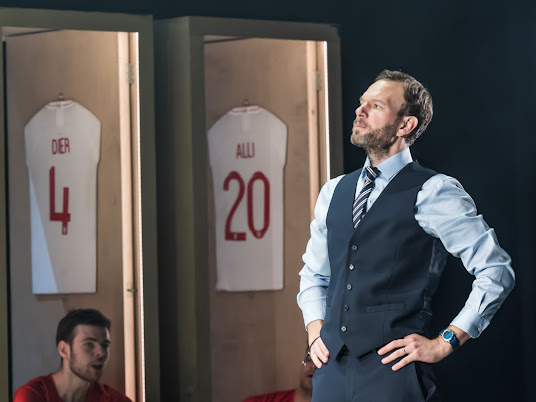
David Sturzaker plays Southgate and he has a way about him which is beyond impersonation or impression with a portrayal that let’s us in to understand the personality and drive. This is, as another knight of the realm Sir Ian Duncan-Smith famously said during his 2001 Conservative Party leader speech, – “Do not underestimate the determination of a quiet man”. Sturzaker oozes personality and charm making it easy to understand why Southgate made that vital connection with his players. Though the overriding memory I have of seeing him on the TV are those era defining waistcoats that ranged from shabby chic to man about town.
This is a very talented cast who bring their characters to life even if they are a little superficial and shallow – this is professional football after all – and they include a posse of caricatures, sportspeople and politicians, who will have people of a certain generation in hysterics. Not Samantha Womack however, who impresses in the part of Pippa Grange, the team psychologist, who brings adult thinking and behaviour to a world of ‘kidults’.
Then of course there are all the ‘football moments’ which happen on a really effective, straightforward set (Es Devlin) of changing room and football pitch and are incredibly well done with sound effects and atmospheric music, to the extent that you really believe you are inside the stadium and the match is taking place. My partner, a football addict, said it immediately took him back to those England matches they were trying to get the audience to relive. The one weakness for me is that Graham tries to pack too much in – including the pandemic, the dreaded “B” word which in the 2016 referendum divided families and friends as much as football has always done, and the increasing malign influence of social media – which of course are important but if he had focused on one the impact would have been greater.
Rupert Goold’s production is a back of the net winner that I would strongly recommend – you may even come out singing one of those football songs, be you fan or foe.
Dear England – www.atgtickets.com
‘Sweet Mambo’
Pina Bausch’s ‘Sweet Mambo’, presented by Tanztheater Wuppertal at Sadler’s Wells, is an evocative if somewhat elusive entry in the great choreographer’s late oeuvre. Created in 2008, just a year before her death, it carries the unmistakable hallmarks of Bausch’s Tanztheater style: a blend of theatre, dance, monologue and visual expression that resists easy description and invites emotional engagement rather than literal storytelling.
From the outset, the evening swings between the sublime and the quirky. Seven of the original cast members return alongside newer dancers, bringing years of accumulated wisdom to their performances. The opening moments, with dancers simply announcing their names and imploring, “Don’t forget,” set a reflective tone — one that seems to ask not just for attention but for empathy.
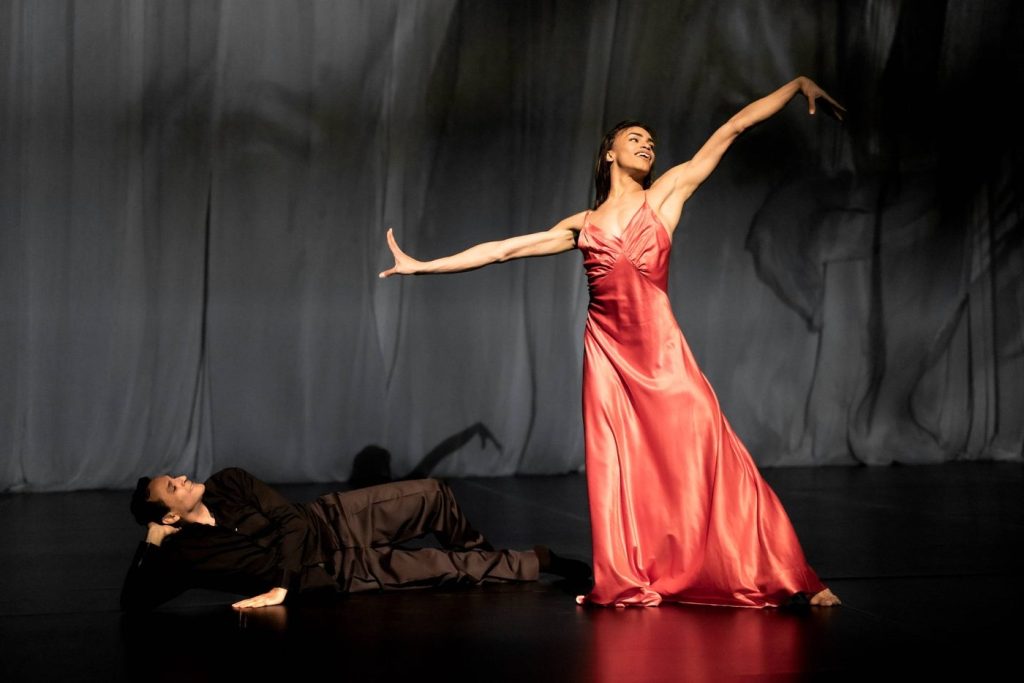
Visually, ‘Sweet Mambo’ is striking. Peter Pabst’s set of billowing white curtains creates an ethereal space in which the performers move in and out of focus, at times drenched in water or draped in silk gowns that are at once glamorous and burdensome. Marion Cito’s costumes — satin, high heels, flowing gowns — add a layer of theatricality, emphasising both elegance and vulnerability.
Yet this is not choreography that delivers easy emotional engagement. The piece can feel long, occasionally repetitive, and suffers from an overabundance of motifs that clumsily compete for attention rather than cohere into an engaging experience. Moments of brilliance — solos grappling with an individual existence, poignant duets charged with both humour and yearning — are offset by long spells that become tiresome.
‘Sweet Mambo’ is a mixed but deeply human experience: dreamy and evocative yet often opaque, hallmarked by Bausch’s exploration of what it means to plough through life and love. It’s a work that has its moments but falls short of delivering a brilliant rollercoaster ride that characterises Bausch at her best.
Sweet Mambo – www.sadlerswells.com
