

“Me? I’m fighting for reasons of theology,” replied Aramis.
“Yes, a point in St. Augustine on which we disagree,” said d’Artagnan.
— Alexandre Dumas, “The Three Musketeers”
The Big Three
Three quotations, all alike in dignity, in fair Verona, where we lay our scene.
These three have become legendary t-shirt slogans. They are among the most abused and misrepresented statements of all time. If we delve a little deeper, they’re not quite what they seem.
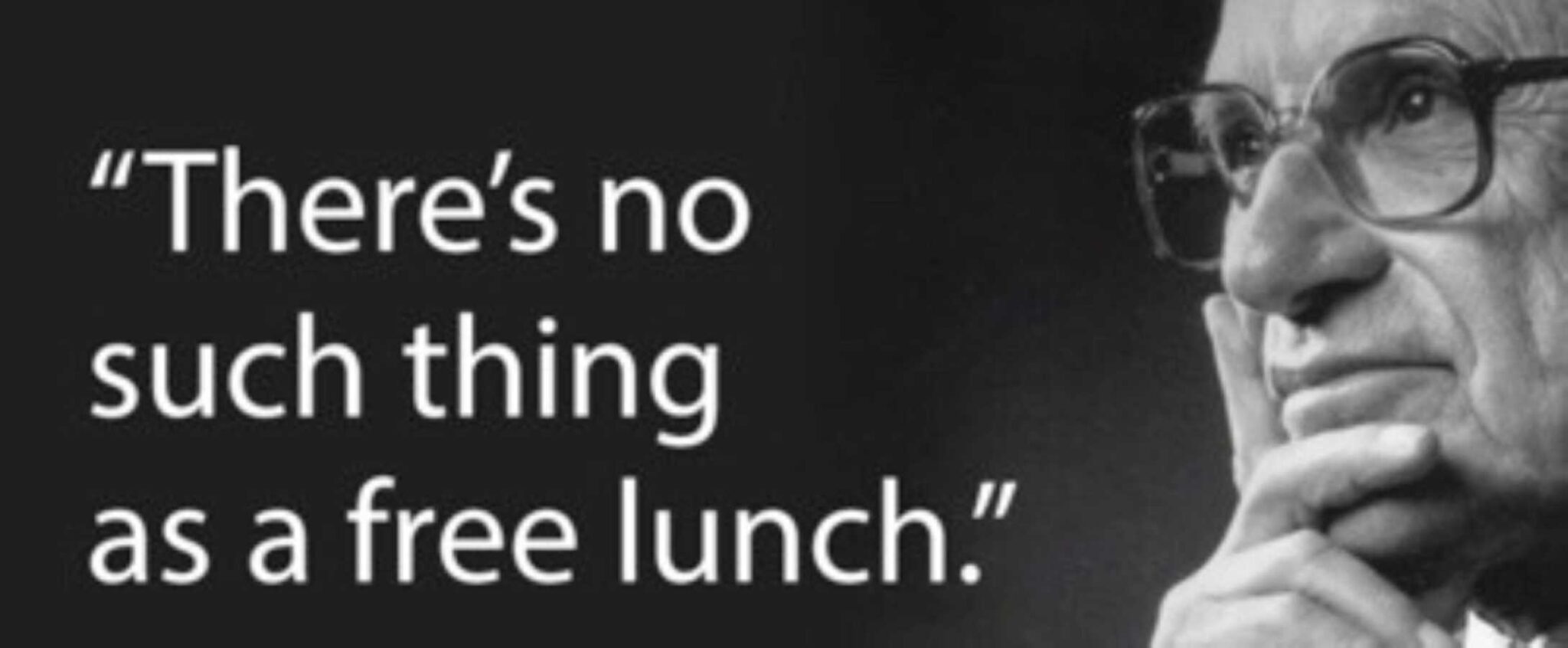
“There is no such thing as a free lunch” — Milton Friedman
In the 1999 documentary film The Corporation, the concept of the big business is dissected. Many executives, academics and activists are interviewed. It’s well worth watching. Noam Chomsky does his Old Testament prophet act, and talks about power, vested interests, and oppressive elites.
The free market economist Milton Friedman was interviewed, and he said that although he was known as the person who said, ‘there’s no such thing as a free lunch’, he doesn’t agree with his own statement.
He continues: “Let’s say that you’re walking along the street, and you pass someone’s house. They have been diligent and proud of their garden. It is immaculate and beautifully tended, with colourful flowers and trim lawns, and it smells wonderful. That pleasure has cost you nothing. Your enjoyment is the result of someone else’s labour and expense. That there, that’s a free lunch.”
“Religion is the opium of the people” — Karl Marx
In the “Critique of Hegel” (1843) Karl Marx wrote that ‘religion is the opium of the people’ – an illusory drug. It’s always quoted out of context. The sentences that precede it read: “Religious suffering is the expression of real suffering and a protest against real suffering. Religion is the sigh of the oppressed creature, the heart of a heartless world, and the soul of soulless conditions. It is the opium of the people.”
The Roman writer Juvenal quipped that in order to gain power, politicians need only give people two things: “bread and circuses.” Those who advocated Karl Marx’s ideas in the twentieth century managed to provide plenty of circuses. It was the bread that they struggled to deliver.
“God is dead” — Friedrich Nietzsche
These days we hear the incantation to wellness, mindfulness, detox, and meditation. These are useful, but there used to be another name for it when we were young: prayer. Whether it be western, eastern or native rural traditions.
Friedrich Nietzsche was one of the deepest philosophers of the 19th century. He influenced virtually everybody that came after him, from Sigmund Freud to Franz Kafka.
Nietzsche says, “God is dead. And we have killed him. How shall we comfort ourselves, the murderers of all murderers? What was holiest and mightiest of all that the world has yet owned has bled to death under our knives: who will wipe this blood off us? What water is there for us to clean ourselves? What festivals of atonement, what sacred games shall we have to invent? Is not the greatness of this deed too great for us? Must we ourselves not become gods simply to appear worthy of it?” (‘The Gay Science’).
The people who learn to recreate their lives represent a new stage in existence, the Übermensch, a person who becomes a mythical hero. This was misinterpreted and misunderstood by the Nazis, who manifested Nietzsche’s prophecies – there really wasn’t enough water in the world to clean the blood that flowed.
Religious mindset and reverent sentiment are as much a part of our sinuous fabric as marvelling at sunsets, and stopping to watch butterflies.
James Neophytou
