
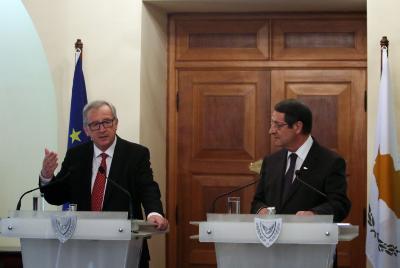

President of the European Commission Jean-Claude Juncker paid on Thursday tribute to Cyprus President Nicos Anastastasiade and to the Cypriot people for their commitment to the programme for the recovery of the island`s economy, noting that “tough decisions and commitment paid off in Cyprus, as they did in Ireland, Portugal and Spain,” and expressing hope that “others will take note”.
In statements after his meeting in Nicosia with President Anastasiades, Juncker, who is paying a two-day official visit to the island, said that “Cyprus found itself in a difficult economic position in 2013 but the Cyprus I am visiting today is very different. The economy is beginning to grow, the financial sector has stabilised and you are again ready to take advantage of the opportunities of the future,” he noted.
“Cyprus I am visiting today is a beacon of stability and European values in a troubled part of the world. You are a stable actor because you are European and this is a source of benefits but also, mainly, of responsibilities. You are on the EU’s front line and you can be an example to others – an example of growth, co-operation and a broad-minded approach,” he noted.
On the Cyprus problem, he expressed the hope of all Europeans “that we do take the opportunity we now have thanks to your efforts and the efforts of the other leader to come to a good conclusion. This is a unique opportunity and we should not lose the momentum,” he noted.
He said that he is convinced “that you are determined to put all the efforts needed into ways to come to a good solution. If this happens, and I pray that this will happen, this will not only be good news for Cyprus, this will be good news for the entire European Union and I would like to let you know that I am taking a personal day by day interest in the developments that are happening here under your leadership,” he noted.
Juncker said that this is his first official bilateral visit to an EU member state since he became President of the Commission, noting that he feels very close to Cyprus by heart and by personal friendship with the President of the Republic.
“I have a profound understanding for the problems, constraints, needs of small countries and these are some of the reasons I feel so happy to be here today. I feel that Cypriots are both family and friends and I asked the Commissioner coming from Cyprus, my good friend Christos Stylianides to be part of the delegation. He is doing an excellent job in Brussels,” he noted.
On his part, President Anastasiades said that they discussed, inter alia, economic issues, including the prospects for the country’s economy and how Cyprus can benefit in the most optimal way from the European Fund for Strategic Investment. He noted that he briefed Juncker on the leaps of progress achieved in the recovery of the Cyprus economy and the implementation of the economic adjustment programme, noting that “our commitment in implementing the Programme, the resilience of our economy and of the Cypriot people, is yielding positive results.”
As regards the Cyprus problem he said that “EU’s role and more active engagement and support in the negotiations, which are under the auspices of the United Nations Good Offices Mission, is of utmost importance, particularly as we have entered into substantive negotiations of all chapters.”
He stressed that “undoubtedly, the EU constitutes the best safeguard and guarantee of the human rights and fundamental freedoms of all Cypriots, Greek Cypriots and Turkish Cypriots alike. The EU’s role and more active engagement and support in the negotiations, which are under the auspices of the United Nations Good Offices Mission, is of utmost importance, particularly as we have entered into substantive negotiations of all chapters,” he noted.
He said that he briefed Juncker on the latest developments in the negotiations for a settlement of the Cyprus problem and that he reiterated his strong commitment to work tirelessly with the leader of the Turkish Cypriot community Mustafa Akinci, in order to reach a comprehensive, viable settlement of the Cyprus problem. “A settlement that will reunite Cyprus and its people in bi-zonal, bi-communal federation, which will safeguard and respect human rights and fundamental freedoms, and which will be in compliance with EU values and principles and the acquis,” he noted.
Anastasiades expressed his sincere appreciation both to the European Commission and to Juncker “for the keen and genuine interest in our efforts to reunify Cyprus, and to end the unacceptable division of the last 41 years.”
He said that he and President Junker share the view that a comprehensive settlement to the Cyprus problem would benefit all parties, the EU and the wider region. “Turkey’s role in reaching a settlement is vital, and we expect that Turkey will contribute concretely to the efforts to reach a settlement,” he added.
Referring to the Cypriot economy, Anastasiades said that “we have successfully returned to the international markets and, since the beginning of July, we participate in the Quantitative Easing Programme of the European Central Bank.” He noted that “challenges still remain ahead, but I am confident that we can address and overcome the remaining challenges.”
As regards the European Fund for Strategic Investment, he said that it is crucial in restarting the engine of Europe’s economy, noting that he expressed his satisfaction to Juncker for the swift entering into force of the Fund, “which paves the way for much needed new investments in member states, and underlined Cyprus’s significant investment needs. In this context we exchanged views on concrete ways in which Cyprus can benefit from the Fund,” he noted.
He also said that they discussed developments in the energy sector, that he informed Juncker on the latest developments in the hydrocarbons and energy sector in Cyprus, and discussed with him the different energy projects and proposals in our region, as well as the possibilities for financial support from European funds, such as the European Fund for Strategic Investment.
We both agreed that Eastern Mediterranean hydrocarbons discoveries can become a catalyst for broader cooperation in the region, contributing to stability and economic development, and ultimately to peace and security, he noted.
