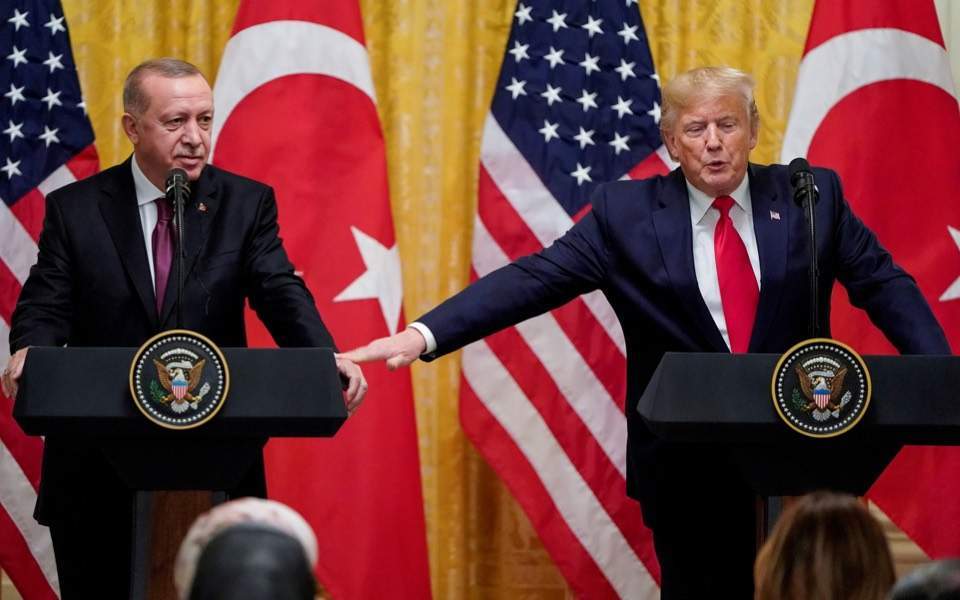

First, there was the meeting that US President Donald Trump organized at the United Nations in New York with Arab and Muslim leaders on the situation in Gaza, at which Turkish President Recep Tayyip Erdogan was placed in a prominent position, almost as a co-chairman with the American president.
This was followed two days later by the reception of the Turkish president in the Oval Office. Last Monday came the ceremony in Sharm El-Sheikh and the Gaza peace agreement.
On all three occasions, Trump praised Erdogan in the superlative degree. A very important leader: “[he] has one of the most powerful armies, actually in the world… If you look at the recent conflicts, he was at the top of them and he was winning them. And he doesn’t want any credit, he doesn’t want anything, he just wants to be left alone. He’s a tough cookie, but he’s been my friend, and every time I’ve ever needed him, he’s been there for me… he never fails us. He’s amazing.”
Although we should not see the world through the prism of Greek-Turkish relations, inevitably the excessive cordiality that the American president shows for his Turkish counterpart cannot go unnoticed in Athens.
I do not know what tangible results Erdogan has achieved so far, perhaps not much if one judges from the aftermath of the meeting at the White House. However, we must monitor this relationship with great attention and move in a targeted manner both at the bilateral level of Athens and Washington, and at the multilateral, through our participation in regional groups that play a role in the Eastern Mediterranean.
The help of the Greek diaspora will be needed here. Those Greek Americans who have access to the White House, now is the time to prove it in practice. At the same time, the Greek presence in Congress remains noticeable and may be upgraded in the midterm elections next November.
With the stakes going beyond specific individuals and governments, there is no room for political games by those who saw “warm handshakes” between Trump and Greek Prime Minister Kyriakos Mitsotakis, nor for the others to slip into the easy but nationally dangerous criticism of how Trump completely “ignored” Mitsotakis during his speech. If he almost ignored anyone, it was not Mitsotakis, but Greece. Any worrying development does not concern the specific prime minister, but the country.
In this context, although the writer was until recently of the opinion that a visit by Mitsotakis to the White House would not necessarily serve national interests and should not be a priority, developments are giving rise to second thoughts.
We need to strike a delicate balance – given the relationship between Greece and Cyprus and Israel, as well as the invitation of the two countries to Sharm El-Sheikh – by highlighting our comparative advantages more strongly, in close cooperation with the Greek diaspora, which constitutes one of them.