

Winds of up to 100mph are expected to batter west Wales and north-west England, with the Met Office issuing its first “red warning” of the winter.
The warning for 13:30 to 21:00 GMT means there is a “risk to life” and people should “avoid dangerous areas” with widespread damage expected.
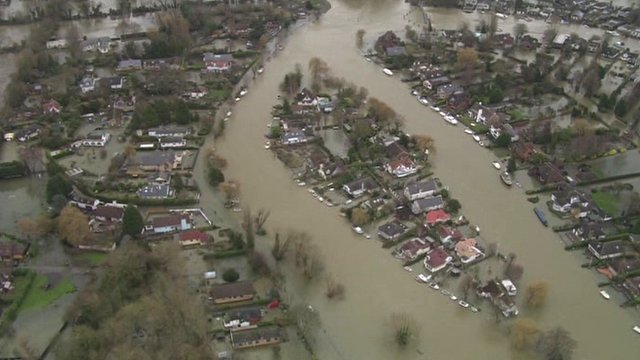
Sixteen severe flood warnings remain for Berkshire, Surrey and Somerset.
Meanwhile, David Cameron has repeated his pledge that “money is no object in this relief effort”.
He also announced money would be available for businesses and homeowners repairing flood-damaged property to build in new defences and said small businesses affected by flooding would get 100% relief from business rates.
The Met Office said: “Winds of this strength can cause widespread structural damage, bringing down trees and also leading to loss of power supplies.
“In addition, large waves are likely to affect some coasts. The public should take action to alter their travel arrangements during this spell of storm force winds.”
BBC forecaster Darren Bett told the News Channel red weather warnings were very rare. “You usually get one or two per year. It’s the highest level of alert – it’s very serious, it’s life threatening and it means people should take action now. It does not get any worse than that,” he says.
Other updates include:
- Up to 3,000 homes are without power in south and west Wales
- There are still major disruptions for several rail services, with severe delays between Reading and London due to flooding near Maidenhead
- BBC forecasters say a month’s worth of rainfall is expected to fall in parts of southern England over the next few days
- The Environment Agency warns more homes will be flooded as rivers in Herefordshire and Worcestershire continue rising
- Winds gusting to 94mph have brought down electric power cables and trees, blocking roads in Devon and Cornwall

Speaking at Prime Minister’s Questions, Mr Cameron told MPs there would be “no penny pinching” when it came to funding flood relief effort and the government would “spend whatever is necessary” on immediate support for flood-affected communities, including sandbags and military help.
But Labour leader Ed Miliband said he had doubts about this “grand promise” of financial help and those still at risk needed a “speedier response”.
He urged the government to reconsider planned cuts to the Environment Agency and said it should be spending more on flood defences in the future to make the UK more resilient.
Mr Cameron accused his Labour counterpart of “dividing the nation” over the issue of flooding at a time when the country should be pulling together in the face of adversity.
BBC News Channel chief political correspondent Norman Smith said a Downing Street source accused critics of “deliberate mischief making” by suggesting the prime minister was backtracking on his commitment to provide whatever money was necessary for the current crisis.
Aides to the prime minister say the pledge related to the present relief effort and not to any wider spending commitment.
A source accused critics of “deliberate mischief making” by suggesting the prime minister was backtracking on his commitment to provide whatever money was necessary for the current crisis.
Earlier on Wednesday, the prime minister chaired a meeting of the Cobra emergency committee on the flood crisis and will lead another meeting at 17:30 GMT.
Chancellor George Osborne was among those at the meeting even though he does not normally attend – our correspondent said this was “to rein in any of his colleagues who suddenly thought that the coffers were open and they could help themselves”.
Analysis
 Roger Harrabin Environment analyst
David Cameron’s cash promise refers to flood relief – it’s not a blank cheque for flood defences.
This government’s floods spending is lower than the previous Labour government (although total spending is higher thanks to local councils).
And what’s more, ministers are ignoring their own climate change advisers, who say that the cost of flood damage in the UK is likely to increase from £1bn to £3bn as the world warms.
They say another £0.5bn must be spent over four years just to keep pace with the climate – and this figure may go up following the current shocking floods.
Government rules will come under scrutiny too. Every £1 spent on flood defences gives £8 of benefit. Yet other schemes – like a relief road in Hastings – have no proven benefit.
Follow Roger on Twitter @rharrabin
Environment Agency chief executive Paul Leinster told the committee that water levels could rise to “higher than current levels” over the coming weekend.
He said: “Oxford to Maidenhead we think could rise over the next five days and may lead to more flooding in that area.
“Below Maidenhead, the levels are holding at the current level but potentially over the weekend and going into the beginning of next week they could rise to higher than the current levels.”
The BBC’s Ben Geoghegan, in Wraysbury, Berkshire, overnight, said the local primary school had been turned into “24/7 control centre” for residents affected by flooding.
Lucy Foster, who has been helping to run the operation, said the village had been “looking after itself for a long, long time and morale was getting very low, energy levels were getting low”.
“Finally we’ve got the boys and girls that we need – we’ve got the Army, the police force, the fire service and getting a lot of support from them and a lot of direction from them, which is what was needed.”
Our correspondent said that, with so many homes in the village evacuated, there was a real fear some of the empty properties might be looted so the Army had set up checkpoints on some roads to monitor overnight who comes and who goes.
‘Unprecedented’ flooding
More than 1,000 homes have been evacuated along the Thames after towns and villages including Wraysbury, Chertsey and Datchet were flooded.

Chief Supt Matt Twist, of Surrey Police, said the flooding in the county was “unprecedented” and warned that a further 2,500 homes were at risk.
An 85-year-old resident forced to leave her bungalow in one Surrey village spent the night at an evacuation centre.
She told BBC Radio 4’s Today programme it was a “terrible experience”. “I want to go, I want to get out of it [community evacuation centre] really, because you can’t live like this, can you?
Further evacuations have been taking place in the Staines and Egham area. Almost 6,000 properties have been flooded altogether in the past two months.
About 100 properties remain flooded on the Somerset Levels, where extra pumps are being brought in from the Netherlands, and groundwater flooding is also expected in the coming days in Hampshire, Kent and parts of London.
As well as 16 severe flood warnings, the Environment Agency has also issued about 350 less serious flood warnings and alerts, mostly in southern England and the Midlands.
The agency said it looked “increasingly likely” there would be problems along the River Severn and River Wye.
And it said groundwater levels were so high in some parts of the country that flooding was likely to persist for weeks or even months flooding was likely to persist for weeks or even months.
