
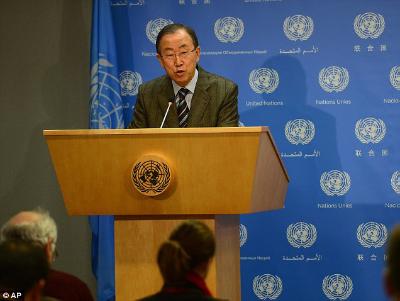

The UN Secretary General Ban Ki-Moon has reiterated his call to the two sides in Cyprus to refrain from the “blame game” and from negative rhetoric about each other, and called on all interested parties to help create a conducive environment for resuming structured negotiations.
Ban Ki-Moon`s afore-mentioned statement is included in his report on the United Nations operation in Cyprus covering developments from 21 June 2014 to 15 December 2014 for the information of the members of the Security Council. The report, secured by CNA, was given late on Friday night to the members of the Security Council.
The UN chief said in his report that on 6 October 2014, the Greek Cypriot side announced its decision to suspend its participation in the talks following the announcement by Turkey about the conduct of a seismic survey in Cyprus’ Exclusive Economic Zone.
Following the suspension of the talks, he added, “I have underscored the need for a prompt resumption of the negotiations and appeal to the sides to find a way to accomplish this without delay. I have noted that both communities can ill afford to perpetuate the status quo, in particular in light of the wider regional context”.
“I reiterate my call to the sides to refrain from the “blame game” and from negative rhetoric about each other. I call on all interested parties to help create a conducive environment for resuming structured negotiations in a results oriented manner as agreed to by the leaders in the Joint Declaration of 11 February 2014”, UNSG stressed.
Ban ki Moon also announced that he intends to issue a separate report on the state of play in the negotiations in the coming months.
He went on to say that “I have repeatedly stressed that it is important to ensure that any new-found wealth, and in particular any natural resources found around Cyprus, will benefit both communities”, adding that “I remain of the view that the existence of common natural resources constitutes a strong incentive for all parties to find a durable solution to the Cyprus problem and should engender deeper cooperation for the benefit of all stakeholders in the region”.
As UNFICYP concluded the fiftieth year of its continued presence in Cyprus, he noted, “the situation along the ceasefire lines remained calm and stable. At the same time, minor incidents and challenges, which passed largely unnoticed by the wider public, remained a regular occurrence”.
He also called upon the opposing forces “to respond positively to the Force Commander’s efforts to strengthen relations, and engage actively with UNFICYP on military confidence-building measures as a sign of their commitment to a common future”.
Ban once again call upon both community leaders “to exert efforts to create a climate conducive to achieving greater economic and social parity between the sides, including through joint projects and increased trade, which will make an eventual reunification easier and more likely”.
In the context of an internationally sanctioned peace process, he added, “efforts in the opposite direction can only be counterproductive”.
He said that the United Nations “remains committed to supporting the critical humanitarian work being done on behalf of the families of victims through the Committee on Missing Persons. While I welcome the results achieved by the Committee during the reporting period, I also note that up to fifty years after their disappearance, half of all missing persons have yet to be located and more than seventy per cent have yet to be identified. It is critical that the work of the Committee suffer no further delays”.
In calling upon both sides to continue to cooperate with UNFICYP in good faith, he recommends that the mandate of the mission be extended for a period of six months, until 31 July 2015.
President Anastasiades suspended his participation in the UN-led peace talks following a Navigational Telex or NAVTEX, issued by Turkey in October last year, as Turkish seismic research vessel Barbaros violated the Republic’s exclusive economic zone.
Repeated calls for the withdrawal of Barbaros went unheeded by Ankara, which announced on Tuesday the NAVTEX`s extension until April 6, 2015.
Turkey, whose troops occupy Cyprus’ northern part since they invaded in 1974, does not recognize the Republic of Cyprus, in spite of numerous calls by the EU, which Ankara aspires to join, to do so and normalize relations with Nicosia.
