
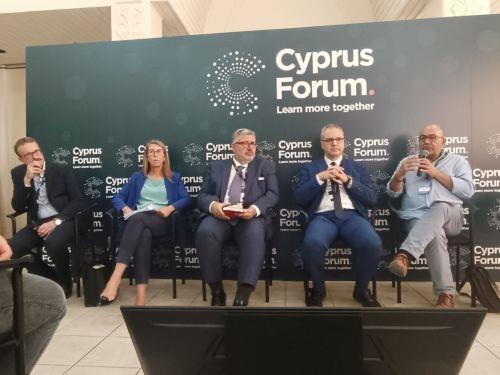

What is defined in the UN Security Council resolutions constitutes the only viable path ahead for Cyprus and for all Cypriots, negotiator of the Greek Cypriot side for the Cyprus problem, Menelaos Menelaou, said on Friday.
He was speaking during a discussion on the future of the Cyprus issue in light of recent developments, within the framework of the Cyprus Forum 2025, taking part at Ledra Palace Hotel, in Nicosia.
In his opening remarks, Menelaou reviewed the initiatives undertaken recently since the appointment of the UN Secretary-General’s Personal Envoy, María Angela Holguín, the first stage of her mission, the UN Secretary-General’s dinner with the leaders of the two communities in October 2024, after which two meetings were decided and held, one in Geneva in March 2025 and the other in New York in July 2025.
Menelaou noted that some confidence-building initiatives were decided upon in the meetings, not as a substitute for the effort to revitalise the political process, but to assist the effort to create an appropriate climate for the start of the talks process.
Within the same framework, he continued, the meeting of the UN Secretary-General with the President of the Republic and the leader of the Turkish Cypriot community in New York was recently held. While the completion of the process for the leadership of the Turkish Cypriot community is pending, Antonio Guterres is expected to send his personal envoy after 19 October for contacts in Cyprus and in the capitals of the other countries involved in preparation for the next meeting, which will take place before the end of the year, he pointed out.
The Greek Cypriot negotiator also referred to the appointment of the personal envoy of the President of the European Commission, Johannes Hahn, calling it “a very important step both in terms of substance and in terms of semantics, in the effort we are carrying out to start the negotiation process and to utilise factors that can be mutually beneficial in the broader context for all those involved, so that we can move forward.”
Speaking of the UN and their position, Menelaou said that “they’ve always upheld what is prescribed and it has been made clear by the UN Secretary General and by the Personal Envoy and by all UN officials in all meetings that we have had that the mandate is what is defined in the UN Security Council resolutions.”
He went on to say that “it represents a historic compromise”, adding that “against the backdrop of what is happening in the surrounding environment, the message that we should take is that it constitutes the only viable path ahead for Cyprus and for all Cypriots.”
Otherwise, he noted, “we run the risk of becoming a prey to the wider geopolitical contradictions, competitions and fights over geopolitical influence, which has been the reason for which Cyprus has found itself in the position where it is today in the past.” He also said that trust building initiatives are not a substitute but “they are enablers so that we can have progress on the political track.”
Referring to the Schengen issue, the Greek Cypriot negotiator pointed out that “in principle, Cyprus should be pursuing each and every possibility and opportunity that it can accomplish and not be a state under restriction because it is facing a political problem.”
“If this had been the case, Cyprus would not have been now a member of the European Union,” he emphasised. “Those who are entitled to cross through the (Green) Line are going to continue to be able to cross even after Cyprus’ accession to Schengen,” he concluded.
The Head of the Cyprus Settlement Support Unit, Directorate-General for Regional and Urban Policy at the European Commission, Giulia Bertezzolo, said that “there is an ongoing UN process and this shouldn’t be underestimated”, adding that “it would be really unwise not to take advantage of it, especially in this situation.”
Referring to the role of the EU in the efforts to resolve the Cyprus problem, she pointed out that “what we do here is not just carrying out projects, but we also discuss with both communities to find common ground and to smooth misunderstandings and to also bring to each other’s side the more understanding of what the other community’s views are.”
Referring to the Schengen issue, she noted that “the full access to Schengen can happen only taking into account the specific situation of the island and also of the Green Line.” She further pointed out that “it cannot happen to the detriment of what is the current situation of the intra-island crossing, and it cannot be at the detriment of the unification discussion that we are having.”
Former MEP, Niyazi Kızılyürek, pointed out – among other things – that what is feasible in Cyprus “is a common destiny, shared destiny, sharing power and sovereignty in even politically lighted cycles.” He also said that there are several ideological and political obstacles “because the political elite’s culture is not responding with the ones of the historical process of the Cyprus conflict.” “We want inter-communal activities and common spaces. That is something we can really build up our future,” he noted.
Kızılyürek suggested the provision of Turkish and Greek languages in schools on both sides and the organisation of inter-communal cultural festivals, cultural and economic spaces. “We cannot wait the big powers to decide to solve the Cyprus conflict, as it happened in 1959,” he pointed out. “The Republic of Cyprus could have or should do much more in the field of intercommunal rapprochement,” he concluded.
Dr. Marvin Suesse, Associate Professor in Economics at Trinity College Dublin, spoke of the case of the Irish conflict, pointing out that “each historical case is unique, but nonetheless we can draw some potential lessons from the complexities of those cases.” He said that the Irish case “was held to be one of the most intractable conflicts in the world, and it was at the time held to be the longest-running violent conflict in Europe after the conclusion of the Second World War.”
The discussion was moderated by Harry Tzimitras, Director of the PRIO Cyprus Centre.
The Cyprus News Agency (CNA) is a media sponsor of the Cyprus Forum 2025.
Cyprus has been divided since 1974, when Turkey invaded and occupied its northern third. Repeated rounds of UN-led peace talks have so far failed to yield results due to Turkish intransigence. The latest round of negotiations, in July 2017 at the Swiss resort of Crans-Montana ended inconclusively.
In 2025 the Secretary-General hosted two informal meetings on Cyprus, in March in Geneva and in July in New York, while a tripartite meeting with the Cyprus leaders was also held in late September, at the end of the UN General Assembly High Level Week. An informal meeting in broader format is expected later this year.
María Angela Holguín, the UN Secretary-General’s Personal Envoy on Cyprus, is tasked to engage with the parties, while former European Commissioner Johannes Hahn, designated by the Commission as Special Envoy for Cyprus, is also expected to contribute to the settlement process, in cooperation with Holguín.
