
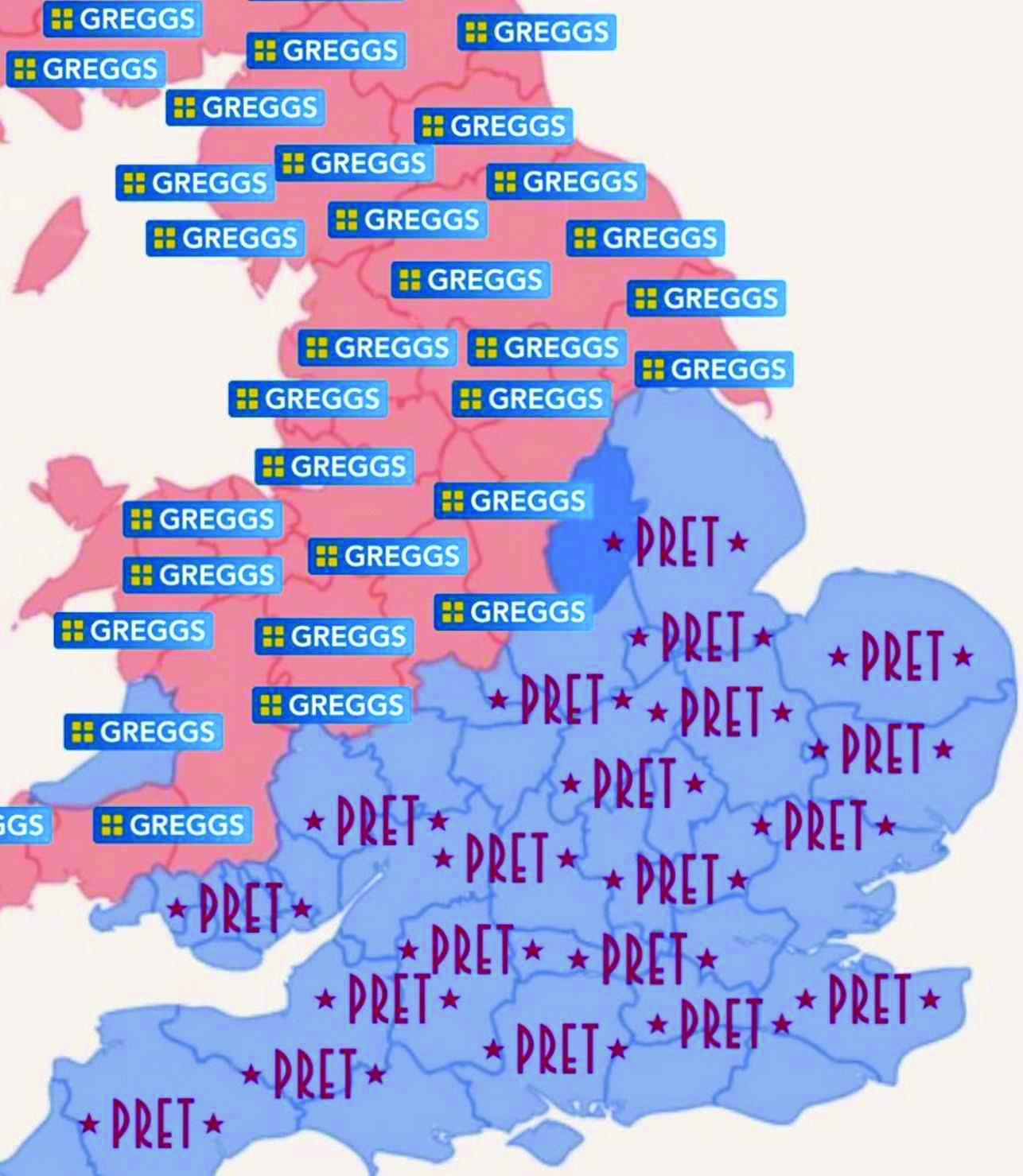
Some say it’s the Watford Gap services, some say it’s the Severn-Wash line – but isn’t the true marker of arrival in ‘the North’ the moment you reach a place where you can’t get a smashed avocado and roasted pepper baguette, but can get an impressive variety of sausage rolls?
That is the contention of mathematicians who have calculated the location where southern Pret a Manger sandwiches ends and the rule of honest northern Greggs pies begins – and they have declared it the north-south divide.
Lest the analysis seems flimsy, they have strengthened it by augmenting it with a separate set of strongly correlated data: the Waitrose-Morrisons Index.
As far as Sophie Maclean, from King’s College London, is concerned, this study ends a discussion that began with William the Conqueror, who noticed that the resi-dents in the north of his kingdom were more unruly and, “In mad fury… descended on the English of the north like a raging lion.”
“There’s a lot of debate but thankfully mathematicians have worked this out,” said Maclean, speaking at the Cheltenham Science Festival. “Really there is only one way to judge what’s north and what’s south and that is by looking at the distribution of Pret and Greggs.”
The analysis, published in journal ArXiv, used Machine Learning to define the optimal north-south boundary, seeking to divide the country in two according to the ratio of Prets to Greggs and, separately, Waitroses to Morrisons. Then, researchers combined the two.
This produced a line that cut off the top of Norfolk and all of Cornwall and Bristol, thereby declaring that these traditionally southern regions are in fact spiritually and culinarily northern.
Part of this may be explained by the metric failing in the west country. While most of the country has a dominance of one of the fast-food chains or another, Cornwall is fairly low on Prets, possibly on socioeconomic grounds, but the region also resists Greggs, on grounds of ‘pasty-purism.’
Less controversially, further east, the line confirmed conventional intuition – passing close to the Watford Gap.
Dr Robin Smith, from Sheffield Hallam University, led the study, adapting machine learning techniques normally used to look at nuclear reactions. He said that in an inevi-tably subjective area, this analysis was as good as any.
“The food we eat is a very good indicator of whether someone is northern or southern. Greggs is very popular in the north, where people do seem to prefer a steak bake.”
The new definition will undoubtedly trigger some discomfort. Cheltenham residents, who like little better than meeting on a Saturday morning in Waitrose to pick up ‘essential’ parmigiano reggiano, might at the very least argue the case they are an enclave of the south.
Maclean accepts that there will be controversies, disagreements and some anomalies. The same goes for any other purportedly objective measure. There was even sometimes a pathos to the data, where you can see the anomalies in action – for instance in the few individuals trying to eke out a sophisticated culinary lifestyle amid the pastry-based wastelands of the north.
“You could imagine the single Pret in Newcastle surrounded by a swarm of Greggs,” Maclean said. Whereas, she added, “In London, they say you’re never more than 6m from a rat, or a Pret.”
Greggs has begun a southern invasion, with an appeal to more liberal metropolitan tastes.
“Since Greggs produced the vegan sausage roll, it has become more popular in the south, so this might not be a marker of northernness for that much longer.”
(Source: Tom Whipple,
Science Editor, The Times)
When Greggs met Pret | The north-south divide


