
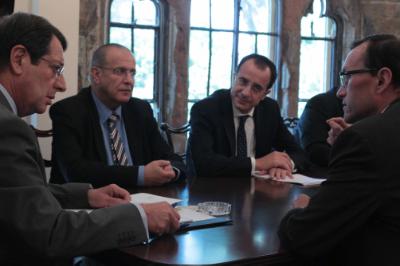

Α focus right now in the Cyprus peace talks is on building economic support for a settlement, Special Adviser of the UN Secretary-General on Cyprus Espen Barth Eide said, speaking after being received on Tuesday by President of the Republic Nicos Anastasiades.
He described yesterday`s meeting at the United Nations Protected Area as very good, noting that today he talked to the President about how to organise the time ahead. Because, he added, “we said in our statement yesterday that crucial months are coming, that we recognise progress been made, we also recognise hard work remaining”.
Eide said the big question now is “how do we optimise our time in the coming months, which means which issues do we deal with and with which sequence and how do we connect all the dots”.
The Special Adviser of the Secretary-General on Cyprus said the conversation they are having now before the meetings coming up in New York is about the overall picture of affairs. The solution, he said, “is a big picture solution. It has many details and these details matter and they are serious, important issues but there is only a solution, if we connect the dots, and now we are in the connecting the dots phase, which is exactly where I think we should be in September”.
So, he continued, “I am happy with the state of affairs and I also reiterate as the leaders correctly said both in their statement and individually that there is a lot of work and there is little time and we have to get that work done.”
Eide added that “a particular focus right now is on building economic support for a settlement”.
Over the summer, he recalled, the EU leadership visited Cyprus and now the US Undersecretary of State, adding “I am going to have a lot of meetings over the next weeks in New York, using the opportunity of the whole world coming together, building willingness to help build that fund relatively quickly because the more we succeed on that front I think some of the crucial issues will be easier to solve”.
Replying to a question as to why the coming months are so crucial, he said “because these processes have a dynamic of their own.”
“Four months is in one sense very short because we have many decades of not solving the Cyprus problem, but it is also very intense and this type of momentum comes and it might go, so we really want to use it while we still have it,” he said.
This momentum, he added, is also “a reflection of the fact that the stars are well aligned now, they may not be well aligned all the time. Again both for the internal quality of the process but also for the surrounding circumstances, I think it would be good to use this opportunity when we have it”.
Replying to a question, he made it clear that “there is no timeline. It is quite quite important to underline that we haven`t even sought to have a timeline, because a timeline can be suffocating, because then the dates take dominance over substance”.
However, he said he is very happy to hear the leaders repeatedly say “that there is no time to lose”.
Eide also said there is a decision that talks will be intensified after October. “They are meeting all the time. But the leaders want to take more direct charge and that means significantly more frequent meetings from November on”, he added.
Eide said “we have open issues where I think our shared sense is that they will be solved but they will be solved in a context and we have to create that context”.
Asked if the elections in Turkey will affect the process, Eide said the primary focus is to deal with this between the two sides in Cyprus. “Of course we are aware of the electoral conundrums in several neighbouring states but the main issue to get as much done as possible what is within the control of the two leaders meeting in the negotiations”.
Asked whether the UN will bring bridging proposals to the table, he said “the leaders are doing a very good job in leading the process.”
Cyprus has been divided since 1974 when Turkey invaded and occupied its northern third. UN-led talks, aiming to reunite the island under a federal roof, resumed on May 15, this year.