
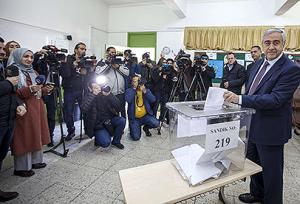

NICOSIA – Turkish Cypriots on Sunday voted in a snap parliamentary election overshadowed by last year’s failure to reach a peace deal for the divided island in UN-backed talks.
More than 190,500 people were registered to vote.
The vote comes ahead of presidential polls later this month in the Republic of Cyprus with peace efforts on hold until both sets of elections are over.
Polling stations opened at 0600 GMT and closed at 1600 GMT.
The elections in Cyprus comes six months after efforts to reunify the island collapsed at a UN-hosted peace summit in Switzerland over a number of disputes, including the withdrawal of Turkey’s 45,000 troops.
The election, originally planned for July, were brought forward.
Like every new year and every new day is a new beginning. I hope and wish that this will be a good beginning for our community,” Akinci told reporters after casting his vote.
Turkish Cypriots will go to the polls on Sunday in an early election that may impact efforts to solve the Cyprus problem, one of the longest standing issues on the United Nations agenda.
The 50 seats are contested by eight parties, but only 4 or 5 of them are expected to win over the 5-percent threshold which allows any party to attain a seat.
Though the number of voters who will cast ballot papers is expected to be much smaller than the total of registered voters, the chief election officer said the first results are not expected before Monday morning.
This is due to a new and complicated electoral process that will permit voters to choose candidates from different parties.
Most analysts expect a close sharing of seats between parties of the center-right and those of the left.
However, it is more difficult to make a guess as to the parties which will form a new Turkish Cypriot administration as small parties holding the balance may move either way.
A center-right administration on the track of the outgoing one will be considered as a strong indication that Turkish Cypriots move further away from an agreed solution for a federal Cypriot state that would again bring together Greek and Turkish Cypriots.
Cypriot President Nicos Anastasiades, who in his capacity as leader of the Greek Cypriot community is negotiating with Turkish Cypriot leader Mustafa Akinci, said in an interview on Friday that a center-right administration will most likely try to impose its nationalist policies.
“Though the negotiations are being conducted by the leader of the Turkish Cypriot community, it will be possible for a nationalist administration to try to influence his decisions,” said Anastasiades.
Center-right parties oppose a federal solution and a joint government with Greek Cypriots and favor either a separate state or a loose association with Turkey.
Leftist parties oppose breaking away from the rest of Cyprus and support a federal system under which Greek and Turkish Cypriots would share power.
Greek and Turkish Cypriots came close to an agreement last summer, but the negotiations broke up in disarray.
Observers say that the Cyprus problem has not played a central role in the campaign, which focused on bread-and-butter issues like the economy, with Turkish Cypriots still hugely dependent on Turkish assistance.
But a pro-solution government could give Akinci a better hand to play in any future talks with the Greek Cypriots while a harder line administration would deal a blow to his authority.
On January 28, the Republic of Cyprus is set to hold a presidential election in which conservative incumbent Nicos Anastasiades is the frontrunner.
Anastasiades has campaigned on a pro-peace ticket, vowing to try to revive talks with Akinci, despite the souring of their relationship after two years of tough and ultimately fruitless negotiations.