
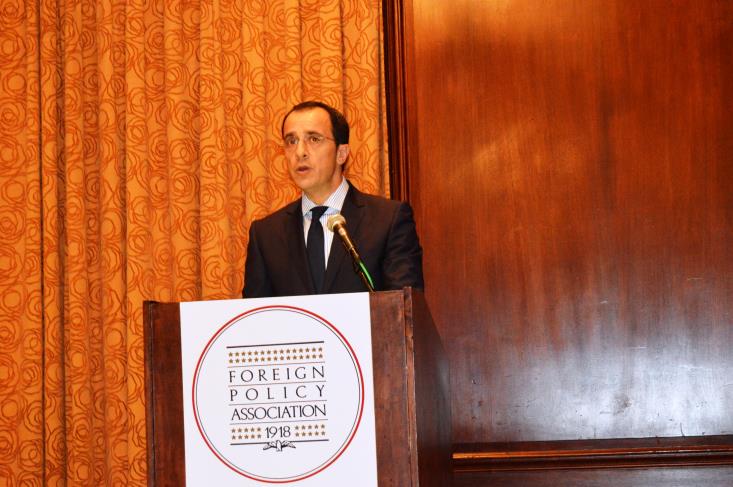

Government Spokesman Nikos Christodoulides said it was crucial to avoid mistakes of the past in a future settlement of Cyprus, noting that people need to be presented with “a clear plan with no constructive ambiguities and no gaps that would jeopardize its implementation, and which would risk the possibility of not achieving a positive outcome in the referenda”.
Addressing on Thursday an event in New York, at the invitation of the Foreign Policy Association, Christodoulides also underlined President Anastasiades` belief that a settlement in 2016 is possible, if all interested parties engage with seriousness, discussing and submitting constructive proposals on all pending issues.
Moreover, he said that they needed to refrain from actions that could jeopardise the good climate.
“Turkey’s contribution in tangible terms is crucially important”, he went on and said that Nicosia was counting on the United States’ influence. In this direction we work closely with the US administration, which is taking a keen and active interest in the efforts for reunification, he added.
Christodoulides said that Nicosia is well aware that Turkey will not decide to solve the Cyprus problem because it will realize the illegality of its presence in Cyprus or the violation of basic human rights of Cypriots, but will rather decide to move decisively towards a solution, because it will realize the benefits of such a development.
Referring to such benefits, Christodoulides noted that a solution will enable Ankara to be part of the strong regional cooperation that has unfolded in the region, in the field of energy and security and will boost EU-NATO and EU-Turkey relations.
Christodoulides called the division in Cyprus an “anachronism” and a “paradox” at the heart of Europe, and noted that it is the sole EU member state with a divided capital.
The Government Spokesman also referred to the country`s efforts to overcome the economic crisis, noting that three years after the EU decision for a ‘bail-in’, Cyprus has exited the economic adjustment programme and is now referred to as a model for economic recovery.
According to Christodoulides, with the economy on a confident recovery path, the government and President of Cyprus Nicos Anastasiades are focusing their efforts on reaching a comprehensive settlement of the Cyprus problem, in line with EU law, values and principles.
He said that after the choice of Mustafa Akinci as leader of the Turkish Cypriot community, in May 2015, negotiations have unfolded in an overall improved, more positive climate.
The Government Spokesman noted that there has been reached common understanding on an important number of issues related to the chapters of Governance and Power-Sharing, Property, Economy, and the EU, but “that there are still outstanding differences in the aforementioned four Chapters” while at the same time “we still have not held any substantive discussions on two decisive chapters, namely, Territorial Readjustments and Security and Guarantees”.
Foreign policy realignment
——————————–
The Government Spokesman also spoke about the government`s effort in realigning and re-orienting Cyprus’s foreign policy towards “enhancing bilateral and regional cooperation, and exploiting the prospects created by Cyprus’s unique geographical position” while demonstrating that Cyprus does not practice a single- issue foreign policy.
“To put it simply, it is not just the Cyprus problem” Christodoulides underlined.
Speaking on the country`s regional relations, Christodoulides said that given the very close relationship with Israel, as well as with the Palestinians, Cyprus has acted as a strong proponent for stronger EU involvement in the efforts to revitalize the Middle East Peace Process.
Moreover, Christodoulides underlined Cyprus` key involvement in the international efforts to combat terrorism. “Cyprus has steadfastly supported from the very beginning the coalition against ISIS” and is well aware that international cooperation and solidarity was crucial, he added.
Furthermore, he referred to trilateral cooperation mechanisms, Cyprus has initiated in the region, noting that they provide “ample proof of Cyprus’s valuable regional role”.
The common denominator for the countries that participate in these cooperation mechanisms is the understanding that these arrangements could serve as a model of regional dialogue, contributing to the consolidation of peace, stability and prosperity, he said.
Cyprus has initiated a series of trilateral cooperation schemes with Greece and Egypt, Greece and Israel, and moire recently with Greece and Jordan and Greece and Lebanon.
Issues on the agenda of such schemes vary, according to Christodoulides, from energy to maritime cooperation and tourism, and they are open for participation to any country of the region that wishes to do so. “No one is excluded”, as long as there is a commitment to good neighborly relations, respect of international law and mutual respect for the sovereignty, he said.
The Government Spokesman also referred to the discoveries of hydrocarbons in the Eastern Mediterranean and in Cyprus` exclusive economic zone and noted that the involvement of energy giants, such as French “Total”, US “Noble” and the Italian-Korean consortium “ENI-Kogas”, provide concrete evidence of the great potential.
“We are optimistic that the third round of licensing which was recently announced by the Republic of Cyprus and is under way, will bring more energy companies in our EEZ” he noted.
Christodoulides said finally that Cyprus is pursuing its energy policy in accordance with international law, and is working closely with its neighbors in favor of stability and peace.
Apostolis Zoupaniotis