
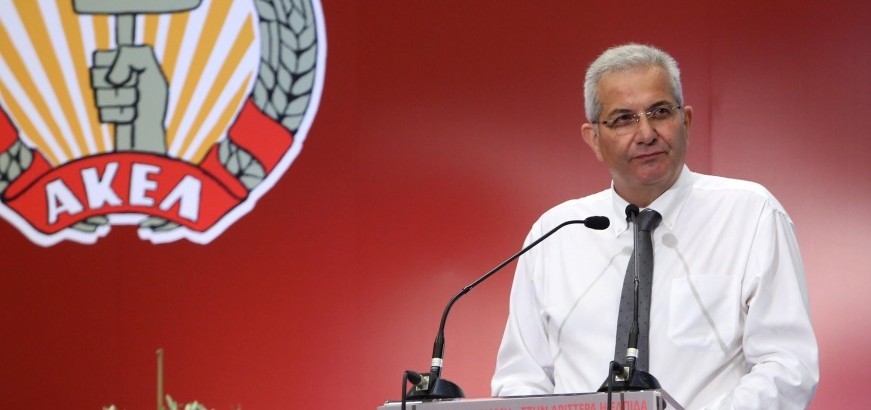

Speech by the General Secretary of AKEL, Andros Kyprianou at the
meeting with Ambassadors on recent developments in the efforts to
reach a solution to the Cyprus problem and the way ahead
15th February 2017, Nicosia
Permit me to welcome you all to our meeting today. I thank you because you
have once again honored us with your presence.
We felt the need to convey to you our positions and thoughts on the Cyprus
problem because we believe the negotiating procedure is at a critical juncture.
We do so because we feel that this two-way communication that we have
established between us for some years is important for us, but for you too. At
the same time we consider that where the ongoing procedure is heading will
soon be clarified, namely whether it will lead to an agreement or whether it
will too end in failure with all that this entails. I point this out because, without
constituting timeframes the upcoming Presidential elections will influence the
discussions.
In stating the above I do not mean that this is the last chance for a solution of
the Cyprus problem. There will always be a next opportunity if the necessary
political will exists on the part of all involved parties. However, the aimless
passage of time erodes our objectives, particularly with regards the chapters
on property, demographic structure and by extension the territorial issue too.
Our own desire, our own aspiration and the reason why we as AKEL are
struggling is that this procedure under way arrives at a positive result. By a
positive result we mean in the sense that a solution will be achieved based on
principles and the agreed framework; a solution that will create the prospects
for a lasting and viable peace on our island; a solution that will ensure security
and stability for all Cypriots, so that together we can build a future in conditions
of progress and prosperity for all of us. This has been our vision for decades
regarding the Cyprus problem.
As I said previously, we are going through a critical and decisive phase of the
Cyprus problem. What deepens the concern of public opinion is the conflicting
and contradictory messages it is receiving from political parties and figures.
We therefore want to present our own positions and thoughts to you.
It was always the long-standing position of AKEL and the Greek Cypriot side in
general that we must first agree or, at least, get within a range of an
agreement on all the chapters of the internal aspect of the Cyprus problem
(Governance and power sharing, economy, European Union issues, Property
and Territory) and that a representative international conference should
subsequently be convened for a solution of the chapter on Security and
Guarantees. The Turkish Cypriot side’s position was that the above chapters2
of the internal aspect, except the territorial issue, must be agreed and that we
should then enter into a final stage with the negotiation of the territorial issue
and subsequently of the security issue in a four or five-party conference.
Things did not evolve exactly as either one or the other side wanted. On three
of the five chapters of the internal aspect (Governance and power sharing,
economy, European Union) significant progress had been recorded during the
Christofias – Talat talks. It would not be an exaggeration to say that these
three chapters were since then within range of a convergence. I particularly
point out the progress registered on the chapter of Governance, which is
extremely complex and composed of nearly twenty sub-chapters. It was a
significant achievement, taking into account the bicommunality, bi-zonality
and political equality that demanded delicate balances, as well as the
safeguarding of functionality, without simultaneously deviating from the
principles of the solution and the aforementioned guidelines.
Conversely, satisfactory progress was not achieved on the chapter of property,
while there was limited discussion on the territorial issue. There are reasons
for the difficulty on these chapters. The property issue has to do with the
individual right of property of tens of thousands of our compatriots, Greek
Cypriots and Turkish Cypriots. More than forty years later, the situation on this
specific issue has been complicated tremendously. It has become even more
complicated with the Dimopoulos and Meleargos judgement of the European
Court of Human Rights which, I regretfully note, were most probably taken
according to political rather than law criteria. The Turkish Cypriot side’s
persistent refusal to negotiate the property issue in connection with the
territorial issue, made progress on both of these chapters even more difficult.
The assumption of the leadership of the Turkish Cypriot side by Dervis Eroglu,
in 2010, brought about a setback in the negotiations given that he went back
on the basic convergences that existed previously. Mustafa Akinci accepted the
Christofias – Talat convergences, a fact which helped President Anastasiades
accept them too. The result was a change in the negative atmosphere and
further progress began to be recorded.
In the almost two years of talks between the two leaders steps forward have
been made. However disagreements still exist on key issues. This is also
attributable to both side’s regressions regarding the convergences that had
been agreed between Christofias and Talat. At some stage and while there
were no objective conditions, in our view, the decision was taken to continue
the discussion abroad. The ultimate goal was the convening of a Conference
on Security issues, even if there significant pending issues remained on core
issues.
During the first meeting in Mont Peleran it was agreed to devote three days to
the discussion of outstanding issues on the internal aspects and two days to
discuss the territorial issue. Furthermore it was agreed that there would have3
to be a range of convergence on criteria existing before Maps would be
submitted. Indeed, during the first three days further progress was achieved
on some outstanding issues. So at last the discussion of the territorial issue
also began. In the course of events it was apparent that a range of
convergence was achieved on the ostensibly most important criterion, namely
the percentage of territory that will remain under Turkish Cypriot
administration after the solution of the Cyprus solution (28.2% according to
the Greek Cypriot side, 29.2% to the Turkish Cypriot side). It was also
apparent that room for convergence existed with regards the second criterion
too, namely the percentage of coastline under Turkish Cypriot administration.
However there still exits a significant difference with regards the third criterion,
namely the return of territories to how many Greek Cypriots will potentially
return to their properties under Greek Cypriot administration. I clarify that this
third criterion in reality also concerns territory, given that regions to be
returned are highlighted. Somewhere at this stage the negotiations were
interrupted, with an agreement to continue them one week later, again at Mont
Peleran.
The interruption of the procedure had negative consequences. The momentum
was lost, while it was now clear that the prospects were not the best in view
of the continuation. AKEL did everything it could for the effort to continue
keeping hope alive. We proposed to the two leaders not to insist on a range of
convergence on the third criterion as well, but that they should submit and
discuss Maps. We were not heeded and Mont Peleran 2 ended without a result.
The view that we conveyed to Mr. Anastasiades was that an effort should have
been made, without concessions on principles, to resume the negotiation. We
had warned that a potential prolonged stalemate harbored serious dangers for
the future of the negotiation procedure. One danger that existed, was the well-
known threat issued by Erdogan that if there was no progress by the end of
2016, he would insist on the “naturalization” of a large number of settlers.
Such an action would have represented a blow to the talks, since it would
negate the very significant convergence on the demographic ratio at the time
of the solution. The President of the Republic evaluating the given situation
took his decisions which he discussed with Mr. Akinci. They decided to continue
the effort to achieve convergences in Cyprus and for a Conference on Cyprus
to follow in Geneva. The internal aspects would be discussed there, they would
continue with the submission of Maps and conclude with the Conference on
Security.
For AKEL the procedure that was agreed was not the appropriate one because
that we assessed that it would not yield the expected results. We also strongly
believed that every time expectations are raised among the people and the
effort fails the people are left disappointed. If this happens repeatedly it
provokes serious problems among public opinion. We still believe that the best
procedure would have been first to get within range of an agreement on all the4
internal aspects of the Cyprus problem, including the territorial issue, and to
subsequently convene a representative international conference on Security
with the participation of the Republic of Cyprus, the two communities, the
guarantor powers, the other permanent UN Security Council members and the
European Union. Regarding the Security issues we considered that a
preparation could have been made and the International Conference to be
convened at the very last stage. However, given that the two leaders agreed
the specific procedure and measuring the potential problems that would arise
if we had rejected it, as a responsible and serious party we decided to back it.
Our goal was and remains the achievement of a solution of the Cyprus
problem; a just, under the circumstances, functional solution so as to be
viable.
Both during the talks in Cyprus, as well as during the negotiation of
outstanding issues on the internal aspect in Geneva, a little further progress
was achieved. Hence, we reached the stage of the submission of a Map by both
sides. The Maps that were submitted meet the agreed criterion of the territorial
percentage under the administration of each community but, as expected,
from there onwards each side submitted the best Map for its own community.
Therefore, there is still a distance on the rest of criteria, but the fact that we
will now have a discussion of the territorial issue on the specific maps rather
than generally and vaguely is important.
The Conference on Cyprus followed, which as expected did not lead to a
solution of the chapter on Security and the Guarantees, not even to the start
of a substantive discussion on the issue. This was a first discussion and the
Conference must certainly continue. In Geneva the conditions for tangible
progress on this specific chapter were not ripe. To better prepare the ground
it was decided to continue the Conference at a technocratic level. In the
Conference, which was again held in Mont Peleran, both sides presented their
concerns on the specific matter, relevant questions were submitted and
answered and the means that each side deems necessary to address the issue
were defined. Our evaluation is that at this level everything possible was done
to prepare the continuation of the Conference at a political level, something
which will be done in the second half of next month.
Taking into account the current situation as I have roughly outlined it above,
the question arises as to what should be done from now so that we can reach
the sought goal of a comprehensive solution of the Cyprus problem.
Before I answer the question, I would like to refer to some events that will
most certainly affect the ongoing procedure.
First of all, I would like to refer to the Referendum due to be held in Turkey
this April regarding the Constitutional amendments. Regardless of the
statements being made by Turkish and Turkish Cypriot politicians, it is obvious
that this does represent an obstacle to the waging of a substantive discussion5
on the core issues. Mr. Erdogan even if he wants to will not be making moves
that would potentially cause him problems in his effort to secure the required
percentage of votes that would permit him to proceed with the constitutional
amendments.
On the other hand, the deterioration of the relations between Greece and
Turkey as a result of the Turkish provocative behaviour, leaves no room for a
substantive discussion between them on the issue of Security. The whole
atmosphere is even more burdened by unacceptable statements being made
recently by Turkish officials and others. Bearing in mind the above, it is our
belief that the time between now until April is not suitable for real progress to
be recorded. However what should be done is the necessary preparatory work
with the elaboration of alternative proposals which while insisting on the basic
principles of the solution, they will create preconditions for convergence.
AKEL assesses that the current negotiation procedure is currently blocked. If
specific moves are not undertaken in the immediate period ahead, we fear that
the talks might result in a deadlock. The fact that we will enter a pre-election
period in the summer cannot also be underestimated, which will inevitably
adversely affect the entire effort.
The worrying messages about a possible negative development began in the
meetings in Mont Peleran. Although further progress was made there on the
outstanding issues and, most importantly, they arrived within range of a
convergence with regards the most basic criterion of the territorial issue,
namely the percentage of territory under the administration of each
constituent state, nevertheless we had a failure. There are several reasons
that led to that disappointed development, but the most important reason was
the following, in our view, namely the tactic of both sides to leave issues of
the internal aspect at the end so as, they believe, to have room to negotiate,
leads to deadlock. For example, when the Turkish Cypriot side leaves the
territorial issue at the end, the Greek Cypriot side does the same with the issue
of executive power, or vice versa. Who started this tactic isn’t important, but
where this leads to. It only leads to blockage, having particularly in mind the
Turkish stance on security too. Ankara has already stated that it will not say
its final word on this issue if it does not previously see how the issues of
executive power, the effective participation of the Turkish Cypriot side in
federal institutions and decisions, as well as the issue of the four freedoms for
Turkish citizens (the latter is a recent demand) will be solved.
Therefore, if the two sides continue this practice, the inevitable result will be
all attempts will fail. If something doesn’t change, we fear that the new session
of the Conference for Cyprus will also have the fate of the former conference.
In this way we will soon arrive at the unsuccessful end of this effort too, with
all the resulting negative consequences for the country and our people.6
AKEL has a clear view of what needs to be done. The pre-election campaign
period may be approaching and perhaps our position might have a cost for us,
but for us what takes precedence is the solution the Cyprus problem and not
any temporary petty-party gains. As we have repeatedly stated, what we are
interested in is the future generations, not the next elections.
At this crucial point it is pointless to discuss all the outstanding issues, which
are admittedly quite a few in number. We must in a targeted way and by the
next phase of the Conference on Cyprus focus on some key issues, the
resolution of which will have a positive effect on the Conference as well. I refer
to the issues of executive power, effective participation, the four freedoms,
and the territorial and property issue. These above issues must now be
discussed together and any convergences on these issues will only apply if
they are all resolved. Otherwise the whole exercise should be considered as
void and no relative convergence whatsoever will apply.
More specifically, the only core outstanding issues on the Chapter of
Governance and Power Sharing is the rotating presidency issue and effective
participation. AKEL’s position was and remains that the Christofias – Talat
convergence on the issue of executive power must be adopted, namely a
rotating Presidency with cross and weighted voting. This proposal obliges the
political Parties in both communities to cooperate for the election of the
President and Vice President. It transfers whatever confrontation to a political
level, as all modern States operate and not to an ethnic level. As far as the
issue of effective participation is concerned, if the Turkish Cypriot side respects
the outcome of the negotiation in the first Mont Peleran meeting, then we can
arrive within range of a convergence. If a convergence is recorded on these
two issues, we believe that it opens the way for getting within range of a
convergence on the territorial issue as well, something which in turn will assist
the solution of the two-three main outstanding issues of the property issue.
The most difficult issue seems to be Turkey’s new demand for the four
freedoms. However, if everyone respects the Christofias – Talat convergence
on this specific issue, this issue too will be overcome. According to this
convergence, which is recorded in the Downer document “Convergences 2008-
2012”, namely that one Turkish Cypriot vote will not be required in all the
bodies but only in some, the four freedoms for Turkish citizens will be
implemented in a way so as the population ratio is not violated. More simply,
the burning issue concerns the abode of Turkish citizens on the island. You
perhaps know that the Treaty of Establishment contains a provision under
which the granting of citizenship of the Republic of Cyprus to Greek and Turkish
citizens will be done according to a ratio of 4: 1. Back then, of course, the four
freedoms of the European Union didn’t exist while now they do. This made the
expansion of this ratio absolutely necessary so as to cover not only the
nationality, but also the abode of Turkish citizens on the island. Turkey must
respect this important convergence and understand the legitimate concerns of7
the Greek Cypriots who have opposite them a country with a population of 80
million people.
If the above key issues are not addressed in the way that we propose, we will
arrive to the conference with clean hands, in the sense that the only key
chapter that will be discussed there is the core issue of security and the
guarantees. The remaining outstanding issues, which do not concern core
issues, can be resolved easily and quickly before we arrive at the referenda.
Of course we do not harbour the illusion that the solution of the chapter on
security is an easy task. However, we believe that the prior resolution of all
the other key issues will make it easier to address the matter. As the discussion
on a technocratic level revealed in Mont Peleran, both communities have their
concerns on this issue. We the Greek Cypriots fear Turkey, while Turkish
Cypriots fear us. It is therefore clear that the security of both communities
must be ensured. This in turn means that the security of one community
cannot be safeguarded at the expense of the other community’s security.
The above mentioned also explains our position that the anachronistic system
of guarantees, any rights of intervention and the stationing of Turkish troops
on the island cannot be accepted. Such arrangements would cause great
uncertainty among Greek Cypriots and will drive them to vote against the
proposal in a new referendum. It is therefore necessary to find other ways so
that both the Greek Cypriots and Turkish Cypriots feel secure. We consider
that the proposal of President Anastasiades for an international police force
with a UN umbrella can constitute the basis for a solution of the specific issue.
From the preparatory discussions at the level of technocrats in Mont Peleran it
follows that the Turkish Cypriot side’s concerns have nothing to do with the
content of the solution itself, but rather with the possibility of it being violated.
Neither could they be related to the content of the solution, given that in the
solution many strong safeguards are provided for: bicommunality, bi-zonality,
political equality, an indissoluble federal system, the prohibition of any union
with another state or secession, effective participation in the bodies and
decisions at a federal level, the exclusion of the usurpation of federal
competences, the provision that no community will have jurisdiction or
authority over the other, and much more.
As you know, in Mont Peleran both sides analyzed their concerns on the issue
of security. All the questions of the Turkish Cypriot side without exception are
centred on what will happen if the Greek Cypriots violate the agreement and
usurp power. They fear that in this case they will again be found stateless while
Greek Cypriots will hold the state exclusively in their own hands. Concerns are
being expressed by the Greek Cypriots as well about a future secession which
this time will lead to either recognition because now the Turkish Cypriot
constituent state will exist or even about the usurpation of the Republic by the
Turkish Cypriots, because there will be a rotating Presidency. AKEL does not8
share such fears given that all these will be excluded with the overall
settlement.
However, taking into account the fears on both sides we believe that apart
from the clear safeguards provided by the solution itself, a system could be
the subject of elaboration that would guarantee the imposition of severe and
dissuasive sanctions on the side that will violate the agreement. That is, a
credible mechanism should be established which in the event of an usurpation
of power by the Greek Cypriots or Turkish Cypriots would activate such
sanctions so as to prevent any such intention and restore the constitutional
order. Similarly, in the event of secession punitive measures would be
triggered and they of course would exclude the international recognition of the
entity that will secede. In any case the measures will not concern the continuity
of the federal state but, on the contrary, will ensure the respect of the
international legality and rule of law. We believe that such a mechanism meets
the most convincing manner these widely prevalent concerns in both
communities.
At this crucial point of the Cypriot problem, AKEL reassures you once again
that for us what takes precedence is the solution of the Cyprus problem on the
basis of the principles of International Law, the principles upon which the
European Union is founded and the agreed framework. As time is dangerously
running out, we will exhaust all possibilities to reach the sought goal. In this
sincere effort we need your help and support. We ask you to exert your
influence on Turkey since it is obvious that at this particular stage we are at,
the solution of the internal aspects of the problem will basically depend on
solution of the security issue. I do not believe anyone in this room doubts that
the key not just of the chapter on security is held by Turkey and nobody else.
The solution of the Cyprus problem serves the well-intentioned interests first
and foremost of the Cypriots themselves, but also of Turkey, Greece, the
peoples of our turbulent region and the European Union itself. As regards
Cyprus in particular, we consider that there will be many benefits generated
by the solution for both Greek Cypriots and Turkish Cypriots, Maronites,
Armenians and Latins.
The liberation and reunification of the island will create conditions of peace,
security and stability. These conditions will encourage investment from abroad,
leading to economic development. There will also be a further increase in
tourism and the prospect of improvements in other sectors of the economy
especially of the construction sector due to the needs that will arise. We
shouldn’t forget that with a solution of the Cyprus problem the exploitation of
natural gas will also be unimpeded, while new and big prospects for its
commercial exploitation will also be created. All this will lead to progress and
prosperity for the people as a whole. It would be a real shame at the point we
have reached to lose this opportunity too.