
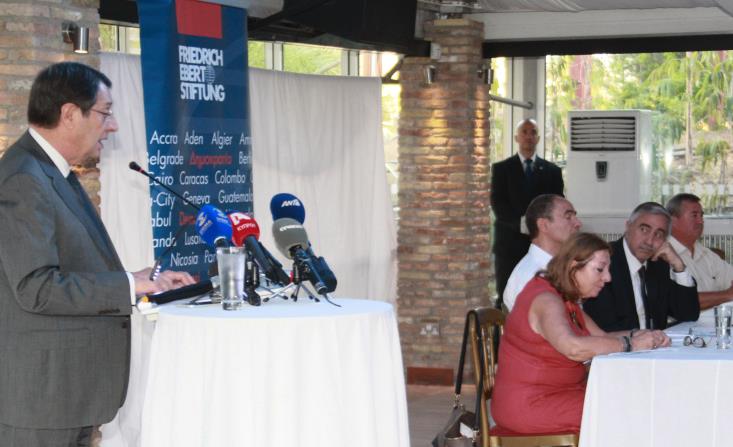

President of the Republic Nicos Anastasiades said on Monday he was hopeful that the current negotiating process for the Cyprus issue might lead to a solution the soonest possible.
Addressing a Cyprus Academic Dialogue event entitled `Life in a Federal Cyprus`, in the presence of Turkish Cypriot leader Mustafa Akinci, President Anastasiades noted that “I am hopeful that the current negotiating process might lead to a solution the soonest possible, since I believe that both Mustafa and I not only possess the political courage, resolve and genuine desire to reach a solution to the Cyprus problem, but I do believe that we also share the same approach and vision as regards presenting to the people a viable, lasting and functional settlement”.
He added that both himself and the Turkish Cypriot leader aim to reach a settlement in full conformity with the values and principles of both the Charter of the United Nations and the High Level Agreements between the leaders of the two communities of 1977 and 1979, as well as the Joint Declaration of February 11, 2014.
`Considering that Cyprus is a member of the European Union and will continue to be, the active involvement of the European Union in the negotiating process has been established, so as the solution to be fully in line with the values and principles of the EU` the President pointed out.
In addition, he said that `it is our common position that the settlement that we will present to the people must be clear and comprehensive, without any gaps or constructive ambiguities`.
Referring to the benefits of a solution, he said that these include respect of human rights, the four fundamental freedoms and the principles upon which the EU is founded, unrestricted freedom of movement, the right to acquire property and the right to establishment anywhere in Cyprus, the preservation of the cultural, linguistic and religious identity of each community, etc.
In addition, he said that by reuniting the country, its people, institutions and the economy and ending the uncertainty related with the status quo, Cyprus has the potential to establish itself as one of the EU’s most stable and predictable economies in this volatile region, ensuring long-term prosperity, through, inter alia, the significant improvement of the investment climate and an increased attraction of big foreign investments; reaching out to currently unexploited markets across the world, including the Turkish one; stimulating various economic sectors such as the construction and real estate industry, or enhancing the potential of other ones, like the tourism, shipping, retail and trade sectors.
Reaching a settlement to the Cyprus problem would not only be beneficial to Cypriots themselves, he said, and explained that reaching a solution can become a paradigm of how diplomacy and the adoption of a reconciliatory stance can contribute to the resolution of even the most difficult international issues, prevailing over mistrust.
Referring to the discovery of hydrocarbon reserves in Eastern Mediterranean, President Anastasiades said that this has the potential to create even further synergies and a grid of alliances for broader cooperation between hydrocarbon-producing and hydrocarbon-consuming countries of that area and beyond, to the benefit of the welfare of their and our people.
The Cypriot President pointed out that a settlement will enable Turkey to claim a much needed foreign policy success, will boost EU-Turkey and EU-NATO relations and will allow Turkey to become part of the strong regional co-operations that have been unfolding in the region, including in the field of energy and security.
Concluding, he said that “on my own behalf, and, if I am allowed, on Mustafa’s behalf, I wish to assure all of you present that we will continue working tirelessly with the aim of reaching a settlement within 2016 so as to alleviate our children and grandchildren from the mistakes and burdens of the past and provide them a homeland of prosperous collaboration and peaceful co-existence, under conditions of stability, security and safety”.
Addressing the event, Akinci said that Turkish Cypriots and Greek Cypriots should see each other not as enemies but as future partners, noting that now is the time to establish a partnership which will bring new benefits and opportunities.
`This is what we are working for. This is what our generation owes to our children and the future generations` he said.
Noting that the aim is neither a unitary state nor a confederation, he said that `our objective is to achieve a bi-zonal, bi-communal federation based on political equality within the framework envisaged in the 11 February 2014 Joint Declaration`.
Federation in a United Cyprus will comprise two constituent states of equal status, single international legal personality and single sovereignty emanating from the Turkish Cypriots and Greek Cypriots equally, he added.
Referring to the benefits of a solution, he said that it will not only do away with political uncertainty but economic uncertainty as well, noting the numerous benefits, including investments, a boom in the construction and tourism sectors, agricultural potential from the benefits that water from Turkey can bring, improvement of the quality of life, increase in import and export opportunities, since Greek Cypriots too will have an access to the 78-million Turkish market, abolition of the compulsory military service, EU funds for infrastructure, etc.
As regards natural gas, he said that “combining our current and future energy resources with the resources of other countries in the region, primarily with Israel, and transferring them to the EU via Turkey is the most economic and reasonable means.”
Similarly, he said, the costs in terms of finance and time for the electric cable, which is planned to run under the sea between Israel and Greece via Cyprus to reach Europe will be very high, adding that if the said cable were to connect to Europe via Cyprus and Turkey, the relevant costs will be lower.
`For that I believe we have a crucial time until the end of the year which we need to make good use of. As everyone will realise, if we enter into a new year without a solution, we risk missing this opportunity once again` he said, noting that in 2018 there will be presidential elections in Cyprus.
The Cyprus Academic Dialogue was founded in 2009, with the aim to promote mutual understanding, trust and cooperation between academics, intellectuals, social actors and policy makers of Cyprus, Greece and Turkey.
The Republic of Cyprus, an EU member state since May 2004, is divided by Turkish troops since the Turkish invasion in the summer of 1974.
UN led Cyprus talks resumed in May 2015 with the aim to reach a solution of the Cyprus problem under a federal political system.