
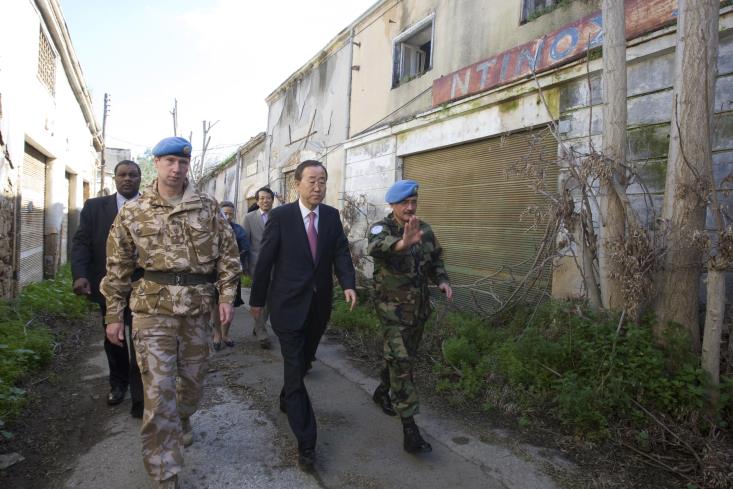

UN Secretary General Ban Ki-moon has expressed his strong willingness to engage again with the two Cypriot leaders when the time is right. However, he stressed that this is a leader-led process and the United Nations and he personally are committed to supporting the leaders’ efforts as and when they call upon them.
In an exclusive interview with CNA correspondent at the UN headquarters, the Secretary General says he is encouraged that the Cyprus peace talks continue to make good progress in an atmosphere of trust and goodwill. Although he acknowledges that reaching an agreement won’t be easy, he firmly believes that “the current round of talks offers the best chance that Cyprus has had for a lasting peace.”
Asked if after his recent meeting in Istanbul with Turkish President Erdogan he thinks Turkey is ready for concrete positive moves in order to unblock important chapters of the negotiations, the SG characterizes the role the guarantor powers have to play in support of the peace talks in Cyprus as important.
“I am encouraged by the high level of political support that they are all providing to the process, including Turkey. This is particularly welcome as the talks are now entering an intensified phase,” he told CNA.
He praised the unified support of the Security Council to the Cyprus negotiations, pointing out to public statements by the 5 Permanent Members, on the first anniversary of the talks between the current leaders.
“This strong support by the international community will be very important in the critical months ahead. The two leaders should have no doubt that they can continue to rely on it as they pursue their efforts towards solving this decades old issue for the benefit of all Cypriots”, the UN Secretary General said.
On the chapters of Security and Guaranties, asked whether the UN could play the key role in the post-settlement security arrangement, Secretary Ban expresses the readiness of the organization to help and support both sides. He underlines that UN has intensified its planning in relation to a settlement, as requested by the Security Council most recently in its resolution 2263 (2016).
“As of now, both sides have indicated that they would like the United Nations to continue to play a role in Cyprus post settlement. The modalities of this engagement will be decided in due course, as the two sides get closer to reaching a comprehensive settlement.”
Ban Ki-moon will visit Athens, Greece on June 16 and on the 17th the refugee hot spots on the island of Lesvos. He sees his visit as an opportunity to discuss with Greek officials the refugee and migration crisis, the conflict in Syria, and developments in the Middle East. He will also discuss “the positive developments in the Cyprus talks as well as the prospects for resolving the name dispute between Greece and the former Yugoslav Republic of Macedonia.”
As by the end of the year he concludes his second and final term as UN’s Chief, the Secretary General talks about his accomplishments, especially on issues such as the Climate Change, the involvement of Women etc that were set as his priorities.
He recalls childhood memories from the Korean War when asked to offer a message to the future generations and tell us if he considers peace a utopian dream or a realistic goal.
“I have a memory from my early childhood walking up a muddy road into the mountains. Behind me, our village was burning. Then the United Nations came. They fed my family, my community, they provided us shelter. Even being just a few years-old boy, that event made a strong impression on me; it gave me hope for a better future.”
As far as on how he wants to be remembered, Ban Ki-Moon reminded us of the politically difficult issues he challenged and he says “I care more about results for people than I do about credit for myself.”
The full text of the UN Secretary General’s interview is as follows:
Q: In recent months there has been renewed hope for a settlement of the Cyprus problem. How realistic one can be to expect an agreement for a solution of the problem before the end of your term? Is the UN considering the end of 2016 a deadline?
S.G. I am encouraged that the Cyprus peace talks, facilitated by my Special Adviser, Mr. Espen Barth Eide continue to make good progress in an atmosphere of trust and goodwill.
· It has been over a year of intensive negotiations; the Greek Cypriot leader, Mr. Nicos Anastasiades, and the Turkish Cypriot leader, Mr. Mustafa Akýncý, have been working hard to address the most important issues for their own communities, while also respecting the rights of the other community.
· I am confident that a peaceful reunification of Cyprus will reap real political and economic benefits not only for the Cypriots, but it will also resonate well beyond the island by contributing to stability and co-operation in the region.
· No one assumes that reaching an agreement will be easy, but I firmly believe that the current round of talks offers the best chance that Cyprus has had for a lasting peace.
· I would like to stress that the UN has no timetable of its own. I welcome the leaders’ joint statement, issued on the first anniversary of the talks on 15 May 2016, when they expressed their commitment to intensifying their efforts with the aim of “reaching a comprehensive settlement agreement within 2016”.
· Building on this statement, the two leaders reconfirmed during their latest meeting on 8 June that they will intensify their negotiations, “working to resolve the remaining outstanding issues in an agreed structured manner”.
· Both leaders have reiterated their determination to overcome their remaining differences in the coming months. The United Nations and I personally are committed to supporting their efforts, while maintaining that the future of Cyprus will be determined by Cypriots, for all Cypriots.
Q: Recently you have visited Turkey and met with President Erdogan. Do you see Turkey ready for concrete positive moves besides general statements of support, in order to unblock important chapters of the negotiations? Do you intend to exercise your influence on certain powers that are in a position to facilitate the negotiating process and especially Turkey?
S.G. All guarantor powers have an important role to play in support of the peace talks in Cyprus.
· I am encouraged by the high level of political support that they are all providing to the process, including Turkey.
· This is particularly welcome as the talks are now entering an intensified phase.
· I am also encouraged by the fact that the Security Council is united in the support to the Cyprus negotiations.
· As recently as 15 May 2016, on the first anniversary of the talks between the current leaders, permanent members of the Security Council made public statements, expressing support to the two leaders.
· This strong support by the international community will be very important in the critical months ahead. The two leaders should have no doubt that they can continue to rely on it as they pursue their efforts towards solving this decades old issue for the benefit of all Cypriots.
Q: Do you foresee any time soon some personal involvement of you as Secretary General in order to accelerate progress in the negotiations?
S.G. This is a leader led process, facilitated on a day to day basis by my Special Adviser Mr. Espen Barth Eide.
· The United Nations and I personally, are committed to supporting the leaders’ efforts as and when they call upon us, while maintaining that the future of Cyprus will be determined by the Cypriots themselves.
· I look forward to engaging again with the two leaders when the time is right.
Q: Security and guarantees is one of the main issues for the Cyprus issue. Could the United Nations play the key role in the post-settlement security arrangement?
S.G. The chapter of security and guarantees is a crucial part of a settlement. It is critically important that the outcome of the negotiations will be a federation where both communities can feel safe and secure without seeking their security to the detriment of the other side.
· The United Nations stands ready to assist and support both sides with post settlement security arrangements once they reach a comprehensive settlement. It has intensified its planning in relation to a settlement, as requested by the Security Council most recently in its resolution 2263 (2016). This planning has been welcomed by the two sides and will continue to be guided by developments in the negotiations and the views of the sides on the possible role of the United Nations in that regard.
· As of now, both sides have indicated that they would like the United Nations to continue to play a role in Cyprus post settlement. The modalities of this engagement will be decided in due course, as the two sides get closer to reaching a comprehensive settlement.
Q: What do you expect to discuss with Greek officials?
S.G.· This visit provides an opportunity to discuss the enormous challenges the region is currently facing, including the refugee and migration crisis that is so acutely felt in Greece, the devastating conflict in Syria, and developments in the Middle East, including in the peace process.
· The visit also provides an opportunity to discuss the positive developments in the Cyprus talks as well as the prospects for resolving the name dispute between Greece and the former Yugoslav Republic of Macedonia.
Q: Since the beginning of your first term you have made Climate Change your top priority. The Paris Agreement of last December can rightly be claimed as one of your personal achievements. What other historic milestones have been achieved during your two terms? Do you have any regrets for something that you could have done differently but you didn`t either in the field of peace and security or human rights and development?
S.G.· I decided to make climate change a top priority even before I became the Secretary-General of the United Nations.
· Member States felt that it was not an issue for the Secretary-General to get involved in and also, at the time, it was not seen as much of a political issue as it is now.
· But I decided that it was just too important to play it carefully. If I didn’t do something, who would?
· It has been a long, hard road, but it has paid off.
· I won’t stop pushing until my very last day in office as Secretary-General – it is my responsibility, but it is also my personal passion.
· I have also been successful in appointing a large number of women to key posts at the United Nations, whether at Headquarters or as my Special Representatives in peacekeeping missions.
· We created many ‘firsts’ in female leadership — first female legal counsel, police chief, force commander and more.
· Let me also say a word about my personal diplomacy to fight discrimination against LGBT people.
· I have been urging many world leaders whose countries have harsh domestic policies to amend them. Sometimes I am successful and other times I am not but I will continue to fight until all LGBT people can live freely without suffering any intimidation or discrimination.
· As for your question about regrets, I prefer to concentrate on the present and on the positive. My approach is to focus on universal values and take practical steps for progress.
Q: Looking back to 1945 when the world was coming out of the ashes of two catastrophic wars, we realize how elusive is the quest for peace even in our days. What would be your message as Secretary General to the future generations? Is peace a utopian dream or a realistic goal?
S.G.· I have a memory from my early childhood walking up a muddy road into the mountains. Behind me, our village was burning. Then the United Nations came. They fed my family, my community, they provided us shelter. Even being just a few years old boy, that event made a strong impression on me, it gave me hope for a better future.
· The United Nations was established at the end of the World War II and one of its objectives was to foster a global environment free of armed conflicts.
· History taught us that this is not always possible but I firmly believe that without the United Nations the world would have been a less peaceful human habitat.
· My life experience has also taught me that regardless of our differences – ethnic, religious, cultural, we, people, strive toward some universally shared values and longing for love and understanding. In that sense peace is realistic and achievable goal.
Q: How you want to be remembered as Secretary General?
S.G.· Every United Nations Secretary-General enters office with unique experiences and perspectives. Mine was formed growing up in Korea during wartime. The experiences of Koreans from my generation resonate around the world. Korea as a country shows transformative power of global solidarity.
· My approach is: first build trust and friendship and then confront difficult issues. This may not draw attention but it definitely gets results. And I care more about results for people than I do about credit for myself.
· I also believe strongly in leading by example. I do not want to go around the world demanding equality for women if I have a cabinet dominated by men. I do not want to insist on best practices in public administration if the United Nations is using outmoded systems. I cannot speak up for the human rights of LGBT people if they do not have full benefits at the United Nations. On all three of these areas – and more – I have made dramatic improvements.
· We overhauled our administrative systems to make the United Nations and its staff more dynamic, mobile and modern, able to rise to 21st century challenges.
· These were politically difficult challenges – but they were well worth the legitimacy of having the United Nations to be a leader not only in words but in deeds.
Apostolis Zoupaniotis