
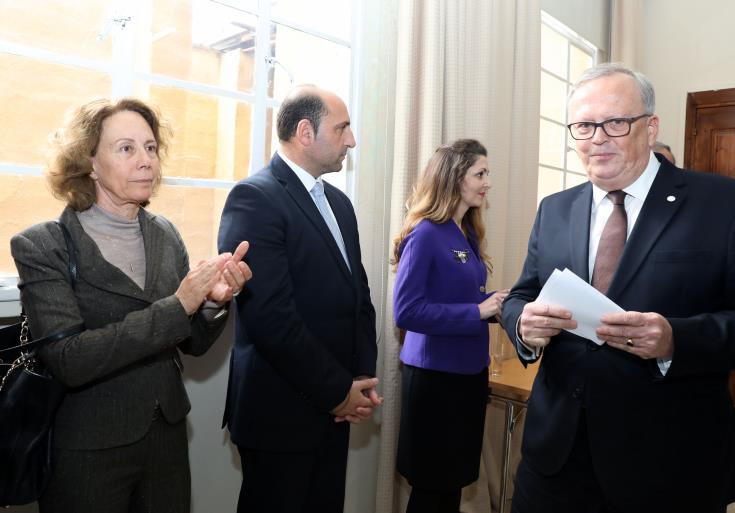

Committee on Missing Persons in Cyprus (CMP) Third Member Paul-Henri Arni said on Wednesday that elderly people who have information on sites where missing persons have been buried must be convinced or even pushed to talk, stressing that no one will be prosecuted for providing this information to the committee.
Furthermore, he referred to the case of a 95 – year – old Turkish Cypriot woman who passed away a few months after giving information to CMP about two burial sites in the Turkish occupied village of Trachonas where the remains of 36 Greek Cypriot missing persons were found in 2015.
Arni was speaking during a bicommunal event hosted by the Slovak Embassy in Cyprus, at Ledra Palace, and was attended by Greek Cypriot and Turkish Cypriot political party leaders or representatives, Cyprus` religious leaders or their representatives, diplomats and other officials.
All three CMP members, who were guest speakers at the event, stressed the need for all relevant actors to continue providing political and financial support to the committee. As it was noted out of the 2002 missing persons, the remains of approximately 900 have been discovered and identified in the framework of CMP`s Project on the Exhumation, Identification and Return of Remains of Missing which kicked off in 2006.
In his speech, Arni said that CMP found in 2015 a group of 36 missing persons thanks to an old witness, who was at the time 95 years old. As he noted this woman decided to speak despite any fears, because she felt that she would soon die without giving this important information. A few months later, after talking to us, after we found these 36 remains, she indeed passed away, Arni, added.
He went on to say that “many people who know firsthand where the secret burial sites of missing persons are located have already passed away. The surviving witnesses are very old. We have no time left to convince them to talk to the CMP for the sake of all the families who are still looking for their loved one 55 years and 44 years after they went missing.”
Noting that political leaders of both sides have a lot of influence on people`s minds, Arni said that people with vital information have to be convinced to come forward, they even have to be pushed to talk. They have to understand that no one will prosecute them for providing information to the CMP. They also have to realise that families of all communities need this vital information to put their suffering to rest, he added.
Herni said that the humanitarian work that the CMP does is critically important even if it is difficult, expensive, and time-consuming. It heals individuals, families and communities and gives them back their dignity, he noted.
He assured that the CMP will do its utmost to find and identify the remaining hundreds of missing persons in Cyprus in the shortest possible time. For this we need the help of all those elderly witnesses who know where we should dig. You leaders of political parties could help us to convince them to talks, Arni stressed.
Addressing the Ambassadors who were present at the vent, he said that the CMP needs continuous financial support from the EU, its biggest donor, but also from countries which wish to help this vital process in Cyprus.
Furthermore, he noted that the CMP is implementing its new three-year strategy with a special effort on archive research and use of news technologies, adding that this represents a 20% increase of its regular budget.
He stressed the need for the CMP donors to continue to support the committee`s work, noting that in this way they will directly contribute to helping these families and restoring trust between the communities and therefore prepare the ground for lasting reconciliation.
Greek Cypriot member of CMP Nestoras Nestoros said that families of Greek Cypriot and Turkish Cypriot missing persons are looking for a single answer, which is what happened to their loved ones. “And we have to give them this specific answer. It is important to give an answer not in general, but we have to be very-very specific,” he noted.
Nestoros said that CMP is trying to solve technical issues, adding that there are also political issues that need to be solved “maybe from people who are here, maybe from people who are not here,” as he noted.
He said that the CMP project is important and useful for the society, the future and the new generation. “There is a need for practical support and not only nice words,” Nestoros stressed.
We are looking for practical solutions, he said, noting the very good cooperation which exists among the members of the committee.
Nestoros thanked the Slovak Embassy, the EU, UNDP and the UN for their support as well as the US for their financial support on the management of archives and for their technical help, noting that CMP members will soon have a meeting with the US Ambassador in Nicosia to discuss various issues concerning the committee`s work
Turkish Cypriot member of CMP Gülden Plümer Kücük described the results of the committee`s work as “a great success under the circumstances.” She thanked the religious leaders and the political parties for their support, noting that without political support CMP`s work would not be possible.
Furthermore she said that the EU`s financial support is also very important, because CMP`s project is costly. “Working with the Greek Cypriots and the fact that young people work together hand in hand, daily, teaches us a lot of things. We learn how to respect different cultures, work together. This project really helps the young generation to come together,” she noted.
In his welcoming speech, Ambassador of Slovakia to Cyprus Jan Skoda referred to the meetings of Greek Cypriot and Turkish Cypriot political parties which take place regularly under the auspices of the Slovak Embassy in Nicosia, as an impartial facilitator, stressing the importance and necessity of this platform of direct contact among politicians.
“Maintaining this channel of communication between both sides represents a permanent commitment of the Slovak diplomacy alongside with the deployment of the Slovak contingent of peacekeepers to UNFICYP,” he noted.
He said that bicommunal activities can help improve the atmosphere of trust and mutual understanding required as a prior condition for a just, lasting and sustainable solution of the Cyprus issue.
Cyprus has been divided since 1974, when Turkish troops invaded and occupied 37% of its territory.