
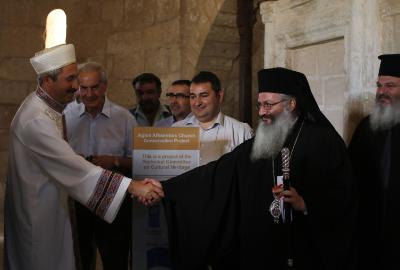
The once derelict church of Agios Afksentios in the Turkish occupied village of Komi Kebir, was returned to its Greek Cypriot owners after complete conservation during a ceremony by the Technical Committee on Cultural heritage, the European Commission and the United Nations Development Programme Partnership for the Future (UNDP-PFF).
Speakers told the gathering at the church, packed with refugee villagers of Komi Kebir and locals, that only through accepting and respecting the existence, principles and cultural heritage of each community, can Greek Cypriots and Turkish Cypriots co-exist and flourish in a peaceful atmosphere,
Turkish Cypriot Co-chairman of the Technical Committee on Cultural Heritage Ali Tuncay said after more than two hundred meetings of the TC, many visits to hundreds of monuments on both sides of the island, thousands of hours of technical work of experts in the Advisory Boards and the UNDP-PFF, fulfilling the task given by the leaders of both sides, “we have also achieved a lot among ourselves”.
“The most important achievement of the Committee is the establishment of trust between its members”, he said adding that the committee has also become a forum for dialogue on the protection of the cultural heritage between the two sides.
Tuncay said “cultural heritage is not just about stones and buildings. Cultural heritage also carries values from the past that are important for the future”, he stressed.
“We believe that it is only by accepting and respecting existence, values and cultural heritage of each other, both the Turkish and Greek Cypriots, can benefit and progress in a peaceful environment”, he added.
Greek Cypriot co-chairman of the Technical Committee Takis Hadzidemetriou in his speech, talked about Stavroulla, the daughter of Papacostas who according to a 16th century memorial inscription, had died at a very young age and her figure was bequeathed on the wall of the church along with the reminder “that a basic part of the church was built in memory of her name”.
Welcoming Stavroulla, he said that “she passed through the ages and reached our days” and despite the complete abandonment, people now came to take care of her church. This made her come forth in beauty again. “Your presence here, our dearest Stavroula, has given meaning to our petty lives. E said to ourselves `the fact that we found you here makes us think that our work in the Technical Committee has not been in vain”.
Tiziana Zennaro, Programme Manager for UNDP-PFF which implements the projects chosen by the Technical Committee, said undoubtedly things have changed on the island in the last month and a “new atmosphere prevails”. Perhaps this is the greatest reward for all those who have worked to make the changes a reality, just like the members of the Technical Committee and many Greek Cypriots and Turkish Cypriots.
She said irrespective of religion, everyone acknowledges that the church is a point of reference in our cultural heritage because it is part of our lives.
Zennaro said “today we can build new memories. Memories of peace, trust and respect”, adding that “we wholeheartedly believe that cultural heritage has this power and this is why together with the Technical Committee for Cultural Heritage we have decided to extend the project from mere emergency intervention to complete restoration”.
Alessandra Viezzer, head of Programme Team at the EU Programme Support Office EUPSO said the project is another example of the successful partnership between the EU and the bicommunal Technical Committee on Cultural Heritage and the UNDP.
She said the EU gives great importance to preserving and supporting the many different cuoltures that constitute Europe.
“Today I look at this accomplished project and see a symbol of how Cypriots can work together for a common purpose. We see here the very tangible results of cooperation and confidence between Greek Cypriots and Turkish Cypriots”, adding “I see a more prosperous future being built for Cypriots”.
Imam Fahretin Ogdo who attended the ceremony told gatherers “we are all God`s creations, the children of Adam and Eve. Cyprus is a very beautiful island and we have time ahead to enjoy it. We should not remain attached to the past but see how we can offer a better future for ourselves and our chidlren”.
Bishop of Karpasia Christoforos, receiving the key to the church from the members of the Committee, thanked all who worked to restore the once derelict church.
This project shows in practice that G/ C and T/C can coexist and even be creative. Therefore, we can disappoint those who believed the opposite of what we did here, “said Bishop Christoforos.
Finally he said, “I would not wish for better days to come to our island because I think we will have better days in our island. I am sure”.
Komi Kepir Community leader Demetrakis Paschalis thanked all those who helped in the restoration of the Church of Saint Afxentiou, calling it the “nice gem” in the occupied village.
The village is located on the Karpas Peninsula, 33 kilometres north of Famagusta.
The existing structure of the church was built on several periods, although the exact date of the church remains unknown. Parts of previous structures were incorporated in the existing building. The church is a single aisle orthogonal plan building. It is roofed with a pointed vault
which is supported by two transverse strengthening arches. The east end has a wide semicircular apse which is covered by a semidome. Two arch recesses are built on both the north and south walls respectively. The church is entirely built with stone.
The project which was born as emergency measures and was later turned into a conservation project aimed at consolidating and stabilizing the structure to prevent possible collapses hence leading to an aesthetic upgrading of the church
The interventions for this monument comprised rendering, pointing removal and grouting of all masonry surfaces in the interior and exterior of the church; replacement of broken/cracked or heavily weathered stones with new stones of similar characteristics (texture,toughness, size etc.); existing stones and mortar have been removed, wall cavity cleaned and rebuilt with the same material (stones).
In order to strengthen the walls and vault’s stability, metal tie rods were placed across the church. Also a metal tie beam was inserted at the top of the apse wall to tie apse with church. New wooden doors and windows were placed while a proper protection of the mural painting has been carried out by a specialized conservator to prevent further damage.
The Holy Altar has been partially reconstructed (one layer of stones) to indicate the original structure and avoid further destruction of the existing, reconstruction of the South Arcade and Gallery Roof strengthening and partial reconstruction of arcade base and foundation using the existing (placed in the church) material and new stone carving where needed;.
The courtyard was levelled and traditional tress planted
The project was fully funded by the European Union with a total cost including additional safety items, design and works, reaching 229,050 Euro.
The project is a collaborative work and an effort between United Nations Development Programme Partnership for the Future Office, the Technical Committee for Cultural Heritage of Cyprus and local and international architects, engineers, conservators and researchers.