
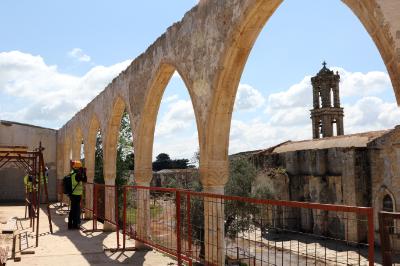

One of the flagship projects of the Technical Committee on Cultural Heritage, the conservation of Agios Panteleimonas Monastery, is underway at the Turkish occupied Myrtou village.
During a visit by the Committee, the European Commission and UNDP-PFF, journalists had the opportunity to see the progress of the first four months of the work carried out at the monastery, which dates back to the 18th century. The monastery’s church was plundered and was part of a military camp.
Conservation work to the Church includes structural stabilization of elevations, vaults and cracks, the installation of a new roof as well as conservation of wall paintings and finishes. Monastic buildings which include the Refectory, South Dorter, North Dorter, Reredorter are also structurally stabilized. The conservation of wall paintings inside the Church is also ongoing as well as repair works to the Church’s roof.
Tiziana Zennaro, Programme Manager for UNDP-PFF which implements the projects chosen by the Technical Committee, said Wednesday`s visit is the first in a series of initiatives to mark the International Day for Monuments and Sites. She said the UNDP-PFF is organising on Saturday a guided tour at 11am to Agios Panteleimonas where everyone is welcome to register and visit.
She said Agios Panteleimonas Monastery is one of the flagship and mega projects of the Technical Committee, along with Apostolos Andreas and the Othello Tower. Thirteen projects have been completed, 20 are ongoing or are about to start soon. All this, Zennaro said, is due to the solid and trustful partnership with the Technical Committee and the EU. The cost of the project, which is fully funded by the European Commission, is estimated at 750 thousand euros.
On his part, Greek Cypriot co-chairman of the Technical Committee Takis Hadzidemetriou said that from the early days of the Committee, discussion was underway about the situation at Agios Panteleimonas. He praised the UNDP-PFF for closely monitoring the project and added without the funding from the EU “I don`t know where the Technical Committee would stand” with its limited budget.
Ali Tuncay, Turkish Cypriot co-chairman of the committee, said they have been working since 2008 and have proved that cultural heritage should not be an issue of blame-game but an issue that should contribute to cooperation and building trust and confidence between the two communities.
“We are working together, we trust each other and together with the EU and the UNDP-PFF we are producing a lot of results. These monuments are not just Greek Cypriot or Turkish Cypriot but are monuments of humanity and we should protect them for future generations”, he said.
Speaking on behalf of team of designers, Michael Pittas, said the Monastery was built around 1600 by two friars coming from the Monastery of Agios Panteleimonas from Mount Athos. Originally there was a small church and a couple of rooms but the monastery grew bigger after it became well known for the miracles of the saint. The monastery consists of the church in the centre, the fountain with the holy water behind the church which was built around the 1820 and buildings for community and religious activities. The buildings are built with traditional materials and suffered interventions which were introduced into the traditional fabric incompatible materials such as concrete, cement blocks and cement plaster.
In the interior of the church, wall paintings cover the walls and roof which have been covered by lime and gypsum. He said that at this phase, works include conservation only. This means support, stabilize, protect and pass it to the next phase when restoration works will take place and emphasised that this phase is not a restoration. The main philosophy of the works concentrate on respect of values, minimal intervention, using compatible materials, making discernible interventions. They include cleaning of the area, provide slopes, new earth surface with puri, draining and fencing around the cloister, supporting the buildings for future restoration, removing the excess load of rubble earth fill, consolidating the roof and walls from the exterior surface, removing exterior plaster, putting the main wooden structure on the women`s gallery inside the church, provide metal ties with rods for the gallery`s arches and repair the floor and fill missing parts.
Michaela Foresti, head of Programme Team at the EU Programme Support Office EUPSO, said she is proud to say the EU has been supporting financially the work of the Technical Committee from the beginning and since 2011 has given 8.5 million euros and now there is an additional allocation of 1.4 million euros for more works, reaching almost 10 million since the financial support began.
She recalled the EU motto of “united in diversity”, noting that it is an indication of the spirit of the EU, ie people from different cultures coming together for the common good while maintaining and preserving diversity. It also indicates cooperation and mutual respect and understanding of diversity. “We believe the work of the committee is completely in keeping the motto and is a very successful example of cooperation and mutual respect and achievement” and shows what people can achieve when united.
The first phase of the project is estimated to be completed by the end of 2016.