
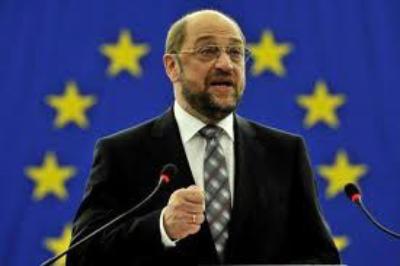

European Parliament President Martin Schultz has sent the message that Cypriot citizens will not be left alone the day after the reunification of their country and pointed out that the EU presents the best guarantee for a prosperous and bright future for all Cypriots in the context of a federal Cyprus.
In an interview with CNA, in view of his official visit to Cyprus, Schultz noted that he has no doubt that even though a settlement of the Cyprus problem is within touching distance, there is still work to be accomplished and efforts to be done even after an eventual unification, adding that “the international community and the EU must be ready to help out wherever this is beneficial.”
Schultz will visit Cyprus at the invitation of House President Yiannakis Omirou. He will arrive in the evening of March 28 and leave on March 30. During his visit he will be received by Cyprus President Nicos Anastasiades and will hold a meeting with Omirou, while he will also address the House plenary. Moreover he will have a meeting with Turkish Cypriot leader Mustafa Akinci and meet with leaders of Greek Cypriot and Turkish Cypriot parties. Schultz will also visit the Committee of Missing Persons` anthropological laboratory.
Asked about the purpose of his visit to Cyprus and the issues on the agenda of his meetings, Schultz said that “Cypriots face some crucial months ahead of them. The chance for reunification has never been so close. Never been so tangible. I will be visiting Cyprus to show the support of the European Parliament to the process being undertaken and publicly back both President Anastasiades and the leader of the Turkish Cypriot community Akıncı in the considerable efforts they are doing.”
He noted that “keeping the momentum going will be essential and I believe that apart from receiving the helpful verbal support of the international community, Cypriots and their leaders can benefit from direct backing on the ground. In this line, I will also be seeking to see with the different actors in what way the European Parliament can best help the process.”
Asked how the European Parliament assesses the ongoing efforts for a settlement and how he sees Cyprus` role in the EU after a possible solution, Schultz said that “the efforts being made by all sides to resolve the division in Cyprus are nothing short of remarkable. The speed and depth of the talks are impressive.”
Schultz said that he sees an invigorated role for a post-solution Cyprus “because it will be the leading example in the EU that deep seated divisions can be overcome through diplomacy with patience and perseverance.”
In a time where the “us” against “them” culture is becoming more dominant, a post-solution Cyprus can provide a counterbalance and a much needed breath of fresh air for Cypriots, for the EU and for the whole Mediterranean region, he noted.
Asked if he agrees that Cyprus` EU membership constitutes adequate guarantee for the security of the country and its people after a solution, EP President said that “one of the recurrent reasons that sovereign nations have advocated for joining the EU has been that the peace and stability of that country are served better inside the EU. I see no reason why this would not be the case also for a united Cyprus.”
Invited to say in which concrete ways could the European Parliament support efforts for a Cyprus settlement, Schultz said that “with my visit I want to convey to Cypriot citizens a message of hope on behalf of the European Parliament. A political message from the European Parliament that the Cypriot citizens will not be left alone the day after the reunification and that the EU presents the best guarantee for a prosperous and bright future for all Cypriots in the context of a Federal Cyprus.”
He added that he has no doubt that even though a settlement is within touching distance, there is still work to be accomplished and efforts to be done even after an eventual unification, adding that “the international community and the EU must be ready to help out wherever this is beneficial.”
Schultz underlined at the same time that the substance of what is negotiated must be Cypriot led and owned. “We must give the necessary space to both leaders to go their way and finalise negotiations, as soon as possible, without imposing any technical deadlines for the conclusion of these negotiations. What is fundamental is to ensure that this time around we succeed to get two `Yes` votes in the simultaneous referenda for the approval of the sought after agreed settlement plan,” European Parliament President has told CNA.
Invited to comment on the fact that Cyprus completes its economic adjustment programme in March, Schultz said that Cyprus` completion of the programme is to be highly commended. “In three years the country has gone from an economy in meltdown with all its eggs in one basket to one on a clear path of recovery. Reforms have been undertaken speedily which will help make the economy more resilient and also help in diversification,” he noted, adding that this rapid recovery shows that effort and persistence pay off.
He stressed, however, that there should be no complacency. “Reforms must continue, notably to reduce the high ratio of non-performing loans, but also to further reform the public administration and move ahead with the privatisation of the Cypriot Telecommunications Authority. Moreover the establishment of a fairer tax system should also be an important goal to pursue,” Schultz concluded.
Cyprus has been divided since 1974, when Turkish troops invaded and occupied 37% of its territory. The latest UN-led effort to reunite the island under a federal roof began in May last year, with talks between Anastasiades and Akinci.