
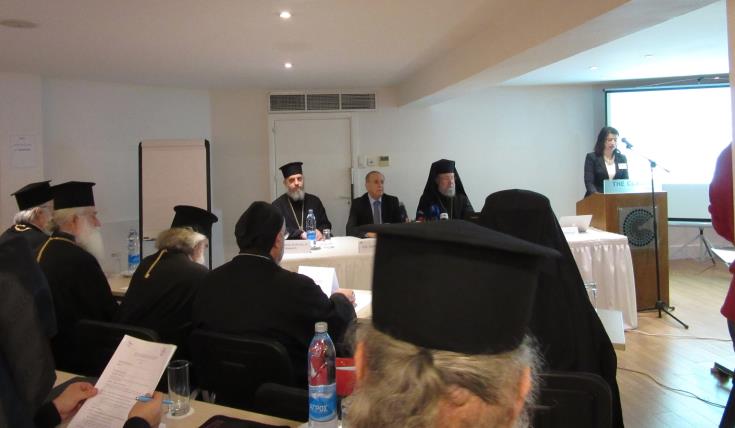

Cyprus` Foreign Minister Ioannis Kasoulides has spoken against using the right of access to places of worship for political ends, noting that it is really not conducive to dialogue and it entrenches divisions.
Kasoulides was addressing, on Thursday, the official opening of the Conference of European Churches, entitled “Places of Worship and Holy Sites in Europe and the Middle East: Status and Protection under National and International Law”, with the participation of 40 delegates from 15 different countries including Australia, Belgium, Cyprus, Serbia and Syria.
Referring to the politicization of the access to places of worship and holy sites during conflict, Kasoulides said that “this is an issue that we have to deal with frequently, as Greek Cypriots request from the occupiers in the north to hold Masses in their village churches mostly on patron Saints’ days and during Easter and Christmas.”
“It is regrettable that the rate of approval fluctuates with the political mood of the illegal administration of the north,” he stressed.
To that extend he informed delegates that “in 2016, there were around 80 such requests from village communities and around 60% were rejected with no justification given.”
“In 2015, the percentages were similar,” he added, noting that “this is not good.”
“On the other hand, the Republic of Cyprus respects the access of Turkish Cypriots to the Hala Sultan Tekke in Larnaca,” he pointed out.
“Politicizing the access to holy sites is really not conducive to dialogue and it entrenches divisions. It should not be used for political ends,” Kasoulides said.
The Cypriot Foreign Minister also informed the Conference on the initiatives undertaken by Cyprus to promote the protection of cultural heritage on an international level, including the signing of the Nicosia Convention, last May, during the Cyprus chairmanship of the Council of Europe’s Committee of Ministers.
According to Kasoulides “it is the only international treaty specifically dealing with the criminalisation of the illicit trafficking of cultural property.”
He commended the Church of Cyprus, which as he pointed out, “has gone to incredible lengths to repatriate religious artefacts, including whole mosaics and frescos that were stolen from churches in occupied Cyprus after the Turkish invasion of 1974.”
Bishop Porphyrios of Neapolis, he said referring to the head of the Church of Cyprus’ Representation in the EU, “has been personally involved in many of these legal battles against buyers and dealers and I am sure this Convention will help other communities not to go through what Greek Cypriots went through.”
On his part Archbishop of Cyprus Chrysostomos said referring to religious pluralism in Cyprus that until 1974, when the Turkish invasion took place everyone “lived together in peace, friendship in their mixed villages and towns, each free to worship their own God.”
“There were never any religious disputes, conflicts or troubles,” he noted, adding that “the situation has not changed and remains the same today in the government – controlled areas of the Republic.”
However, the Archbishop, said, “we regret to note that, unfortunately, in the Turkish occupied northern part of the island, religious freedoms have not been respected or implemented for the past 43 years.”
Moreover, “the Turkish invasion forces and the illegal regime, supported by Turkey, have undertaken an unprecedented brutal and cruel effort to destroy and loot our religious sites and monuments, our churches and monasteries, our altars and hearths, and even our cemeteries, essentially, everything that bears witness to the existence and presence of the Christian population in the northern area of Cyprus.”
For the Church of Cyprus, he stressed, “a longstanding issue has been that of respect for the obvious rights to access, use, operation, restoration and conservation of more than 500 churches that have been desecrated, abandoned to the ravages of time.”
On her part, Elizabeta Kitanovic, Executive Secretary for Human Rights of the Conference of European Churches said, among others that that depending on findings the aim is to see if there is enough material so that European Churches can initiate a discourse on this matter in the European institutions especially as 2018 is the European Year of Cultural Heritage.