

An urgent appeal was made on Tuesday by Xenophon Kallis, the advisor on missing persons’ issues to Commissioner Photis Photiou for DNA samples from families who lost loved ones during the bombing, by the Turkish air force, of Athalassa Psychiatric Hospital in July 1974.
Kallis, who dedicated all his life to the humanitarian issue of the missing persons in Cyprus, called on families who, for whatever reason, have not come forward to give DNA samples for the identification process, to do so, because the process cannot be completed and time is running out. A total of 32 people were buried in the area and so far the remains of 17 victims have been found in two different locations. Eleven people were found in a mass burial site behind the morgue and six other persons were found in three different sites nearby.
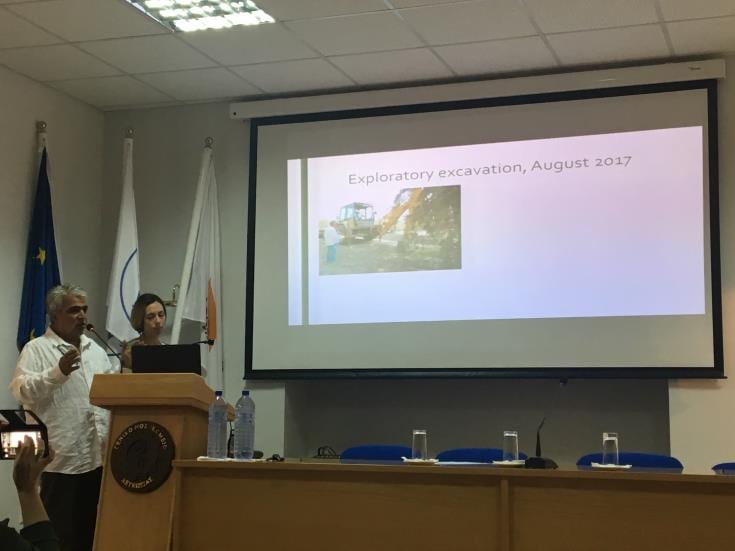
Kallis briefed Greek Cypriot and Turkish Cypriot political parties on the process of exhumation at the Athalassa Psychiatric Hospital and on the state of affairs as to the identification process. He also showed the parties the actual burial site, which is located behind the morgue of the Nicosia General Hospital which was built years later.
The visit and the briefing was organized by the Slovak Embassy which is hosting meetings of the political parties in Cyprus for a number of years.
Kallis told the press that three Turkish Cypriots were among the dead and that the identification process after the exhumations, has already begun and one Turkish Cypriot has been identified as his family had given DNA samples and other information. The remains of the six people who were found in three burial sites were brought to the anthropological laboratory run by the Cyprus Republic and samples were sent for DNA analysis.
Kallis explained that so far “we have seven identifications from the remains of the 17 people” but pointed out that the list of the 32 people is missing crucial information and cannot be described as explanatory, so he called on families who may have lost loved ones during the ’74 bombing of Athalassa Hospital to come forward and give DNA sample.
Kallis told the press that the reason the identification process cannot be completed is solely because no DNA sample was given by the families. He said that all the skeletal remains, found at the site, have given DNA extracts and that what is needed now is matching DNA by families for identification.
He went on to say that there has been some information that some other victims of the bombing were buried at Constantinou and Eleni Cemetery in Nicosia but this piece of information as well as additional information is being examined and the situation is assessed properly in order to decide the next steps.
Kallis also said that excavations are taking place in some other locations and that research is taking place to see whether an excavation will take place in Pachyammos village in Pafos district where a hospital was bombed by the Turkish forces in August 1964. All the excavations are planned thoroughly because what it is of great importance is to be able to locate remains and be effective in doing so as time is running out, he noted.
The parties which participated in the briefing and the visit to the Psychiatric Hospital, decided on a joint declaration which was read out by the Slovak Ambassador Jan Skoda. In the declaration the parties express their sorrow over civilian victims of military action on the island and their support to the efforts of the Committee on Missing Persons (CMP) in order to identify all remaining missing persons, civilians or military, and heal the pain of their families.
‘’To achieve this goal, they call upon the public of both communities for more accurate information that could lead to burial sites and the identification of missing persons. Leaders and representatives of Greek Cypriot and Turkish Cypriot political parties are convinced that the time has come to consider the construction of a common monument of reconciliation, dedicated to the memory of victims of the Cyprus conflict’’, the statement says.
Photis Photiou , the Presidential Commissioner in a brief address read out by a representative of his office, said that the Government of Cyprus considers the tragedy of the missing persons a humanitarian issue and its correct solution is long overdue for the sake of the families but also for the sake of the generations to come.
‘’Human pain and suffering is the same whether you are a Greek Cypriot, or a Turkish Cypriot.This is our approach and this is what guides our humanitarian initiatives.Our aim is to give answers to as many families as possible so they can have closure’’, he pointed out.
Cyprus has been divided since 1974, when Turkish troops invaded and occupied its northern third. Since then, the fate of hundreds of people remains unknown. A Committee on Missing Persons has been established, upon agreement between the leaders of the two communities, with the scope of exhuming, identifying and returning the remains of missing persons to their relatives.
The CMP is a tripartite intercommunal investigatory committee comprising a representative of the Greek Cypriot community, a representative of the Turkish Cypriot community, and a Third Member nominated by the International Committee of the Red Cross (ICRC) and appointed by the UN Secretary General.