
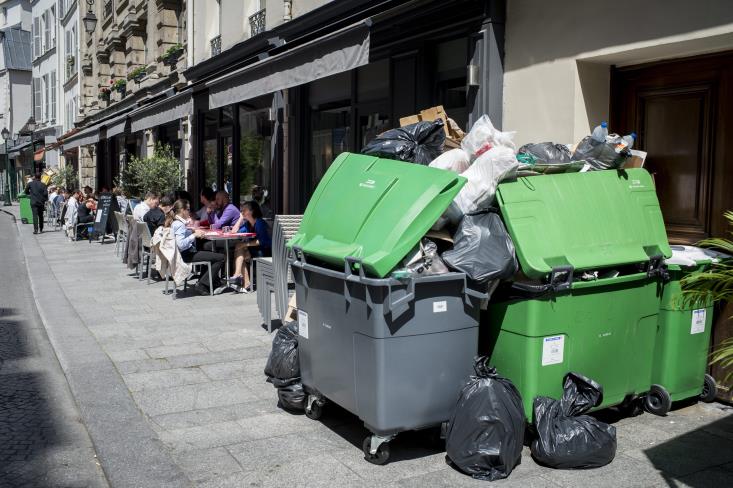

Cyprus` domestic waste amounts to approximately 40% of all the waste the country produces and although an EU obligation dictates that the waste must be recycled, the government has yet to bring to the Parliament a bill that will regulate the management of the waste island-wide and put an end to the issue of plastic bags.
The bill is expected to be tabled by the end of the year.
Environmental Commissioner Ioanna Panagiotou has told CNA in an interview that domestic or organic waste, in other words the waste that can be degraded in the environment, can be recycled at source, and this means it can be sorted at home and generate energy instead of being collected and transferred to landfills where it is buried.
Panagiotou said that Cyprus lacks an integrated strategy for sorting at source as well as the proper infrastructure.
“If there were a policy and people knew what to do with their household waste, then they would recycle it at source with all the benefits that this has mostly for the environment,” she told CNA.
Currently in Cyprus households and businesses recycle plastic, metal and tetrapak packages, as well as paper and glass. The recycle of batteries and electronic/electric devices is also quite popular in Cyprus, however a lot still needs to be done regarding the recycle of domestic waste.
Panagiotou said that some Municipalities have launched projects for the recycle of organic waste mainly from hotel units through EU co-financed programmes, however a comprehensive policy must be applied for the whole of Cyprus.
According to the Commissioner, the bill that is being prepared by the Department of the Environment of the Agriculture Ministry will solve all these issues.
“I understand that the Department is dealing with lots of other issues at the same time, they are also understaffed, but I believe that if we move a bit faster and become more flexible, we could solve this huge issue“, she told CNA.
Panagiotou said that the political will is there and that the Minister has recently reassured her office that the policy will soon be implemented, however she thinks that it is high time “we move from words to deeds.”
She also believes that people will quite easily learn how to sort their organic waste in the kitchen by just placing a separate bin.
The landfill units in the villages of Koshi in Nicosia and Pentakomo in Limassol are currently receiving the volumes of waste but there is a big question about the volumes of waste that Nicosia is producing. The waste management in Paphos district also needs to be adjusted, the Commissioner said.
She said that the unit in Koshi follows a compost method for the organic waste and creates good quality and poorer quality of compost. Part of it ends up at Vasiliko power station.
Asked whether it would have been better for Cyprus to set up small units to deal with the waste management and recycle instead of big factories, the Commissioner told CNA that one does not exclude the other. “We could apply a combined method. The fact that we have a big unit at Pentakomo for example does not exclude the possibility of establishing a smaller unit somewhere in the mountains for composting green and organic waste“, Panagiotou explained, adding however that the issue of economic viability is always on the table.
The Commissioner told CNA that collecting recycle materials from door to door should also be implemented for the countryside. She said that a single waste pricing policy should be applied throughout Cyprus.
Panagiotou agreed that incentives and motives should be given to both the consumers and business groups. She referred to the `pay as you throw` policy which was supposed to be implemented by some Municipalities where consumers pay according to the volume of their waste, thus giving them an incentive to recycle and decrease the volume of their waste.
“Another simple strategy that is being enforced abroad is to charge for each plastic bag of waste that the household is producing, this is a way to get people to think twice before they throw things away, to think whether they can recycle it etc“, the Commissioner said.
She said that economic difficulties are blocking the implementation of `pay as you throw` system, but there are other policies which Cyprus could implement.
Panagiotou said that vouchers could be given to consumers if they recycle and reward them with purchases from supermarkets or restaurants.
She also said that biogas companies should be given incentives in order to modernise their units and take in larger quantities of swine wastes for energy production.
“I strongly believe that if people are given incentives and if you educate them and raise awareness through campaigns, they will recycle and do what needs to be done to meet the goal for zero-waste policy or at least to decrease the volume of waste the island produces“, she said.
Today there are around a dozen such units operating in Cyprus.
Referring to the operation of green points where people can place material they no longer use, such as old furniture, television sets etc, Panagiotou said that what needs to be done is to implement a unified policy for the management of these points by the Municipalities.
“The point is not to just throw out whatever we do not need in these places, the management needs to have some kind of cooperation with recycle companies in order to collect these materials and recycle them, otherwise we will end up with cluttered spots all over and this is not the point“, she said.
She said that the EU is funding various projects for zero waste policy, however local authorities are a bit reluctant in applying because this requires a great amount of time to prepare the proposal and one cannot be sure if one will finally be granted the money.
The Commissioner said some Municipalities on the island have applied and have granted money in the past for such projects, however she believes that a state policy should be implemented island-wide which would solve the problems that appear.