
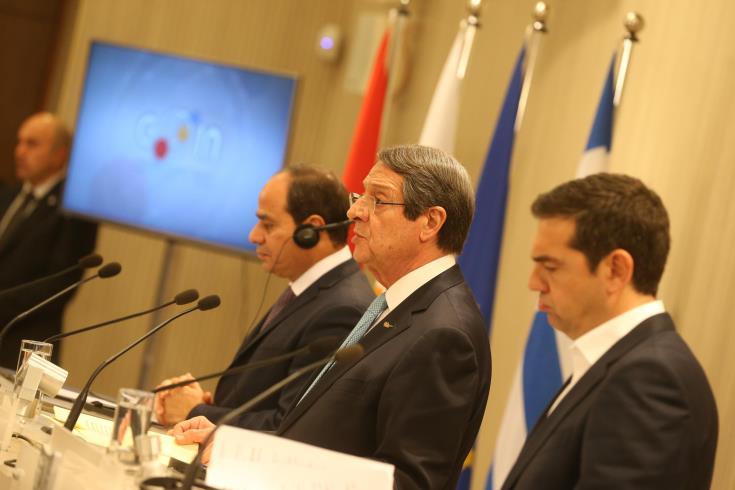

Heads of state and government of Cyprus, Greece and Egypt have adopted on Tuesday a Joint Declaration after the 5th Cyprus- Egypt-Greece, Trilateral Summit, expressing their firm commitment to further broaden and deepen their trilateral partnership in various fields of common interest, one of which is energy.
President of the Republic of Cyprus, Nicos Anastasiades, President of the Arab Republic of Egypt, Abdel Fattah al-Sisi and Prime Minister of the Hellenic Republic, Alexis Tsipras, who met in Nicosia, also expressed their firm commitment to enhance their efforts towards promoting peace, stability, security and prosperity in the Eastern Mediterranean, based on their common values and interests.
“At this Summit, it was agreed to enhance trilateral cooperation in the fields of Energy, Migration, Tourism, Environment, Protection of Cultural Heritage, Information and Communication Technology, Agriculture and the Diaspora, the Joint Declaration says.
The Heads of State and Government stressed the importance of the respect of the sovereignty, sovereign rights and jurisdiction each State has over its maritime zones in accordance with “international law, as reflected in the UN Convention on the Law of the Sea (UNCLOS) and expressed their desire to strengthen their cooperation through a series of agreements on the exploitation and transfer of natural gas, where the discovery of hydrocarbon reserves would serve as a catalyst for regional stability and prosperity.
They underlined that this cooperation is based on the well-established rules of international law. In this respect, they emphasized the universal character of the UNCLOS and stressed their commitment to proceed expeditiously with the negotiations on the delimitation of their common maritime boundaries as appropriate.
They called on Turkey to cease all illegal activities within the maritime zones of Cyprus and refrain from similar actions in the future.
The Heads of State and Government reaffirmed their unwavering support to the efforts of the Government of the Republic of Cyprus for a comprehensive settlement of the Cyprus problem that will reunify Cyprus in a viable, functional state in line with UN Security Council resolutions and international law.
They stressed that a comprehensive settlement must safeguard Cyprus’s independence and sovereignty, without outdated security arrangements which allow for the right of foreign military intervention and without foreign troops. They underlined that the United Nations remains the forum through which a settlement can be achieved under the Good Offices mission of the UN Secretary General.
In the Joint Declaration it is stated that they concurred that the guiding principles of the tripartite partnership are the respect of international law and of the purposes and principles enshrined in the Charter of the United Nations, including commitment to good neighbourly relations, international peace and security, respect for sovereignty, independence and territorial integrity of States.
Noting that the trilateral partnership serves as an exemplar for furthering dialogue and promoting the relations between the European Union (EU) countries and the countries of the region, it is stated that they reviewed the relationship between the EU and Egypt, highlighting the mutual benefit deriving from various areas of cooperation between the two sides.
The Heads of State and Government also reaffirmed their willingness to continue their excellent cooperation in the context of International Organizations and especially within the UN system, by also supporting each other’s candidatures in these fora.
They underlined the importance of preserving and protecting the cultural heritage of the Eastern Mediterranean and the Middle East in general, and emphasized their resolve to counter looting and illicit trafficking in cultural property including cultural property originating in armed conflict areas.
The Heads of State and Government were particularly pleased to inaugurate today the Cyprus Egypt Greece Collaborative Innovation Network (CEG COIN), headquartered in Egypt and branches in Cyprus and Greece respectively. The CEG COIN will serve as a platform to enhance collaboration, networking and business matchmaking of the innovation ecosystems of the three countries.
They expressed the intention to pursue joint actions in the following five priority areas: Preparedness and response to major marine pollution incidents in the Mediterranean; Combating coastal erosion and coastal zone management; Biological diversity and nature protection; Waste management; and Climate change adaptation.
The common challenges faced in the energy field, the need for diversification of energy resources and routes, the security of energy supply and the need to modernize and develop new energy infrastructures, enrich the prospects for further promoting trilateral energy cooperation.
In this context, aspects of cooperation especially in the areas of hydrocarbons, electricity and renewable energy sources were discussed.
To this end, they also encouraged and welcomed initiatives from the private sector of mutually beneficial energy infrastructure projects which contribute to the energy security of all three countries, such as the EuroAfrica Interconnector.
They welcomed the signing by the Ministers responsible for Tourism, of a Protocol aimed at promoting the development and strengthening of cooperation in the field of cruise tourism in the Eastern Mediterranean Sea
The Heads of State and Government agreed to further develop cooperation through the identification of specific initiatives involving the diaspora.
Also, the Heads of State and Government agreed to intensify efforts to tackle regional challenges, to fight terrorism in all its forms and manifestations, increase information sharing and promote regional security, long-term stability and prosperity. They expressed solidarity to the people and the Government of Egypt, who are suffering from acts of terrorism which seek to destabilize the country, and who are at the forefront of the efforts to fight terrorism both inside the country and in the region.
The Heads of State and Government agreed that, on the basis of the principles of solidarity and equitable burden-sharing, the effective management of large movements of refugees and migrants is the responsibility not only of neighbouring States and of Europe but also of the international community as a whole. To this end, initiatives should be undertaken to address the root causes
On the Palestinian issue, they called for a just, negotiated and lasting peace settlement entailing a two-state solution based on the relevant UN Security Council Resolutions.
On Syria, they expressed their commitment to the unity, sovereignty, territorial integrity and independence of the Syrian state. They reaffirmed their support to the UN Special Envoy Staffan de Mistura and to his efforts to convene the 8th round of the intra-Syrian talks in Geneva on 28 November.
On Libya, they welcomed the appointment of Ghassan Salamé as new Special Representative of the UN Secretary General, and, the “Action Plan for Libya” presented during a high-level meeting on 20 September 2017. They expressed their deep concern for the continued threat posed by terrorism in Libya, as well as smuggling and trafficking through Libya, and encouraged all Libyan parties to work constructively with SR Salamé.
On Iraq, they expressed support to the unity, sovereignty and territorial integrity of Iraq. ‘All outstanding issues should be resolved by Iraqis through peaceful and constructive dialogue within the provisions of the Iraqi constitution’ it is stated.
On Yemen, they expressed their concern with the escalation of violence and they expressed support for a peaceful and negotiated political solution, in accordance with the relevant UNSCR.
‘The Heads of State and Government encouraged by the positive results thus far and convinced by the strategic importance of the trilateral cooperation will continue to work closely on issues of mutual interests to the benefit of their peoples and of the peoples of the wider region’ the Joint Declaration says.
Finally, the three leaders welcomed the planting of a symbolic olive grove in Egypt involving 4500 olive seedlings originating from Cyprus, Egypt and Greece in equal numbers.
‘They acknowledged that the olive tree, as a symbol of peace and prosperity, best symbolizes the underlying principles of this tripartite cooperation’ the Joint Declaration concludes.