
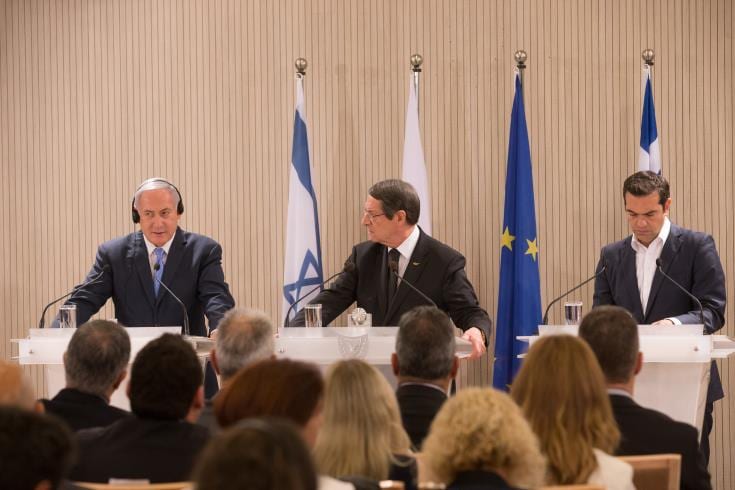

Cyprus, Greece and Israel forged closer ties, on Tuesday, in Nicosia, at their 4th trilateral summit in two years, in the context of which they expressed their commitment to go ahead with the preparation and signing within 2018 of an inter-state agreement on the construction of a natural gas pipeline connecting Israel, Cyprus, Greece, Italy and the rest of Europe, known as the EastMed.
In statements after the trilateral summit, in Nicosia, entitled “Building bridges between people”, the three leaders also referred to the Cyprus problem, the Middle Eastern peace process and the situation in Syria.
Addressing the press conference Cyprus President noted that “the mechanism we have established puts in practice our common vision for peace, stability and security in our turbulent region on a daily basis.”
He added that the trilateral cooperation framework has already gained international recognition.
President Anastasiades noted that the three countries have managed to create a credible framework of cooperation which is based on stable democratic principles and values “which gives us the ability to create bridges of communication not just between our governments, but also between our peoples.”
Referring to the agreements and memoranda of understanding signed today, he noted that they agreed to jointly move forward with the implementation of new projects and programmes, including in the areas of interconnectivity and communications, innovation, health, energy, entrepreneurship, research and technology, environmental protection, digital diplomacy, defence and combating terrorism.
On the EastMed natural gas pipeline, President Anastasiades said that promoting its implementation is a key ingredient of the cooperation between the three countries.
“We reiterated our commitment to work decisively aiming to sign a relevant inter-state agreement within 2018,” he stressed.
Referring to the Euro-Asia Interconnector, a sub-sea electricity cable connecting Israel, Cyprus and Greece, he said that “we reconfirmed our commitment in the next steps forward” and recognised its benefit in upgrading our countries’ role in this area.
At the same time, he expressed his satisfaction on the proposed connection of the three countries through fibre-optics in the context of the cable project.
The Cypriot President further noted that he briefed Tsipras and Netanyahu on recent developments on the Cyprus problem and the prospects of resumption of negotiations.
He stressed the readiness of the Greek Cypriot side at any moment to be involved once again in a new dialogue where it had left off in 2017 in Crans-Montana given that the goal is a common one, that is to say, for Cyprus to evolve to be a “normal state” as the UN Secretary General has described. He explained that this means a truly independent and sovereign state, ridden of third country dependencies, foreign guarantees and troops.
“In order for the dialogue to be creative and productive, Turkey should cease from taking any provocative steps or violations of the Republic of Cyprus’ sovereign rights,” he pointed out.
He conveyed the Cypriot people’s gratitude for the consistent and stable positions of principles shown by the Prime Ministers of Israel and Greece on the solution sought, as well as on their solidarity in relation with Turkish actions in the Republic of Cyprus’ EEZ.
Referring to the Middle East peace process President Anastasiades spoke of the need for the resumption of negotiations aiming to reach a viable and just solution which will recognise and guarantee the security of the state of Israel while also providing for the establishment of the state of Palestine.
In his address Benjamin Netanyahu spoke of a great alliance the three countries are building noting that “the sky is the limit.”
“I find these meetings not merely productive but also very encouraging,” he stressed, explaining that “they encourage us about the future.”
Because, he added, “you have to look only a few years back and is almost inconceivable that our countries did not have this warm, intimate and direct contact.” “We were in many ways isolated from each other and that is incredible,” he said.
According to Israel’s Prime Minister “we are three democracies of the Eastern Mediterranean, we have common interests, precisely because we have common values. We are committed to the same vision of how society should be organised, how freedoms should be nurtured, how pluralism should be protected and I think we can do it better than separately.”
“I know that we can do it better together and in fact we are doing exactly that,” he stressed.
He referred to the help all three countries have lent each other when they faced fires and to a Cypriot policeman who was wounded in the line of duty and is receiving emergency medical care in Israel.
“These are simple examples of something that it is very real; We are building a great alliance, an alliance for good among our thee democracies,” he stressed.
Referring to the EastMed pipeline Netanyahu said “it is a very serious endeavour,” pointing out that not only is it important for the three countries and Italy but also “for Europe that wants to diversify its energy sources.”
He also referred to the Euro Asia Interconnector electricity cable and the “information pipeline” that will be created through fibre-optics.
“There is a fourth pipeline; The human pipeline,” the Israeli Prime Minister said, adding that he is “talking about a quarter of million Israelis coming to your beautiful country.” Each time we meet the numbers grow, he said, adding that “all I want is reciprocity.”
He announced that the next summit would take place in Beersheba, Israel.
Greek Premier Alexis Tsipras spoke about the “strategic cooperation” among the three countries, adding that there is a common understanding on the need to deepen this cooperation, as well as on the need to find ways for a secure transportation of energy resources from the Southeastern Mediterranean to Europe.
The main topic of today’s meeting was the EastMed pipeline, Tsipras went on, adding that they also talked about the submarine electricity cable “EuroAsia Interconnector” and the project to instal fibre-optics for telecommunications.
This is a “top interconnectivity project between the three countries” as well as for the broader region and for Europe, the Greek Prime Minister underlined.
Another fact underlining the importance of today’s meeting is the fact that we agreed to sign an intergovernmental agreement the soonest possible, within 2018, he said.
Tsipras also expressed support to the efforts of President Anastasiades to reach a fair and viable Cyprus settlement, for the benefit of all Cypriot people. The settlement must be based on UN Security Council resolutions, be in line with Cyprus’ EU membership, and provide for the abolition of guarantees and the removal of Turkish troops, he added.
“We underlined that we support the resumption of talks, always on the basis of the parameters set by the UN Secretary-General” said Tsipras.
He also called on Turkey to respect the sovereign rights of neighbouring countries, in accordance with international law.
Speaking about the Middle East peace process, he said moreover that Athens supports the resumption of substantial negotiations for a viable two-state solution, securing peace both for Israelis and the Palestinians.
Both Tsipras and Netanyahu conveyed their condolences to President Anastasiades for the passing of his mother.
The three countries signed Memoranda of Understanding in the fields of space technologies, satellite operations and applications, telecommunications, information and communications technology, an implementation agreement on subregional marine oil pollution contingency plan and a memorandum of understanding between their chambers of industry and commerce.
In addition, Cyprus and Israel signed bilateral agreements of cooperation on public security and on film co-production while Greece and Israel signed an MoU on roaming telecommunication services.
Cyprus has been divided since 1974 when Turkey invaded and occupied its northern third. UN led talks to reunify the island under a federal roof have so far been unsuccessful, the latest been at a Conference on Cyprus in the Swiss resort of Crans – Montana which ended inconclusively in July 2017.