
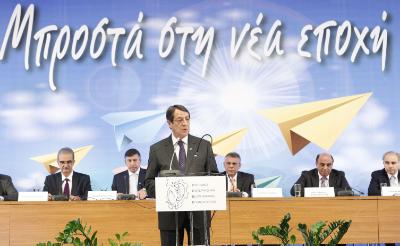

According to official projections, the economy will grow by 1.8% in 2016 and between 2% and 2,5% in 2017, President of Cyprus Nicos Anastasiades has said, expressing hope that “we will exceed these projections as well”.
Addressing the 88th Annual General Assembly of the Cyprus Chamber of Commerce and Industry (CCCI), in Nicosia, the President of Cyprus also said that he anticipated unemployment to drop significantly by that time.
Noting the developments that took place in the past two and a half years, following the deep economic crisis the country has gone through, the President said that “we managed to turn a page” while the economy, businesses and the people are able to look to the future with confidence.
We have proven that the political implementation of the adjustment programme, as well as all the other measures we took, have yielded results, and did not lead to a vicious circle of recession, he noted.
To the contrary, he went on, we followed a policy that allowed for a successful conclusion of the eighth review by the lenders and which, according to the President, will probably be the last.
He continued by saying that this policy has allowed Cyprus to partake in the ECB`s Quantitative Easing (QE) programme, from which it has drawn almost 180 mln euros.
The QE programme has also contributed to lower lending rates for the country, which are at a historical low.
This tendency will continue, the President has said, while noting his decisiveness to implement a steady and principled policy.
By managing its loan portfolio in a more effective manner, Cyprus has saved almost 200 mln euros in interest, in the year that passed. With these funds, he said, along with additional funds from the state budget or EU programmes, we have been able to announce a series of projects throughout Cyprus, aiming to revitalise the economy and improve the people`s quality of life.
The President stressed at the same time that he is fully aware of the big problems people continue to face. Unemployment is still high, but we managed to curb its frantic development that lasted over the past five years and stabilise it, with the trend now being downward, he added. As he noted, the current rate is similar to that of March 2013 or even lower.
Moreover, the President said that the economy continues to face the great burden of non performing loans (NPLs). He noted that now there are tools and legislation that will assist the process of restructuring loans is in place.
The President pledged that the government will continue to encourage a substantial restructuring of loans, and noted that economic recovery will also contribute towards decreasing NPLs. He said that this will be the context of a meeting he will have on Thursday with the leadership of the country`s systemic banks.
The economy continues to suffer from a series of structural problems, President Anastasiades said, and noted that development must be based on more stable grounds.
“We aim to change the whole framework that contributes to development,” he said, noting the efforts to make the country attractive for local and foreign investments.
The latter, he went on, are depending on a series of factors, such as a stable financial system, the tax system, competent human resources, the country`s geographic position, communications, living conditions and others.
Beside its advantages, the President said that Cyprus has also some problems that need to be identified and resolved. According to studies, he went on, these problems focus on the structural and institutional framework that leads to development, with Cyprus lagging behind in a series of important indexes concerning competitiveness and the ease of doing business.
The President spoke about the results recorded due to the implementation of government reforms, that have led Cyprus` ranking up by 13 positions as regards its business environment, according to an IMF report. The country ranks, moreover, among the ten countries with the greatest progress in attracting investment.
As the President said, the government nor celebrates, neither remains satisfied with this ranking. Cyprus, he said, can do and must do better. For this reason, he added, a number of serious structural reforms are due for implementation, in relation to the improvement of the country`s regulatory framework, the facilitation of investments and the initiation of an ambitious privatization programme.
According to the President, the initiatives that are being promoted are dealing with a series of weaknesses and distortions in the Cypriot economy, which have not been tackled for a long time. They contribute in improving our competitiveness, in cutting red tape and in improving the real economy, he added.
He spoke moreover about the contribution of the Cyprus Employers and Industrialists Federation (OEB), as well as of CCCI in formulating the National Policy Statement for Entrepreneurship, for the first time, in cooperation with the Ministry of Energy, Commerce, Industry and Tourism.
The aim, he went on, will be to facilitate business activity and strengthen the existing business environment, while the state budget, which is now being debated at the Parliament, will also contribute towards this direction.
Speaking on developments in Cyprus` exclusive economic zone, the President announced that there will be developments within the following days, that will encourage investment prospects in the field of energy and in related service areas.
We are in constant contact with the companies that are interested to invest in our country and in its energy potential, as well as with our neighboring countries, with which we are cooperating very closely, the President said.
On the efforts to reach a Cyprus settlement, President Anastasiades said that he and the Turkish Cypriot leader Mustafa Akinci are concluding in a few days a round of intensified talks, during which all aspects problem are being discussed. He expressed hope that he will soon have a more clear picture on the course of the negotiations.
“I remain cautiously optimistic – despite the difficulties – since I believe that there is at this point a good chance to solve our national problem” he underlined, while referring to the advantages of a settlement for both the Greek Cypriot and Turkish Cypriot communities.
Our goal, he noted, is to reach a settlement, acceptable to both communities, within the framework of EU principles and which will safeguard human rights.
Cyprus has been divided since 1974 when Turkey invaded and occupied its northern third. UN-led talks, aiming to reunite the island under a federal roof, resumed last May.