
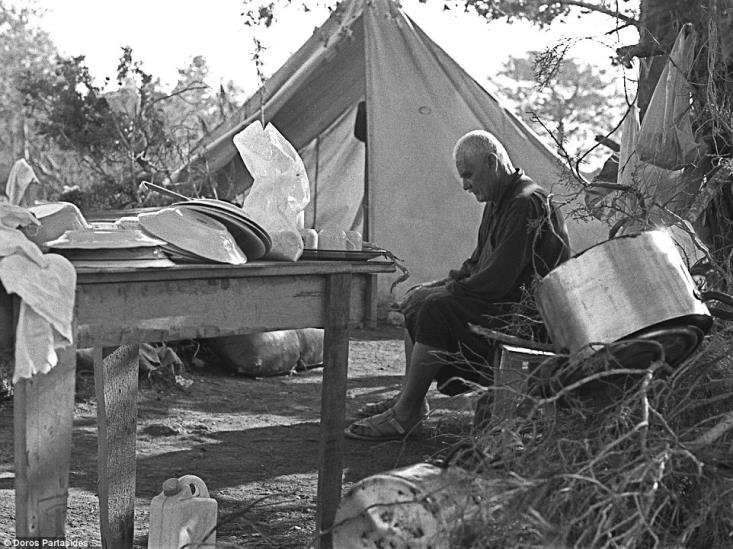

Forty-two years ago, on August 14 1974, the Turkish military launched a second offensive against the Republic of Cyprus, in full contravention of international law, including the UN Charter, and despite the fact that an agreement for a ceasefire was in place.
The Turkish army invaded Cyprus on July 20, 1974, and launched the second phase of the invasion on August 14 of the same year, occupying the best part of Mesaoria, Famagusta, Karpasia and Morphou.
Turkey continues to ignore calls by the international community relating to Cyprus and refuses to comply with UN calls to hand back the fenced off area of the town of Famagusta to its legitimate inhabitants. Dubbed a “ghost town”, Famagusta’s fenced off section – called Varosha – remains to this day deserted, abandoned to the elements.
Turkish troops invaded Cyprus on July 20, 1974, five days after the legal government of the late Archbishop Makarios III was toppled by a military coup, engineered by the military junta then ruling Greece. Two unproductive conferences in Geneva followed; the first between Britain, Greece and Turkey and the second with the additional attendance of Greek Cypriot and Turkish Cypriot representatives. Three weeks after the ceasefire of July 22, and despite the fact that talks were still being held and just as an agreement seemed about to be within reach, the Turkish army mounted a second full-scale offensive.
As a result, Turkey increased its hold to include the booming tourist resort of Famagusta on the eastern coast and the rich citrus-growing area of Morphou on the west.
All in all, almost 37% of the territory of the Republic of Cyprus came under Turkish military occupation. Nearly one third of the population, some 200,000 Greek Cypriots, were forcibly uprooted from their homes and properties, thousands were killed during the hostilities, over 1,000 persons were listed as missing while thousands of Greek Cypriots and Maronites remained enclaved.
Numerous UN resolutions have demanded respect to the independence, unity and territorial integrity of Cyprus, the return of the displaced to their homes, and the withdrawal of foreign troops from the island, but all resolutions have been ignored by Turkey.
UN-led talks between the leaders of the two communities, Cyprus President Nicos Anastasiades and Turkish Cypriot leader Mustafa Akinci resumed in May last year aiming to reunify the island under a federal roof.
The Republic of Cyprus is a full EU member state since May 2004. The Turkish occupied part of Cyprus is also considered EU territory, where the acquis communautaire is suspended until the solution of the Cyprus problem