
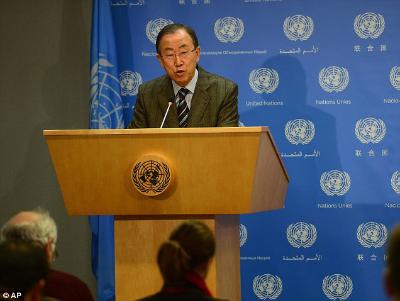

Cyprus has protested to the UN Secretary General the illegal water connection through a subsea water pipeline, between Turkey and the areas of the Republic occupied by Turkey since 1974 contrary to international law.
In a letter sent to Ban Ki-moon dated 8 March 2016, Permanent Representative of Cyprus to the United Nations Nicholas Emiliou expresses the strong protest of the Government to the completion of the illegal water connection, noting that this conduct constitutes yet another deliberate act of provocation by Turkey aiming at consolidating Turkish effective political and economic control over the occupied part of Cyprus and to bolster the military occupation of the northern part of the island.
Moreover, he notes, it is yet another internationally wrongful act which occurs during a critical phase of the negotiating process for the solution of the Cyprus problem. Through this act, he points out, Turkey attempts to reinforce its hold on the occupied territory of the Republic of Cyprus, not only by maintaining ownership of the infrastructure and the water that will be transferred to Cyprus, but also by dictating the terms of its management.
Emiliou adds that Turkey’s assertion that this is a development project which will benefit all of Cyprus is legally unfounded, misleading and false. No authorization has even been sought from or granted by the competent authorities of the Government of Cyprus, as is required under international law, including the United Nations Convention on the Law of the Sea (1982) and the applicable national legislation.
Laying of pipelines in Cyprus’s territorial waters, continental shelf and infrastructure works in the occupied territory of the Republic of Cyprus stands in blatant violation of the sovereignty and sovereign rights of the Republic of Cyprus, as well as of the human rights of the Greek Cypriot owners whose properties have been adversely affected by this project, he adds.
Turkey also stands in violation of basic principles of international humanitarian law. As the occupying power, Turkey is in breach of its obligations under articles 43 and 46 of the annex to the Fourth Hague Convention of 1907 (which has entered the realm of customary international law) to respect the laws of the Republic of Cyprus and private property.
Emiliou notes that it can be safely assumed that Turkey’s real aim is to cement the illegal division of the island and to strengthen the secessionist entity’s economic and political subordination to Turkey.
At this stage, he adds, it is necessary to focus on efforts towards an early solution of the Cyprus problem and the reunification of the island. Only in a reunified Cyprus will it be possible to formulate and implement a holistic strategy for development and to address a number of pressing issues, including adequate and sustainable water supply, away from foreign intervention, control or undue dependence.
My Government, he notes, “kindly requests your assistance in sending a strong message to Ankara, to the effect that the Republic of Turkey must comply with international law, respect the sovereignty of the Republic of Cyprus, and refrain from creating new faits accomplis on the ground, which jeopardize the peace process and potentially deepen the division of the island”.
Such actions, he concludes, especially when accompanied by provocative statements, not only complicate the negotiating process, but also undermine the much-needed trust between the two communities and the efforts to maintain a conducive climate at a very critical juncture.
CNA – Apostolis Zoupaniotis – New York 18/3/2016 20:40