
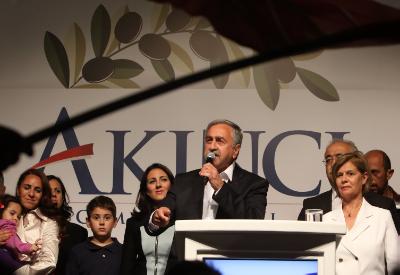

The victory of Mustafa Akinci in the elections of the Turkish Cypriot community on Sunday seems to have brought hope that we could finally move forward on the thorniest of issues plaguing Cyprus. The UN is gearing up for a concerted effort, and confidence-building efforts have been unilaterally announced by President Anastasiades.
After so much time that has been lost, any progress on mutual confidence-building measures would be a very good starting point. The aim of this article is not to discuss the existing proposals but to put forward an additional measure that would increase the commitment of all parties – not just those residing in Cyprus – to an ongoing peace process. It is a fact that the EU has been largely absent from the negotiations:
I have no idea who the EU special representative on the Cyprus issue is. Yet clearly the EU has much to gain from a stable and successful solution of the Cyprus problem. Cyprus could thus suggest to the EU to put “its money where its mouth is” and provide a road map for a possible debt write-off after a settlement – to match what can be expected from Turkey.
Kibris newspaper reported that debt to Turkey in 2014 was TL 7.5 billion, while there was TL 4.5 billion of internal debt. As there is no real market for financial instruments it can be assumed a significant proportion comprises social security liabilities. Thus, debt liabilities are around 150% of GDP – far above the limit the IMF considers as repayable.
It was always expected that Turkey would write off all or part of the debt of the Turkish Cypriot community. This could become a firm commitment even prior to the conclusion of the negotiations.
However, the Republic of Cyprus also has serious debt issues. In 2014, the debt/GDP ratio was 108%, which is very high.
Current debt burden would be an obstacle As the largest economy, it is likely to take the burden of rebuilding, at least at the beginning of a solution. Yet its current debt burden would prevent it from being able to take on that weight.
It would be wise to begin a conversation with our largest international creditors (the EU members through the European Support Mechanism (ESM), Russia and the International Monetary Fund (IMF)).
After all, writing off debt is easier for our creditors than donating new funds to the new unified state. Moreover, there are international precedents, such as the substantial debt write-off of Iraq after the toppling of Saddam Hussein.
International creditors must understand that a commitment to reducing our debt in the event of a solution would greatly help as a confidence-building measure, as it will ensure that the new state will not collapse under the weight of past debts.
Investment and taxation treaties Another confidence-building measure is to ask the Turkish Cypriot community to begin discussions with Turkey on drafting double taxation and bilateral investment treaties.
An open discussion of these issues is important. First, Limassol is already a centre for ship management and foreign companies, and a pre-commitment of a double taxation treaty and bilateral investment treaty with Turkey would make the economic benefit of a solution to Limassol more obvious.
Secondly, it makes the benefit of a solution clear to Turkish businesses that might want to use the advantages of location that Cyprus can offer, and thus lobby the Turkish parliament to be a less negative force in the Cyprus negotiations.
None of the above should replace the efforts of a comprehensive settlement, where the needs of the population in terms of security and justice should be addressed.
Cyprus Weekly
But sorting out the economic aspects of the solution in advance can help to get the international actors actively thinking about how they can support a settlement of our longstanding problem.