
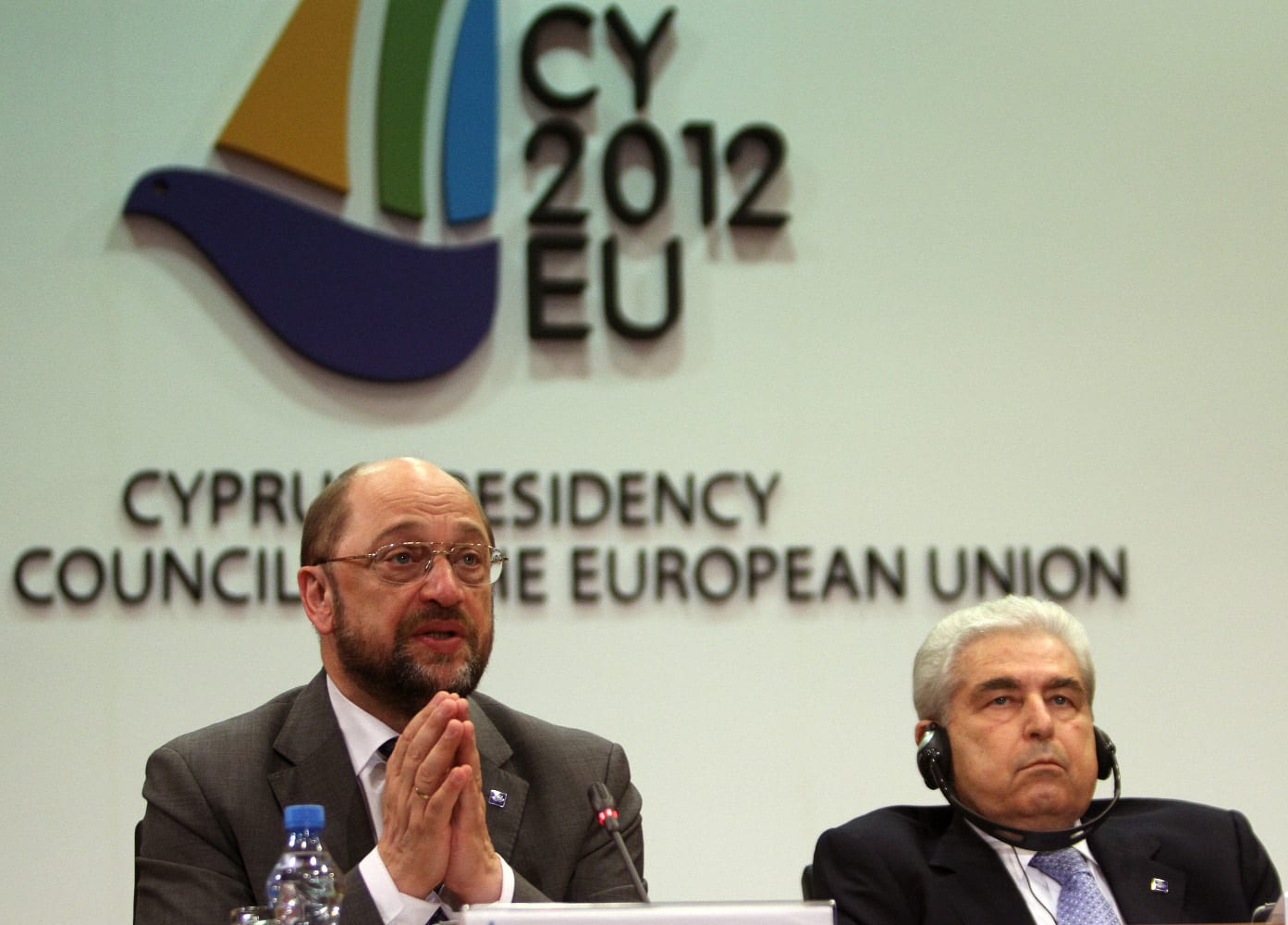

The Cyprus Presidency will attempt to contribute to the greatest possible extent and within its competence to achieving a Better Europe for the benefit of the citizens of Europe, President of the Republic and President of the Council of the EU Demetris Christofias has said.
Addressing the plenary of the European Parliament on the priorities of the Cyprus presidency of the Council of the EU, in Strasbourg, President Christofias said that “Cyprus assumes the six-month Council Presidency for the first time since its European Union accession, during a very difficult period for our Union”.
“Undoubtedly, the challenges our Union faces require a decisive and firm European response. In such times of crisis, such as the present, it is even more imperative to achieve greater solidarity and a more effective Union; to achieve a Better Europe”, he added.
He noted that “we shall work tirelessly this semester to promote, within the Council and to the extent of our competences, any legislative initiative that will contribute to achieve social solidarity and effectiveness in the Union. Towards a Union with far more visible benefits for the welfare of European citizens”.
“It is true”, he continued, “that the European Union has gone through many crises since its establishment. It seems though that the ongoing socio-economic crisis, largely deriving from the global economic crisis, is the greatest challenge that the European Union has ever faced”.
As he explained, “this is because the Union’s prosperity and social cohesion have been significantly threatened. Furthermore, cracks in the institutional unity of the Union have been observed due to the disparate approaches as regards the necessary steps taken as an urgent priority to stabilize the situation”.
President Christofias said that he is convinced that the European Union “will successfully overcome today’s difficulties. The European Union has no choice but to emerge stronger from the current crisis. A crisis that unfortunately seems to undermine the confidence of the citizens of Europe in our institutions”.
He also expressed his belief that “for a successful cure of the problems caused by the crisis, its root causes must be properly diagnosed. The substance and the scope of the socio-economic crisis must be analysed jointly”.
The President expressed the opinion that “we should have the courage to self-criticize at the national and the European level, regarding the possible political inertia or the weaknesses of European policies mostly of the past two decades”.
“It can hardly be denied that the policies of the previous years, projecting an absolute and dogmatic adherence to the free market model without any social and state control, have failed”, he added.
In any event, he continued, “we should not allow our societies to be at the mercy of markets and the interests that manipulate them. The measures taken in recent years have proven ineffective, because the analysis of the crisis was based on earlier policies, which put the blame only on speculators and sometimes on markets”.
He noted that “the strict austerity policies implemented to address the crisis, not only have been incapable of resolving the problems, but have increased them. The austerity-only policies drain the state`s welfare and limit growth”.
“The economy and sustainable development should serve society. The resulting wealth should be shared more equitably. The chosen approach cannot be ‘socializing losses and privatizing profits.’ We cannot through our policies put the weight of the current crisis on the shoulders of those who barely earn a living”, he added.
The Cyprus President stressed that “ordinary citizens of European Union member states are the last to blame for the inherent weaknesses of the Economic and Monetary Union. In any event, we have a moral and political obligation to apportion the burden of the crisis equitably and, most certainly, protect the financially and socially vulnerable groups”.
He invited the President of the European Commission “to work together in finding ways to expand and strengthen the Most Deprived Persons Programme through the use of public intervention stocks of agricultural products”.
“I will be the happiest person in Europe if, by the end of the Cyprus Presidency, tangible results from this programme are produced, or if we adopt measures with an equivalent effect – based on legislative initiatives of the Commission – thereby reducing this important social problem as much as possible”, he added.
He expressed the view that “the most important points are the fairer redistribution of wealth, a more consistent and humanistic social policy that combined with the support of small and medium-sized enterprises – the backbone of the European economy – will lead to employment growth and to the much-discussed social cohesion within our Union”.
Undoubtedly, he added, “especially during this past year, due to the contribution of all, particularly that of the European Commission, actions have been promoted that will accelerate structural reforms and will create better conditions for competitiveness and growth for the European economy and especially for SMEs.
“We expect that these actions will increase employment, primarily for young people, and lead to a greener economy”, he said, adding that “all of these are complementary measures to those primarily taken to stabilize the debt crisis”.
He said that “we agreed through consensus – to the greatest possible extent under these circumstances – on a fiscal pact that admittedly establishes a strong structure of governance in the Eurozone”.
Furthermore, he said, “we have managed to build a strong protective wall to support Member States facing the most intense financial pressures. The challenge is to complement the fiscal discipline approach, since it is certainly important to cut waste and get public finances back on track, with a strong strategy for growth and job creation in Europe”.
“As Presidency of the Council, we look forward to fully cooperating with you, honorable members of Parliament, so that in cooperation with the European Commission we can promote measures aiming at reducing the social pressures in most countries of our Union, which unfortunately mostly affect the young, our children, the future of our Europe”, he added.
President Christofias went on to present the four key priorities set by the Cyprus Presidency.
On the first priority entitled “Europe, more efficient and sustainable”, he noted that the Cyprus Presidency “will place emphasis on the Multiannual Financial Framework (2014-2020), with the aim to support the finalization of the negotiations and the completion of a fair and effective European Union budget that will lead to growth and enhance employment opportunities”.
The Presidency, he said, “will seek to achieve progress in the negotiations on the legislative framework regarding the common policies of the programming period, such as the Common Agricultural and Fisheries Policies, the Cohesion Policy and the Research and Innovation Policy”.
“Energy policy, the Connecting Europe Facility, and the Trans-European Networks on transport, telecommunications and energy are high on the agenda of the Cyprus Presidency, as they will contribute to further integration and will boost the competitiveness as well as further integration of the European Union”, he added.
During the Cyprus Presidency, he said, “emphasis will also be placed on sustainable development based on the need of an integrated approach on climate change, environment and energy. Special emphasis will also be placed on reviving the Integrated Maritime Policy”.
On the second priority entitled “Europe, with a better performing and growth-based economy”, President said that “the economic crisis has highlighted the need for further effectiveness of policies of the Union”, adding that “The Presidency will focus on the monitoring of the implementation of the Europe 2020 Strategy”.
Furthermore, as he said, “it is of utmost significance to the Cyprus Presidency that economic growth and employment opportunities are strengthened”.
On the third priority entitled “Europe, more relevant to its citizens, with solidarity and social cohesion”, he said that “one of the important objectives of the Cyprus Presidency is the strengthened participation of social partners, local authorities and NGOs in the formulation and implementation of the “Europe 2020 Strategy”, especially as regards employment and combating poverty and social exclusion”.
“Our intention is to utilize best practices at the national and European level and map out the involvement of civil society during the European semester. Social cohesion is an important aspect of the Europe 2020 Strategy and a vital objective in our efforts to effectively emerge from the crisis, especially as regards the segments of the population facing poverty and social exclusion”, he added.
The President stressed that “one of the most important objectives of the Presidency is the establishment of the Common European Asylum System by the end of 2012, in order to strengthen cooperation between member states in protecting the rights of those in need of international protection”.
On the fourth Priority entitled “Europe in the world, closer to its neighbours”, President said that the Cyprus Presidency “will work closely with the High Representative of the Union for Foreign Affairs and Security Policy and the European External Action Service.”
“Within this framework, and under the major political upheavals taking place on the Southern Mediterranean coast, we believe that special attention should be paid to the Southern Dimension of European Neighbourhood Policy, enhancing the Union`s relations with the countries of the Mediterranean”, he added.
For me at least, he continued, “it is evident that our Arab neighbours in the south, who have gained their freedom and are seeking Democracy and the Rule of Law, should themselves decide on their own system of government, in a free and inclusive process”, expressing at the same time the opinion that “any attempt by Europe to impose its own model of democracy on these peoples, is a strategic mistake”.
In conclusion, President referred to the situation in Cyprus and stressed that the country “faces an additional challenge due to the problems of the anachronistic division, as a result of the ongoing Turkish occupation of the northern part of the island”.
However, he assured that “we will spare no effort and will not allow any problems that the occupying power may create from derailing us from exercising an entirely European Presidency”.
Cyprus has been divided since 1974, when Turkish troops invaded and occupied its northern third. A new round of peace talks started on September 2008 to find a negotiated settlement that will reunify the country, under a federal roof.
Turkey, a candidate country for EU accession, does not recognise the Republic of Cyprus and has said it would not talk to Nicosia during its EU presidency.