
In 1816, with his creditors circling, Lord Elgin sold the Marbles to the British Parliament for £35,000, who then placed them in the care of the British Museum.
Talks between the British Museum and the Greek authorities continue towards the reunification of these sculptures in the Acropolis Museum, where their other surviving halves are visited by over 1.6 million visitors per year.
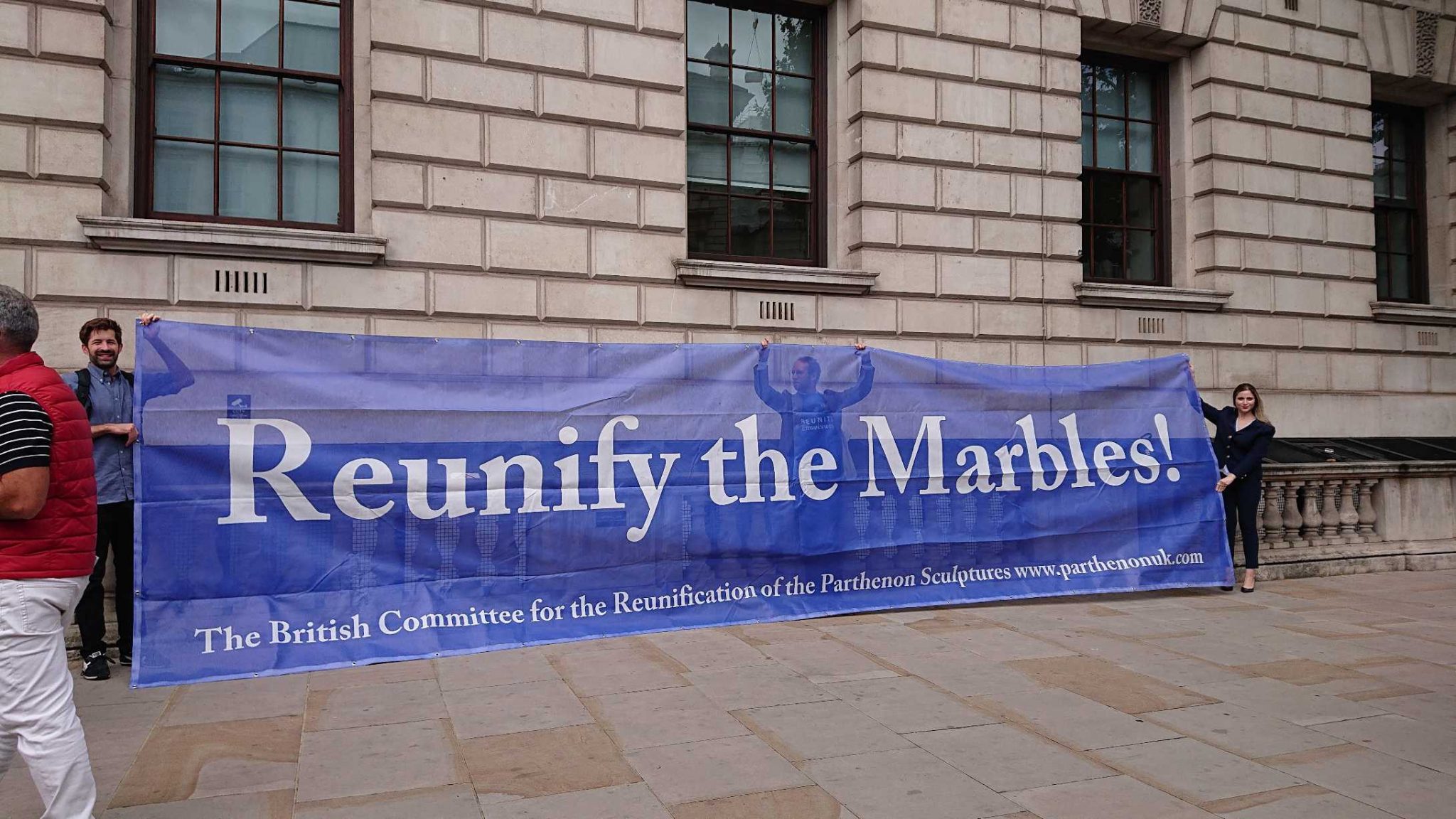
Members of the Greek Community and the British Committee for the Reunification of the Parthenon Marbles (BCRPM) have crowdfunded £35,000 with which to symbolically repay the UK Government the funds used to save the Marbles.
With Rishi Sunak reversing previous government policy that any question of return is one for the trustees of the British Museum, efforts to persuade the government to stand aside are considered central to the future of the Marbles.
“This is about recognising and celebrating the important role the UK played in protecting these peerless works of art, while underscoring that the time has now come for them to be reunified at the foot of the monument they were so wrongly taken from.
“Other countries and other museums around the world are returning their fragments, the British Museum is to be applauded for working towards a solution and now it is time for our government to get out of the way. We hope they will reconsider their position, accept this gift, and stand proud of the role the UK has played.” – George Gabriel, Member of the BCRPM
“Rishi Sunak pointed to the important role the UK played in preserving the portion of the Marbles that were so appallingly hacked off the Parthenon by Elgin. As members of the Greek community we want to recognise the UK’s contribution, while persisting in the clear and reasonable insistence that the time has come for the Marbles to be reunified in Athens.
“This small financial contribution is our way of showing our expressing thanks to the UK. It’s disappointing that DCMS have refused to accept this gift, indeed the refusal could be seen as bringing into question the government’s good faith regarding the Marbles.” – Avgoustinos Galiassos, Member of the BCRPM
Alongside this effort to repay parliament the BCRPM has released the findings of a range of Freedom of Information Requests shedding new light on the Museum & the Marbles:
The British Museum holds 108,184 Greek artifacts
Only 6,493 these artifacts are even on display
Of 3,382,000 searches made in the Museum online archive between April 2020 and January 2022 only 1,936 were made for the “Parthenon Sculptures” with 10,648 mentioning the word “Parthenon”
The British Museum’s Chair, George Osborne’s enthusiasm for a “Parthenon Partnership” is likely part of a new wider strategic direction among Trustees given in recruiting a new Chair they explicitly asked, “What are your views on restitution and the provenance of the BM’s collection”
George Gabriel said “Worries that reunification would somehow “empty” the British Museum seem somewhat overblown when one considers the 100,000 artifacts held that are not even on display. The Greek authorities have long maintained that in the event of reunification they would even send additional treasures to London that have never been exhibited outside of Greece. It’s time for the government to get out of the way and for this incredible work of art to be reunified.”
Avgoustinos Galiassos said, “the British Museum does not keep records of just how many people visit the galleries containing the Parthenon Sculptures at present, but if use of their digital collection is anything to go by, the claimed centrality of the Sculptures to the Museum’s collection seems a little overstated. It’s time to reunite them in the one Museum in the world dedicated solely to the cause, the Acropolis Museum in Athens.”
On 18 June, and to mark the 14th anniversary of the Acropolis Museum, BCRPM organised for a 212-year-old poem denouncing Lord Elgin for stripping the Parthenon to be read for the first time in the British Museum’s Room 18.
The Curse of Minerva, written in 1811 by the philhellene Romantic poet Lord Byron, was read in the Parthenon Galleries of the British Museum, Room 18, by acclaimed actors Bill Nighy and Simon Callow CBE; Baroness Joan Bakewell, Stockard Channing, Anna Savva, and Janet Suzman DBE, Chair of the BCRPM. Alexi-Kaye-Campbell, playwright and member of the Committee, was the MC for this year’s event.
On Tuesday 1st August at 11:30am, members of BCRPM visited the Department of Culture, Media & Sport to donate the funds raised, with thanks. DCMS have refused the donation, but BCRPM has given them a further seven days in which to reconsider.
DCMS refuses £35,000 donation to “repay” money used to purchase Parthenon Marbles by the UK parliament
