
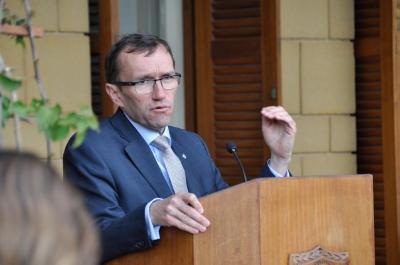

UN Secretary General`s Special Adviser on Cyprus, Espen Barth Eide, has said that Cyprus talks are now entering a more intensified period.
In statements after a meeting he had on Tuesday with Cyprus President, Nicos Anastasiades, Eide noted that “we will have a phase which is critical and which at times will be difficult, because there are still a number of bridges to cross, still a number of issues that are outstanding.”
He recalled that in their joint statement, some weeks ago, the two leaders said they would intensify the talks from now on, noting that “we lost some time but tomorrow`s meeting is very much to start with a more intensified period.”
“And we got the reconfirmation of the dedication to do so in this meeting today and I think that`s the right thing to do, because if the leaders are supposed to actually achieve their stated goal of doing their best to achieve a solution in the course of 2016, we all need to know that there is a lot of work to do,” the UN diplomat said.
He added that “the idea is to use tomorrow to structure this more intense phase, to start by agreeing on exactly where we are”, noting that they will try to have “a joint catalogue of achievements, where we are close, and where we have some way to go, and to take stock of this and then, based on that, have a structured approach, with a slightly different format from the one we have”. He went on to say that the exact details of that will be announced by the leaders themselves when they have met.
Furthermore the UN diplomat noted that he has a strong sense that Anastasiades is deeply and seriously committed to make this work. Noting that he would also have a meeting on Tuesday with Turkish Cypriot leader Mustafa Akinci, Eide said that despite surrounding circumstances and difficulties the two leaders` dedication is there.
Asked if the leaders need to take a more active role from this stage one, Eide said that he does think so. “I think in this phase the leaders have to bring the negotiations even closer to them,” he added.
Invited to say if there is a discrepancy between the United Nations and the two sides about where the talks are, Eide said he read about this in the press, but does not recognise it himself. To a remark that the Government Spokesman, Nikos Christodoulides, has said that they should all be on the same page, Eide said that he agrees with him that they should be on the same page.
The UN diplomat went on to say that “we have changed the paradigm of the talks to something which is much more European, much more federal, and in many ways very different from the Annan plan, I think to the better from both communities.”
“We have made progress on many chapters, particularly the four primary chapters that have been discussed so far, but there is a lot of outstanding work to do, which is why I said that in order for the leaders to achieve their goal of a solution this year, hard work, and dedication, and commitment, and recognition of at times difficult questions, has to be there,” he added.
Eide also noted that in July he will inform the Security Council about the state of affairs at the negotiations, adding that “I will work closely with the sides in order to make sure that we have shared understanding of where we are.”
Asked about what happened in Constantinople, on the sidelines of the World Humanitarian Summit, Eide said that this was clarified in the conversation that the UN Secretary General Ban Ki moon had with Anastasiades, recalling that a readout was issued by the UN on this issue. “I don`t think that we get anywhere by continuing that discussion,” he added, noting that “what I know is that there is a mutual agreement to let bygones be bygones and to work systematically from now on achieving the main goal, which is to find a solution to the Cyprus problem.”
Last month, Turkish President Recep Tayyip Erdogan invited the Turkish Cypriot leader to attend a dinner Erdogan hosted for the heads of state and government who participated in the World Humanitarian Summit held in Constantinople, something which led Nicosia to react, as Cyprus President Nicos Anastasiades decided not to attend the dinner. During his stay in Constantinople Akinci also had a meeting with UN Secretary General Ban Ki-moon, in the presence of the latter`s Special Adviser on Cyprus, Espen Barth Eide, something which also caused Nicosia`s reactions.
Cyprus has been divided since 1974, when Turkish troops invaded and occupied 37% of its territory. UN-led talks between Anastasiades and Akinci began in May last year, with a view to reunite the island under a federal roof.