
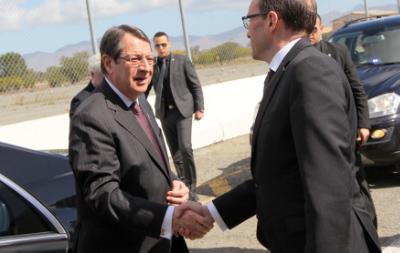

UN Secretary General`s Special Adviser on Cyprus, Espen Barth Eide, has said he has been worried by recent developments in Turkey, noting at the same time that there is no sign of any change to the Turkish government`s position as regards the undergoing efforts to solve the Cyprus problem.
“We have all been rather concerned about the recent developments in Turkey, the failed attempted military coup,” Eide said after a meeting on Thursday with Cyprus President, Nicos Anastasiades.
He said he discussed the events in Turkey with Anastasiades and will do so during his meeting with the Turkish Cypriot leader Mustafa Akinci, in the afternoon. I think there is a shared understanding that this is yet another example of the international environment not always developing in a favourable mood, Eide noted.
In my view, he added, “it makes it even more important to solve all the issues that can be solved by Cypriots on the island, in order to get a solid internationally supported settlement that can provide for a united federal state, that can be safe sound, also in view of developments in this neighbourhood.”
Responding to a question, Eide said that since he came to the island he has been saying that “if a crisis would occur in this round of negotiations, it would not happen inside the talks, because despite the recognised differences, the mood between Mr. Akinci and Mr. Anastasiades is a problem-solving mood and they do have a shared vision of a genuine European modern federation.”
Eide noted that the international circumstances matter, adding that “what we can all do is to reduce the influence of external circumstance.”
I would not be honest if I didn`t say that I have been worried over the last days, the UN diplomat added. He went on to say that it was clearly beneficial not only for the Cyprus problem that the outcome was that a united political class in Turkey rejected the coup, so “things are better that they could have been.”
“We need to follow this closely as it develops. I will do that, my team will do that and I know that both Anastasiades and Akinci will do that,” Eide said, noting that he sees no sign of less commitment by the two leaders.
Asked if he foresees that the situation in Turkey will create problems in the negotiations, Eide noted that “it hasn`t done yet.”
“I mean there is no sign as of right now that there is any change in the Turkish government`s position which is consistently supportive of the talks,” he added, noting that “there`s been a number of second channel conversations going on” which suggest this sustained position.
“As of now I don`t think we have any evidence that it will change the position of Turkey or any other guarantor on trying to support a settlement,” the UN diplomat noted.
Eide also said that “a united Security Council actually wants Cyprus to be solved. They want it off the table. It creates more problems for others than it solves,” he added, noting that on Monday he will be in New York together will the UNSG`s Special Representative in Cyprus, Elizabeth Spehar, to brief the UN Security Council.
Eide noted that he had a very constructive and thorough meeting with Anastasiades, adding that “we are now in the middle of the six meetings in July.”
“The fourth one is tomorrow and then we have two next week. And when we come to the 29th of July, which is next Friday, we can say that the leaders now for the first time have had a strategic discussion about all issues. At that time I think it is appropriate to make an assessment where we really stand for a solution,” he added.
He noted “both sides have been frank and open about their disagreements” and have also “come with a clear, demonstrated and sustained will to overcome them and real progress has been made.”
“I am content with the format, but the format also illustrates that not only do we have known outstanding issues but as we solve issues we also see new things that may look like details but need more thorough exploration,” Eide said.
Cyprus has been divided since 1974, when Turkish troops invaded and occupied 37% of its territory. Anastasiades and Akinci have been engaged in UN-led talks since May last year, with a view to reunite Cyprus under a federal roof.