

The potential for new hydrocarbons findings in Cyprus’ Exclusive Economic Zone, the challenges to the shipping industry and the country’s efforts to create regional interconnections and energy markets, were pointed out by officials at the Cyprus Energy, Oil and Gas Conference in the southern coastal town of Limassol.
Chief Executive Officer, Cyprus Hydrocarbons Company Panos Kelamis, said he was sure that the active exploration program already in place in Cyprus’ EEZ by operators of the type of ExxonMobil , ENI and Total will lead to more hydrocarbons discoveries and perhaps to a new geological place in the region.
Sharing his thoughts on block 11 results, he said that these results are very exciting from an exploration point of view and open new opportunities in the Cyprus EEZ. As he said, Total drilled the first Zohr carbonate type well in the Cypriot Exclusive Economic Zone and the drilling encountered a Zohr type petroleum system as it was expected. He added that it is also fact that gas was found, but not the quantities to make it commercial.
At the same time, he said that you cannot make any prediction in drillings because geology changes from one meter to the next.
Speaking about negotiations of the 3rd licensing round, he said that they happened in a record time and noted that it is not easy to conclude negotiations related to oil and gas. He added that CHC achieved successful conclusion of the negotiations within 2 weeks, including three series of technical exchange between ExxonMobil Qatar, ENI and Total.
He said that the next step is the establishment of a main state body known as a National Oil Company with main activities the reservoir definition, the reservoir engineering and the reservoir monetization.
Speaking about the creation in Cyprus of many academic programmes related to oil and gas, he said he was cautious about these programs and he argued for the building of knowledge in terms of the main competencies required in the business which is physics, mathematics, geology.
“Instead of creating bachelor programs related to oil and gas and create generalists and down the road I am afraid an army of young unemployed, I would prefer to invest knowledge in these three disciplines, physics, mathematics, geology”, he said.
Director of Hydrocarbons Service Stelios Nicolaides said that Cyprus can contribute towards the transformation of the Eastern Mediterranean region into an area of sustainable and balance economic development by enhancing political stability and improving bilateral relations, building on synergies emerging from the exploitation of hydrocarbons in the region.
As he said, the government’s vision is to develop the “East-MED Corridor”, which will comprise different infrastructure projects that will materialize this vision.
“We consider the “East Med Pipeline”, the gas pipeline from offshore Israel and Cyprus to mainland Greece via Crete and then to Italy, a cross-border gas interconnection with a strategic importance for the EU and its Member States, as it will have benefits on its economy, on market integration, security of energy supply, sustainability and competition”, he said.
He added that he pre-Feed results have proved that the pipeline is technically feasible and commercially viable.
The Government of Cyprus, he noted, is making enormous efforts to complete its legal framework and introduce fast-track licensing for these cross-border energy investments in order to allow the development of regional interconnections and the creation of a regional energy markets.
He referred to the Ministerial Quadrilateral meeting to be hosted in Cyprus in early December for signing a Memorandum of Understanding for this important infrastructure project.
He also said that, the “Onesiphoros West 1” well is considered to be extremely important as it confirms the existence of a petroleum system and a carbonate reservoir within Cyprus’ EEZ, rather similar to Egypt’s giant Zohr field.
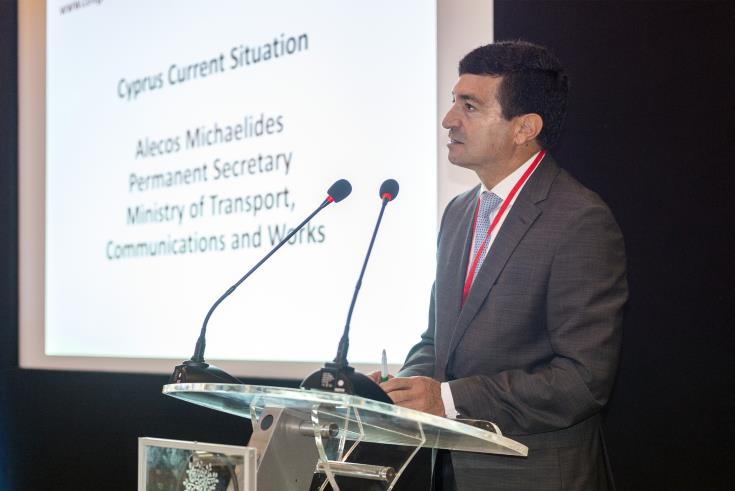
Cyprus can develop into an important Energy Centre in the Mediterranean, while new and vibrant shipping and energy projects can be launched, said Permanent Secretary of the Ministry of Transport, Communications and Works Alecos Michaelides addressing the Conference.
He said that the policy that the Cyprus Government will implement will include Cyprus’ future maritime transport needs for hydrocarbons.
As he noted the discovery of hydrocarbons creates new challenges to Cyprus’ shipping industry, a whole new industry will be created in Cyprus to meet the needs of the offshore activities.
He also said that many Cyprus-based shipping companies are very keen to be involved in the industry and some of the have already taken this step by broadening their services and activities. It is also anticipated, he added, that foreign shipping companies will relocate their offices and operations in the island in order to explore the benefits of the emerging East Mediterranean offshore market.
“The discovery of hydrocarbons places new challenges to our shipping industry. Offshore exploration and production of gas and oil, as well as their transportation ashore require the operation of specialised ships and equipment and the supply of specialised supporting services” he said.