
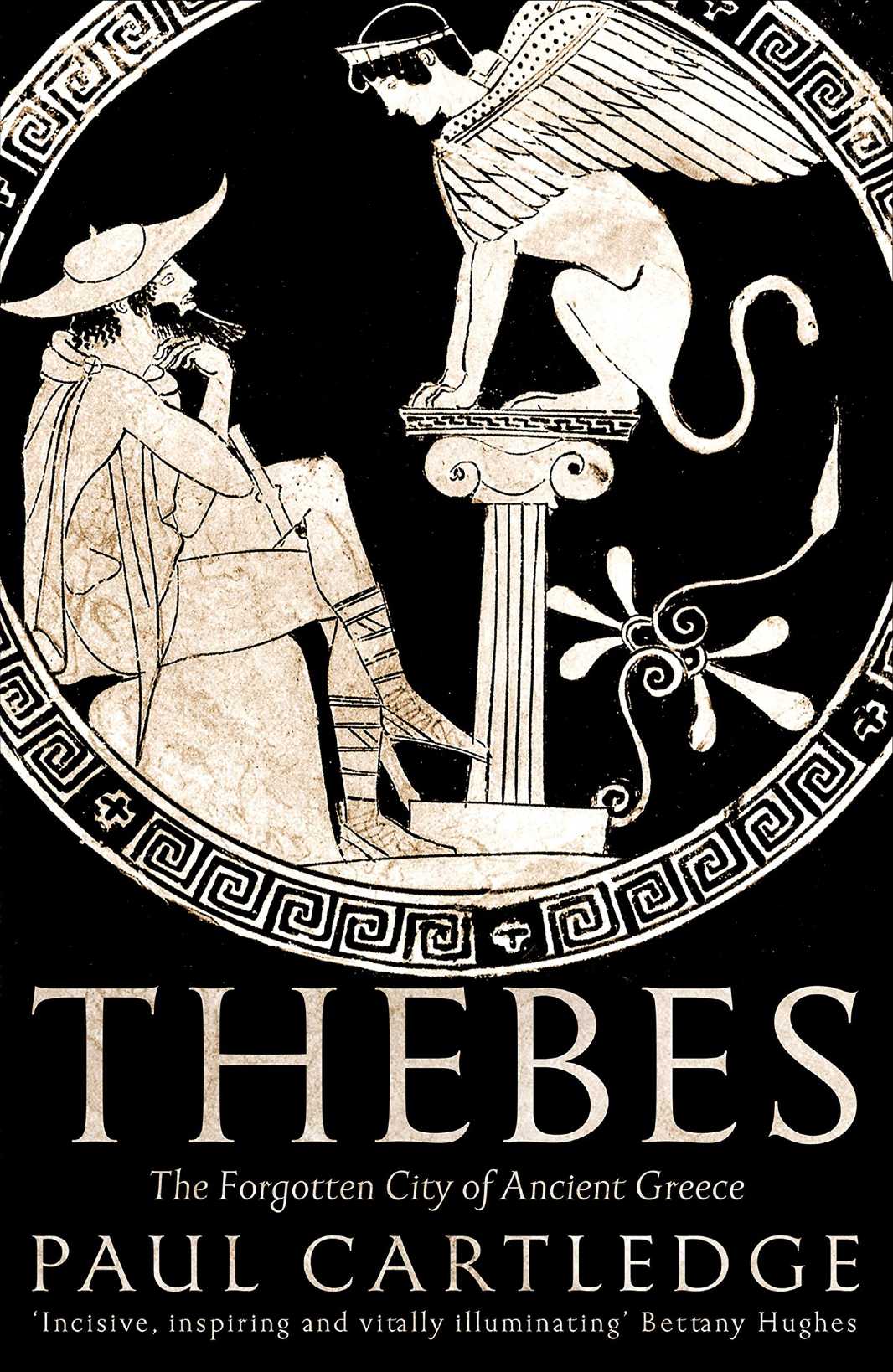

Thebes: The Forgotten City of Ancient Greece
Continuously inhabited for five millennia, and at one point the most powerful city in Ancient Greece; its better-known rivals, Athens and Sparta, have overshadowed Thebes.
According to myth, the city was founded when Kadmos sowed dragon’s teeth into the ground and warriors sprang forth, ready not only to build the fledgling city but also to defend it from all-comers. It was Hercules’ birthplace and the home of the Sphinx, whose riddle Oedipus solved, winning the Theban crown and the king’s widow in marriage, little knowing that the widow was his mother, Jocasta.
The city’s history is every bit as rich as its mythic origins, from siding with the Persian invaders when their emperor, Xerxes, set out to conquer Aegean Greece, to siding with Sparta – like Thebes an oligarchy – to defeat Pericles’ democratic Athens, to being utterly destroyed on the orders of Alexander the Great.
In Thebes: The Forgotten City of Ancient Greece, the acclaimed classical historian Paul Cartledge brings the city vividly to life, and argues that it is central to our understanding of the ancient Greeks’ achievements – whether politically or culturally – and thus to our own culture and civilization.
Oedipus and the Riddle of the Sphinx
Oedipus, in Greek mythology, the king of Thebes who unwittingly killed his father and married his mother. The son of Laius and Jocasta, King and Queen of Thebes, Oedipus is the unfortunate main protagonist of one of the best-known of all legends in ancient Greek mythology.
Left, while still a baby, to die in the mountains by his father – who had been warned that his son would kill him and marry his queen. Oedipus was found by a shepherd and was eventually adopted by the childless King Polybus and Queen Merope of Corinth.
After accidentally finding about the gruesome prophecy himself, in fear and disgust the young Oedipus fled Corinth and – guided by cruel destiny – wound up crossing paths with his real father at a narrow crossroad; after a brief argument with Laius’ charioteer over who had the right to go first, Oedipus killed both of them.
Wandering aimlessly, he subsequently reached the city of Thebes where he encountered the monstrous gate-guarding Sphinx; The Sphinx has the head of a woman, the haunches of a lion, and the wings of a bird and sat in front of Thebes and asked a riddle of everyone who tried to enter the city. If you could answer the riddle, the Sphinx let you go, but if you could not, then you were eaten alive. Nobody ever knew the answer.
This was the Sphinx’s riddle: What goes on four feet in the morning, two feet at noon, and three feet in the evening? Answer: a person: A person as a baby in the morning of their life crawls on four feet (hands and knees). As an adult in the noon of their life, they walk on two feet. But when they are old, in the evening of their life, they walk with a cane, on three feet.
When Oedipus answered the riddle correctly, the Sphinx went mad and hurled herself to her death. As a reward for rescuing the city from this vicious beast, Oedipus was offered the vacant throne of Thebes and the hand in marriage of the ex-king’s widow, his very own mother. Jocasta bore her son four children, before a belated investigation into the death of Laius led Oedipus into discovering the dreadful truth of his marriage. Upon realization, Jocasta hanged herself, and Oedipus gouged his eyes with two pins snatched from her regal dress.
Epaminondas
Epaminondas (418BC – 362BC) was a general and statesman who transformed the ancient Greek city-state of Thebes, leading it out of Spartan subjugation into a pre-eminent position in Greek politics. In the process he broke Spartan military power with his victory at Leuctra and liberated the Messenian helots, a group of Peloponnesian Greeks who had been enslaved under Spartan rule for some 230 years after being defeated in the Messenian War ending in 600 BC.
Epaminondas reshaped the political map of Greece, fragmented old alliances, created new ones, and supervised the construction of entire cities. He was also militarily influential and invented and implemented several major battlefield tactics.
A mere twenty-seven years after his death, a recalcitrant Thebes was obliterated by Alexander the Great. Thus Epaminondas – who had been praised in his time as an idealist and liberator – is today largely remembered for a decade of campaigning that sapped the strength of the great city-states and paved the way for the Macedonian conquest.
Battle of Leuctra
Battle of Leuctra, (6 July 371 BC). Fought in Boeotia, Greece, the battle made Thebes the leading military power among the Greek city-states, ending the long dominance of Sparta.
Thebes defied the Spartans by leading a league of Boeotian city-states that Sparta was determined to suppress. A force of Spartan and other Peloponnesian troops was thus sent to attack Thebes, which hastily prepared to defend itself with its Boeotian League allies. Although the Thebans were outnumbered and their allies were unreliable, Theban general Epaminondas persuaded his colleagues that they should give battle on the plain at Leuctra.
Thebes was strong in cavalry but its infantry phalanx looked certain to lose against the experienced and battle hardened Spartans. Epaminondas improvised a major departure from Greek military convention. Traditionally the armoured hoplite phalanx fought in a block twelve deep, with the best troops in the place of honour on the right. But Epaminondas packed his hoplites on the left of his line in a column about fifty deep, fronted by the elite Theban Sacred Band. The centre and right of his line, weak and depleted, he held back from contact with the Spartan phalanx, screened by skirmishers and horsemen. Advancing obliquely to the attack, the Thebans delivered a crushing blow to the Spartan right, smashing it apart with heavy losses. The rest of the Peloponnesian forces, exposed to attack from the flank, put up little resistance. Sparta suffered above all a blow to its prestige, which encouraged allies and subject states to drift away from its political orbit.
Battle of Mantinea
The Second Battle of Mantinea was fought on July 4, 362 BC between the Thebans, led by Epaminondas and supported by the Arcadians and the Boeotian league against the Spartans, led by King Agesilaus II and supported by the Eleans, Athenians, and Mantineans. The battle was to determine which of the two alliances would have hegemony over Greece.
Despite Thebes winning the battle, Epaminondas in the thick of the fighting, was mortally wounded when facing the Spartan phalanx.
On his deathbed, Epaminondas, upon hearing of the deaths of his fellow leaders, instructed the Thebans to make peace, despite having won the battle. Without his leadership, Theban hopes for hegemony faded. The Spartans, however, having again been defeated in battle, were unable to replace their losses. The ultimate result of the battle was to pave the way for the Macedonian rise as the leading force that subjugated the rest of Greece.
Philip II
Philip II, byname Philip of Macedon, (382BC – 336BC). Born in Aegean now Vergina, Greece. 18th king of Macedonia who restored internal peace to his country and by 339 had gained domination over all of Greece by military and diplomatic means, thus laying the foundations for its expansion under his son Alexander III the Great.
Philip came to the throne suddenly and unexpectedly in 359, when his brother Perdiccas was killed meeting an Illyrian invasion. The Illyrians prepared to close in; the Paeonians were raiding from the north, and two claimants to the throne were supported by foreign powers. In this crisis Philip showed a good sense of priorities by buying off his dangerous neighbours and, with a treaty, ceding Amphipolis to Athens. He used the time gained in military preparations. The army that later conquered Persia was developed all through his reign, but the decisive innovations in arms – the sarissa, a pike nearly one and a half times as long as the spear of the Greeks – tactics, and training belong probably to this first year.
Battle of Chaeronea
The battle (August 338 BC), in Boeotia, central Greece, in which Philip II of Macedonia defeated a coalition of Greek city-states led by Thebes and Athens. The victory, partly credited to Philip’s 18-year-old son Alexander, cemented the Macedonian hegemony in Greece and ended effective military resistance to Philip in the region.
By 338 BC Philip was well into the second decade of his methodical conquest of Greece. The Athenian orator Demosthenes had perceived the threat posed by Macedonian ambitions at a relatively early date, but Philip used diplomacy and the threat of force to isolate Athens and play rival Greek city-states against each other. Thebes, previously a supporter of Philip, was won to the Athenian cause and dispatched troops to supplement the Athenian army and its allies in their efforts to check the Macedonian advance. The Greeks had placed a blocking force at the pass at Thermopylae, so Philip maneuvered his army south toward Boeotia, north of Thebes.
Philip led a force of about 30,000 infantry and 2,000 cavalry. The combined Greek host numbered about 35,000 men. Philip placed Alexander on the left, opposite the Thebans and their elite Sacred Band. The Macedonian phalanx occupied the centre, facing the allied Greek infantry. Philip took positions on the right, across from the Athenians.
There are two dominating interpretations of the events at Chaeronea. The first, firmly established by historian Nicholas G. Hammond in the 1930s and supported by Ian Worthington in the early 21st century, relies on combining the various fragments of ancient texts to provide a complex set of manoeuvres used by Philip to secure victory. In that account, Philip drew the inexperienced Athenian militia out of position with a feigned retreat. As the Athenians sought to exploit their perceived advantage, the troops at the Greek centre moved left in an attempt to preserve the line. That opened a gap between the Greek centre and the Thebans, and Alexander, at the head of Philip’s hetairoi cavalry, charged through. The Thebans and allied Greeks were taken from the rear, while the Macedonians routed the Athenians.
Lion of Chaeronea
Chaeronea was the site of several historical battles. Best known is that of 338 BC, between Philip II of Macedon and a coalition of various Greek states, mainly Thebes and Athens. During the battle, the elite unit of Theban soldiers known as the Sacred Band of Thebes was wiped out completely.
In 1818, the so-called Lion of Chaeronea, a nearly 20-foot-tall funerary monument erected in honour of the Sacred Band, was rediscovered by English travellers. The fragmentary monument was reassembled and installed in 1902 by an organisation called the Order of Chaeronea atop a pedestal at the site of its discovery.
About the Author
Paul Anthony Cartledge (born 24 March 1947) is a British ancient historian and academic. From 2008 to 2014 he was the A. G. Leventis Professor of Greek Culture at the University of Cambridge. He had previously held a personal chair in Greek History at Cambridge. He is also a holder of the Gold Cross of the Order of Honour of Greece and an Honorary Citizen of (modern) Sparta.