
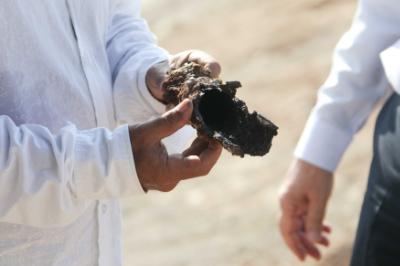

Next week, with the assistance of experts on military excavations who will be arriving from abroad, the second phase of excavations for a Greek military plane shot down by friendly fire during the 1974 Turkish invasion of Cyprus, is expected to begin.
This, according to officials, is the most crucial phase of the operation and thus the work will be carried out in a very thorough and cautious manner, with the assistance of foreign experts from Australia, Canada, Netherlands and elsewhere.
The first phase was completed much earlier than expected and identified three areas of interest. Experts point out that this is a positive development in the whole process.
The aircraft was part of a secret mission from Greece to send reinforcements to the Greek Cypriot National Guard fighting the advancing Turkish troops, equipped with the state of the art military hardware, which invaded Cyprus on July 20, 1974. The plane was shot down on July 22 by friendly fire as Greek Cypriot soldiers mistook it for a hostile aircraft. All but one of its airmen were killed. Thirty-two men were on board the Greek NORATLAS.
The Council of Ministers decided in February 2014 to proceed with the excavations for NORATLAS following a case against the Republic of Cyprus brought before the European Court of Human Rights (ECHR) in 2007 by the families of two Greek military officers who perished in NORATLAS. The Court unanimously declared the application by the families of the dead airmen inadmissible.
Commissioner for Humanitarian Issues Photis Photiou visited the site of excavations on Thursday and briefed the press on the progress of the operation.
Photiou said that “we are slowly entering the second phase of the operation, which is the most difficult and decisive. The foreign experts, along with the Cypriot team, will carry out the necessary work.”
The team of foreign experts comprises specialists in military excavations with a lot of experience in this field.
He said that the findings of the first phase are positive and they indicate that the aircraft is located at the site.
“The aim of course is not only to find the fuselage, the aim is to identify the remains of the fallen Greek airmen. I want to convey a message to their relatives that the government will do whatever is possible and necessary in order to identify the remains of their loved ones“, he stressed.
Photiou explained that the media will be briefed on a regular basis, calling on everyone to realize that this is a difficult operation and the phase it is entering risky.
“Why are likely to find explosives in the aircraft, this makes our job harder, especially for the people who are here, we must take all precautionary measures for everyone`s safety on site“, the Commissioner said.
Photiou assured that there will be transparency throughout the process of excavation, but invited everybody to realize that there are issues that should be kept out of the public eye.
Replying to a question, Photiou said that no one can exactly tell when this phase will be completed as there might be unforeseen difficulties.
Elena Meranou from the Department of Antiquities told the press that the work is difficult and complex.
“We are carrying out this work covering thirty centimeters each time, this means that we have to work very carefully to safeguard the protection and safety of the staff here, of the surrounding area and we want your cooperation,” she said.
Meranou said that the team wants to have good results, adding that so far the experts have located three spots which are considered very important. “We hope that we will have good results in the second phase as well,” she added.
She also expressed her confidence that there will be a very good cooperation with the experts who will come from abroad.
“We will learn from them, hopefully they will learn from us as we have been working here. I hope that by the end of the second phase we will find the remains of Green airmen“, Meranou said.
Xenophon Kallis, the project leader, told the media that all excavations are difficult because there is always the possibility of unforeseen risks.
“I consider this as one more excavation, with the same humanitarian objectives, in this case the identification of the remains of the Green airmen,” he said.
Kallis said the objective is not to investigate what happened to NORATLAS nor is it to announce the state the aircraft is found in.
“There are difficulties and work will continue with the utmost caution, hoping that in the end we will have the results and the answers we seek. But even if we do not find these answers, I wish to assure each and everyone of you that we will continue our efforts until we find the answers we are seeking“, Kallis said.