

Yuri Gagarin, the first cosmonaut, visited Cyprus in February 1962. He received a hero’s reception with banners declaring “the Friendship of the Cypriot and Soviet people is now being founded.”
Bling
Over fifty years later, a rich Russian customer walked into Michalis Constantinou’s jewellery shop in Limassol. She taught him a lesson about succeeding at the high-end. She asked to buy an Omega watch to wear while swimming. Constantinou said, “Don’t you think a €20,000 watch is expensive for the sea?” She replied: “No. This is the cheap one, I have a €150,000 Patek Philippe at home – I just forgot to bring it to Cyprus with me.” And he realised, “I have to grow up a lot, if I want these clients!”
This is the story of Moscow on the Mediterranean, of Cyprus and its Russians; up to 10,000 of them on the island.
As tensions between the Kremlin and the West rise, Cyprus has become a melting pot of geopolitical worries. A scandal around a Cyprus government programme to sell citizenship to thousands of rich foreigners exposed unease about power, corruption and lies.
Cyprus has a long history with powerful forces. Originally settled by ancient Greeks, it was then occupied by the Assyrians, Egyptians, Persians, Romans, Venetians, and the Ottoman Empire. It came under British administration in 1878 until the nationalist struggle won independence in 1960.
“Cyprus strives for this balancing act,” says Fiona Mullen, director of Sapienta Economics. “They don’t want to be enemies of anybody because they have got this one big enemy in Turkey.”
Modern Cyprus has built a financial sector to attract overseas money. Low taxes, light regulation, a favourable tax treaty and depositor guarantees offered by EU membership has turned it into a haven for Russian investors after the USSR collapsed. The attraction is also built on political ties between the Cyprus Communist party and its Russian counterpart, and cultural links in the Orthodox church. Moody’s, the credit ratings agency, estimate that Russian banks and corporations had $31bn deposited in Cyprus – more than the island’s annual gross domestic product.
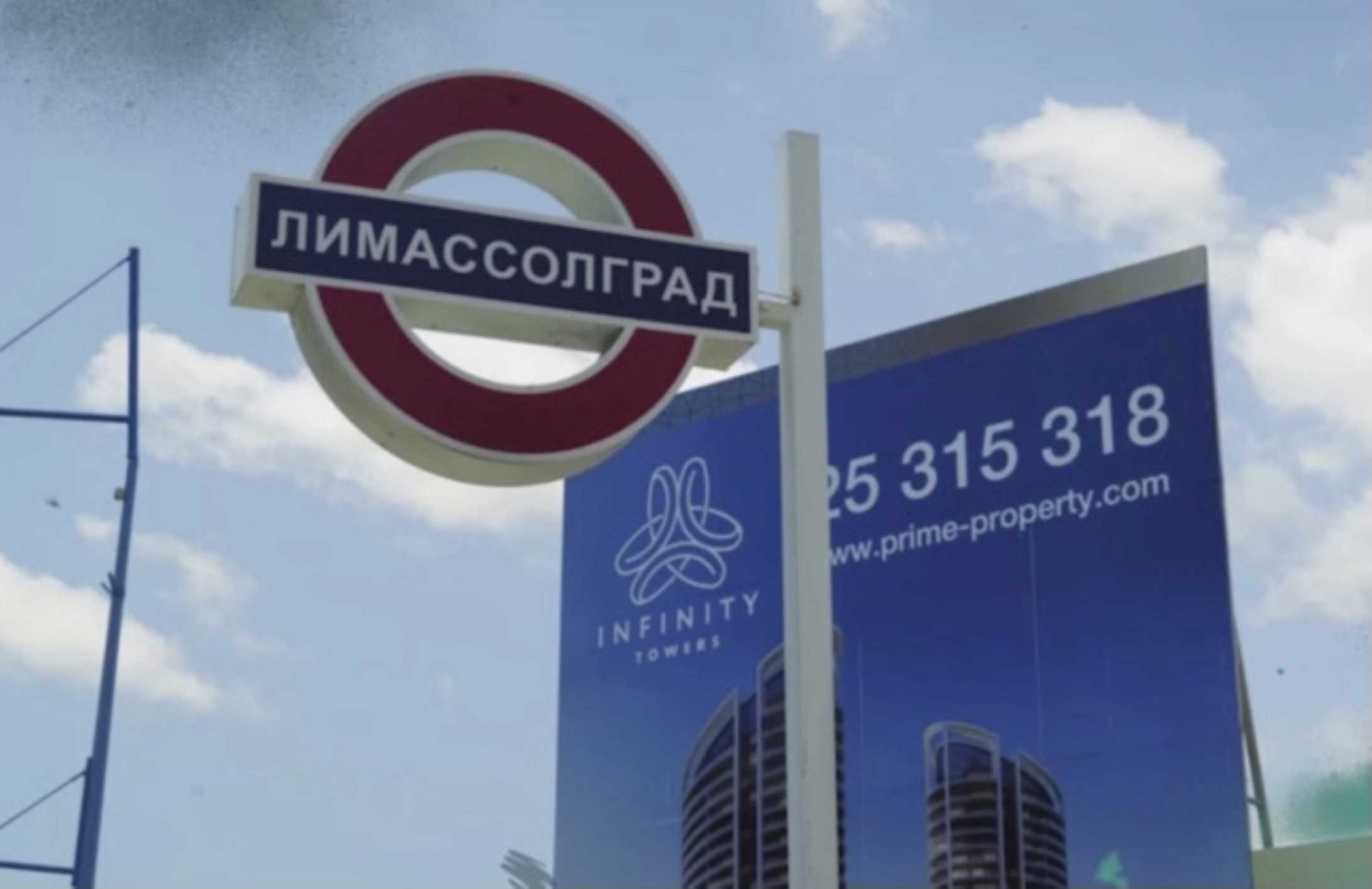
One company, Limassolgrad, promises clients who want to buy property that they can move “instantly, no need to wait.” Its neon sign uses the London Underground logo (pictured).
Some shady characters were also awarded citizenship, including a Malaysian businessman under US criminal indictment. His case was backed by Archbishop Chrysostomos, head of the Orthodox Church of Cyprus, who said that the Malaysian businessman gave €300,000 to a theological school. His citizenship application was fast-tracked by the country’s cabinet, headed by president Nicos Anastasiades.
This Orthodox connection was not lost on Vladimir Putin, who made a high-profile visit to the Mount Athos monastery of St Panteleimon in 2016. A lot of Russian investment went into the monastery.
President Anastasiades denies that his government is too close to the Kremlin, saying, “Our family is European.”
Cyber-Spies
Cyprus is of growing interest to Russia as it expands its regional influence. In 2015, the island – which still hosts two large British military bases – signed a deal to allow Russian navy ships to visit its ports. The USA has urged Cyprus to stop “Russia’s regular navy port calls,” saying that these vessels were contributing to “destabilising actions” in Syria.
In 2018, hackers linked to the Chinese People’s Liberation Army, downloaded years’ worth of EU diplomatic cables via an entry point in the Cyprus foreign ministry.
If the age of globetrotting wealth and mass holidaymaking has now stalled, Cyprus will be severely tested.
(Sources: Financial Times; Wall Street Journal; Reuters; Al-Jazeera).
James Neophytou