

4 January 2026 ‘Politis’
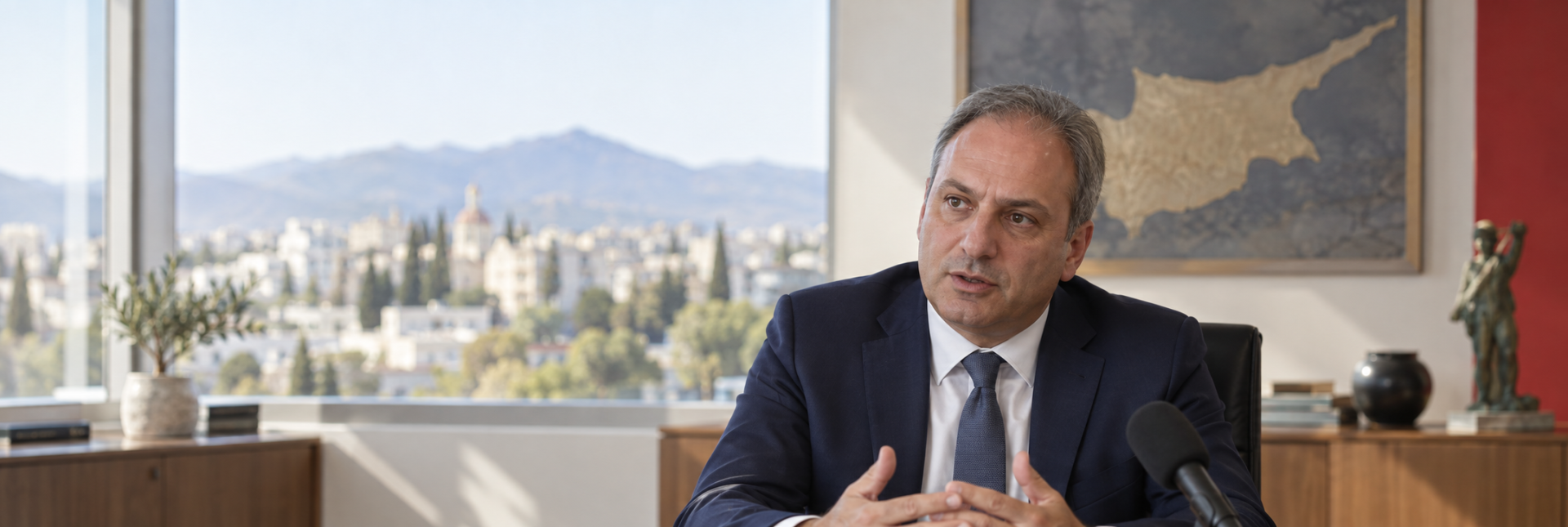
General Secretary of AKEL Stefanos Stefanou interview
QUESTION: AKEL is polling high but is unable to clinch first place. What message does this convey to you?
SS: The fact that AKEL is polling high, especially at a time when almost all the other political parties are experiencing internal problems and are recording low support from their own electoral base, is positive. This is evidence that our own political initiatives and actions in favour of society are recognized by our people, and that is precisely why they embrace the party with confidence.
This positive fact does not make us complacent. On the contrary!
It requires us to continue even more strongly, even more militantly, to assert for society, to solve the numerous problems a very large section of society faces, as a consequence of stagnant incomes, expensiveness, high cost of living and the severe shortcomings observed in the welfare state.For AKEL, the decisive goal is to help society, which is suffering. Of course, if we were to also come first in the elections, so much the better. So let’s not get ahead of ourselves. There is a long way to go until the elections, and it is citizens themselves who will determine the election result by casting their vote. Our goal is for AKEL to emerge even stronger from these elections.
It is our belief that the stronger AKEL is, the greater its ability to fight for society will be.
The choices made by DIKO
QUESTION: DIKO was traditionally an ally of AKEL. Today, however, its leadership disagrees with many of the Left’s positions and is seeking cooperation with DISY. What’s your comment on this?
SS: Historically, DIKO has been an ally of AKEL in presidential and local elections, and this alliance has yielded positive results for Cyprus and our society. However, I point out that in recent years, due to the shift of the DIKO leadership to the right, it wasn’t possible to forge any cooperation with regards the presidential elections.
I would like to remind you that DIKO supported Nicos Anastasiades in 2013 and in 2018, with the tolerance of its leadership, Nicos Anastasiades was re-elected as President of the Republic, while in 2023 it supported the candidacy of the successor of the DISY government, Nicos Christodoulides.
It is the DIKO leadership’s choice not to cooperate with AKEL – which is its right – but in doing so, it becomes jointly responsible for the anti-social policies that are being implemented by the Right, which seen inequalities grow, reinforced the people’s economic and social insecurity and, at the same time, have seen corruption reach unprecedented levels.
The DIKO leadership is so keen to support DISY’s policies that it has gone so far as to support the DISY Right-wing party’s attempt to pardon Grivas for the crimes he had committed against Cyprus.
Anyone can easily draw conclusions from history as to when DIKO had benefited from its collaborations (with AKEL). Whenever it cooperated with AKEL, it registered successes, as was the case in the last local government elections; whenever it cooperated with DISY, it suffered damage and sustained losses.
The Cyprus Problem
QUESTION: Which political forces does AKEL feel it has more affinity today?
SS: First of all, I want to say that AKEL is closer to society. AKEL fights and is working for society. Our principal concern is to assert society’s interests.
Regarding your question, an answer can only be given when the political forces clarify their own positions on the key issues that determine the course of the country and society.
For us, the first and decisive issue — but not the only one — is the Cyprus problem. And at this precise juncture of our national issue, following the failure of the Crans-Montana talks in 2017, it is not enough to simply declare one’s verbal support for a solution based on a bi-zonal, bi-communal federation with political equality. The political parties must have a clear position on how to overcome the deadlock on the Cyprus problem and how to move forward with the negotiations.
AKEL strongly supports the continuation of the negotiations from the point where they were interrupted in 2017, preserving the entire negotiating acquis that has been agreed and making use of the Guterres Framework. It is also very important to us what socio-economic policies the political forces support, what their position is on issues concerning the welfare state and the rule of law, what their policies are on combating corruption and in relation to a number of other important issues.
DISY
QUESTION: Although Nicos Christodoulides is in power, AKEL’s attacks are mostly directed at DISY, with the clear implication that the President of the Republic is an extension of Nicos Anastasiades. However, there are major issues, such as the Cyprus problem, which require extra steps and cooperation with DISY.
SS: AKEL does not need to repeat that President Christodoulides is continuing the implementation of the same policies that were being pursued by the previous President. Besides, the President himself declares this at every opportunity. And it is not AKEL that is attacking DISY. The opposite is true. Whenever AKEL criticises the government for its policies and behaviour, it is DISY that is the first to reply to AKEL, even when the government itself chooses to remain silent.
AKEL has frequently taken extra steps on the Cyprus problem. No one can erase the fact that, even during the Anastasiades administration, AKEL took the lead whenever it believed that policies were being promoted that served the prospect of a solution of the Cyprus problem.
Consequently, we have nothing to prove regarding the Cyprus problem. It is up to others to decide whether they will continue to compete with the far right in exploiting patriotic sentiments and rhetoric.
QUESTION: Will you run for the Presidency of the new House of Representatives?
SS: This question cannot be answered before the parliamentary elections are held. When the elections are held and we have a clear picture of the political party map and the balance of forces, we will subsequently discuss the question of the Presidency of the House of Representatives.
QUESTION: Is AKEL considering the possibility of supporting Odysseas Michaelides’ candidacy in the 2028 presidential elections?
SS: Since we are focused on the parliamentary elections, we are not considering anything to do with the 2028 presidential elections. After the parliamentary elections, we will deal with the presidential elections and, more specifically , how we can achieve progressive change in our country.
Guardians/bodyguards of the banks
QUESTION: AKEL’s proposal to tax the super profits of the banks was rejected, but you have re-submitted it, while some forces argue that (if approved) the cost will be passed on to customers and that it sends the wrong message to investors, as this tax measure would undermine the stable tax system.
SS: We have stated on numerous occasions that we have reintroduced the proposal after the European Commission officially stated that the taxation of exorbitant super profits does not threaten the stability of banks or fiscal stability. Consequently, the most basic claim of those who strongly opposed this taxation proposal has been refuted by the EU itself.
The arguments about shifting the cost on to customers and the alleged concern that this would provoke to investors have been answered by the experience of the 24 EU member states that have imposed either a tax or a levy on super profits.
Only three countries across the EU did nothing to tax windfall profits, and one of them is Cyprus.
We have therefore resubmitted our proposal once again and are waiting to see who will continue to act as bodyguards/guardians of the banks’ interests to the detriment of society’s interests.
QUESTION: You are calling for a vote for “change,” but AKEL is often accused of the heavy price that citizens are paying, even today, for the Demetris Christofias administration. Do you think the party would gain more trust by apologizing to the people for the policies it had pursued at that time?
SS: Mistakes were inevitably made in an environment characterised by the deep crisis of global capitalism and the European economy, as they were also made throughout the EU in the attempt of its leadership to deal with an unprecedented crisis.
However, it wasn’t the policies of the Christofias government that bankrupted Cyprus, but rather the poor practices of the banks. This fact was even acknowledged by the European Commission itself in a report it had submitted to the European Parliament on 17 April 2013.
It is undoubtedly convenient for certain forces to blame the Left for the bankruptcy in question, because by doing so they can, on the one hand, absolve the bankers of any responsibility for the crisis and, on the other hand, they seek to discredit the social policies and efforts that were made to support society by the Christofias government, so as not to pay the consequences of the biggest crisis capitalism has ever faced.
So it is not the issuing of social measures referred to as “cheques”, as some ironically called them, that the Christofias government gave to low-income pensioners and vulnerable groups of the population that caused the fiscal crisis, but the banks.
New developmental model
QUESTION: How can a free market economy function with a left-wing government and policies in favour of state intervention? Isn’t there a risk of generating economic costs, given the current internationalized nature of economies?
SS: First of all, we must ask ourselves to what extent does a free market economy currently operate in Cyprus, bearing in mind that in key sectors, the economy and society are under pressure from the existence of oligopolies and cartels. These restrict or even eliminate competition in many sectors, and consumers pay the price for this negative situation.
Our guiding principle is the implementation of socio-economic policies that benefit working people and society, not the few and the privileged. In the conditions of a capitalist system and given that Cyprus is a member state of the EU, what the Left proposes and supports is the formation of a new developmental model that incorporates the long-standing positive experience of cooperation between the state, the cooperative and the private sector within the framework of a mixed economy, which has brought growth and progress to our country and people.
As for state intervention, we obviously mean different things. The state has been present for decades in vital and strategic sectors of the economy and country, such as energy, telecommunications, the management of ports, and elsewhere. And fortunately so, because state intervention in these sectors strengthens our country’s security and ensures that the whole of society has access to essential goods. The state functions and must continue to function as a pillar of development and productive investment alongside and in conjunction with the private sector.