
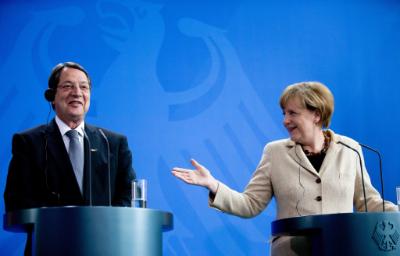

German Chancellor Angela Merkel expressed on Tuesday her support to Nicosia`s request for a more active role of the European Union in the ongoing UN-led talks for a settlement to the Cyprus problem.
“We will do our utmost to promote this dimension and we are of the view and we wish for a swift process that would lead to a successful conclusion soon,” Merkel said in a joint press conference with Cyprus President Nicos Anastasiades following a working lunch they had in Berlin.
Cyprus President on his part stressed the need for a more active involvement on behalf of the EU “so that the ongoing dialogue would lead to a solution and a new state of affairs for a single state that could operate effectively in the EU.”
On her part, Merkel noted that although the dialogue is being held under the UN auspices “it is very important the EU to assume an active role.”
“The settlement should be such so it would comply with the capacity of a fully-fledged EU member-state,” she added, replying to a comment.
Furthermore, Anastasiades referred to the need for promotion of Confidence Building Measures in parallel with the talks.
These measures, “could restore confidence in the dialogue, confidence between the parties and would give new impetus to the whole process,” he said, adding that he received Merkel`s “full understanding” on this issue.
Referring to the Cypriot economy, Merkel praised the Cypriot government`s determination to implement the reforms included in the €10 billion financial assistance package it received by the EU and the IMF in March 2013, but acknowledged the problems that emerged especially to the small and medium sized corporations due to the continued economic contraction and the lack of credit.
“For that reason Germany wants to help,” she said adding that the Finance Ministers of the two countries have engaged in discussions the details of a SME support programme, similar to the ones Germany concluded with other countries under programme.
On Ukraine, Merkel said the EU should pursue of a diplomatic solution and noted that further EU sanctions on Russia should not be an end in itself.
The German Chancellor said the EU member-states requested an impact assessment by the European Commission in case of further sanctions against Russia.
“Therefore, we should show our capacity to take action, but also we should be aware of the consequences,” she added, pointing out the issue of further sanctions against Russia does not only concerns Cyprus but other six EU – member states whose energy supply depend by 100% from Russia.
On his part President Anastasiades reiterated that the EU should consider the consequences on each member-state from a possible drastic EU sanctions.
Rating agencies as well as the Troika (EU Commission, the European Central Bank and the IMF) suggested that a possible crisis between the EU and Moscow could derail the recovery of the Cypriot economy, as the island has strong business and financial ties with Russia.
“I would like to remind that Cyprus is under a financial adjustment programme and has proved that it could recover but possible strict sanctions without considering the damages or the consequences would likely inflict a crucial blow to our efforts,” he said.
Cyprus was divided in 1974 when Turkey invaded and occupied its northern third. The leaders of the two communities agreed in February on a joint declaration which paved the way for the UN-backed talks to resume with the aim to reunite the island under a federal roof.