

The chairmen of the Technical Committee on Cultural Heritage, Takis Hadjidemetriou and Ali Tuncay, have been honored with the `Tefkros Anthias-Thodosis Pierides` prize awarded to them by the AKEL – left wing party.
In his address at the ceremony, Minister of Education and Culture, Costas Kadis, said that Hadjidemetriou and Tuncay contribute in an active manner to the maintenance and restoration of the cultural monuments of all communities in Cyprus.
“The remarkable actions of two persons for the common future of our small country is an example which illustrates the idea of peaceful coexistence and mutual respect in our country”, the Minister stressed.
AKEL`s General Secretary Andros Kyprianou said that Greek Cypriots and Turkish Cypriots have a common cultural heritage noting that the Technical Committee is working under dire conditions.
Receiving the award, Takis Hadjidemetriou said that this distinction he receives along with the Turkish Cypriot chairman of the Technical Committee, raises culture as the most important and timeless achievement of our people. He added that the Committee brought a major change, shifting culture from the conflict aspect to the level of cooperation thus overcoming division barriers.
In his address, Turkish Cypriot Ali Tuncay said that the journey of the Technical Committee that began in 2008 was not an easy one and that its members have made every effort and together have managed to build a spirit of understanding, traveling from Paphos to the Karpas Peninsula.
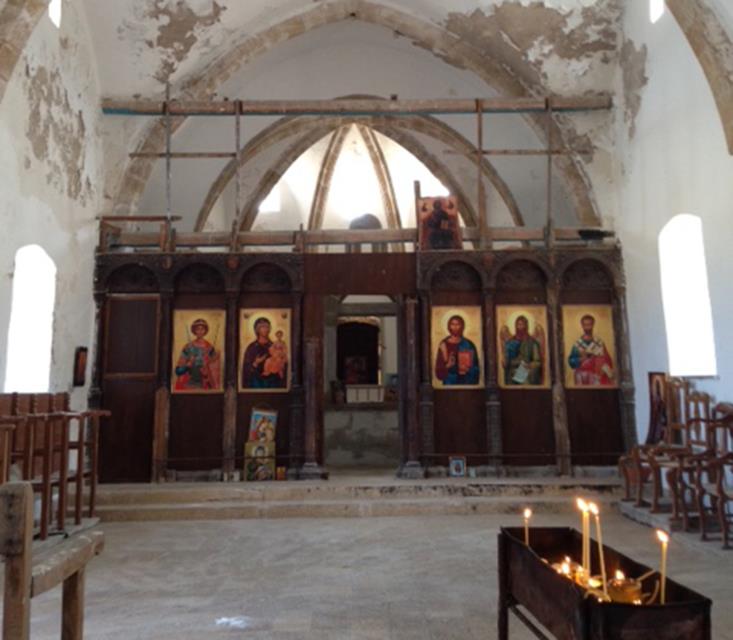
Through the work of the Technical Committee, many monuments island-wide are structurally supported, physically protected or restored – or currently undergoing study/restoration, while many other monuments island-wide will benefit from similar interventions in the near future.
The Technical Committee is funded by the UN Development Programme and the European Union.
The 1974 Turkish invasion of Cyprus and the subsequent occupation of the island have taken a heavy toll on Cyprus’ cultural heritage, despite existing internationally binding treaties regarding the protection of cultural heritage.
The damage is grave and in many cases, irreversible. The occupied museums have been looted and so have many private collections of antiquities. Churches have been vandalized; ecclesiastical icons and vessels stolen, church frescoes and mosaics have been removed and in many cases have been traced in Europe’s illegal antiquities trade markets and in auctions around the world.
The most serious and large-scale damage has been noted on the islands’ occupied churches. Some of the churches have even been demolished, others pillaged and some are currently being used as stables, mosques or as part of military camps.
In 2008 following a decision of the leaders of the two communities, Demetris Christofias and Mehmet Ali Talat, the Technical Committee on Cultural Heritage and the Advisory Board for the Preservation, Physical Protection and Restoration of the Immovable Cultural Heritage of Cyprus were established.
These bodies work as mutually acceptable mechanisms for the implementation of practical measures for the proper maintenance, preservation, physical protection and restoration (including research, study and survey) of the immovable cultural heritage of Cyprus. They provide a space where the practical aspects of cultural heritage preservation can be considered in a non-political manner so that practical measures can be taken to improve the situation on the ground.
In 2012, building on the results achieved and on the positive and friendly atmosphere built, the Technical Committee on Cultural Heritage requested the European Union to support the preservation of Cypriot Cultural Heritage by providing the funds for the implementation of a series of emergency measures to stop further deterioration of a selected number of cultural heritage sites identified in the bi-communal list included in the Study.