
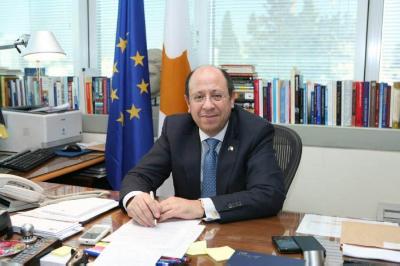

“The key [for the solution of the Cyprus problem] remains in Ankara”, says the High Commissioner of Cyprus to the United Kingdom Euripides Evriviades in an interview with the British diplomatic Embassy Magazine, titled “Full-throttle diplomacy”.
The Cypriot diplomat stresses that the current situation, where Turkish troops occupy the northern part of the island, is “unacceptable and unsustainable.” Mr Evriviades calls for “courage, resolve and vision” in the efforts to reach a solution to the Cyprus question, a solution that “must be in accordance with European values and the EU’s political, democratic and legal order.”
Commenting on Turkey’s concerns for the human rights of the Turkish Cypriots, he notes that since the ceasefire line was opened up in 2003, “we have had more than 40 million incident-free visits.” Mr Evriviades adds that as Ambassador to the Council of Europe in Strasbourg (2008-2011) the Cyprus government offered to accept all human rights monitoring mechanisms, on condition the troops withdrew. “They have no place in today’s Europe,” he comments.
The High Commissioner expresses the Cypriot government’s support for Turkey’s EU membership, but stresses that it should be clear that “it is Turkey joining the EU and not the EU joining Turkey.” He warns that Turkey’s “gunboat diplomacy” in intercepting vessels exploring for gas in Cyprus’s EEZ sends out “bellicose messages.”
He also says he believes that the discovery of hydrocarbon deposits could lead to a regional version of the Coal and Steel Community and become “a game changer.”
Referring to the national economy, the Cypriot diplomat admits that Russian sanctions will have a negative impact, following the bail-in decision by the island’s eurozone partners. Mr Evriviades describes the bail-in measure as “highway robbery”, noting that it has created wider implications with foreign investors thinking twice before approaching eurozone member countries. Nevertheless, he points to the recent improvement of Cyprus’s economy.
In terms of the country’s European stature, the High Commissioner says that Cyprus has offered the EU a predictable and dependable partner in the strategic corner of the often volatile Eastern Mediterranean. He adds that the location of Cyprus contributes to the “umbilical relationship” with the UK, as demonstrated during the President Nicos Anastasiades’s visit to London last January.
The British magazine also features a two-page review of how the relationship with the EU has developed for the member countries that joined ten years ago. Mr Evriviades refers to the membership of his country as “the most important strategic development” since independence.
Asked about the benefits of the membership he points to a redefinition of the parameters of the Cyprus problem, in a parallel track with the accession course of Turkey. As for the biggest challenge Cyprus has faced as a member country, he points to the treatment it faced in the context of the economic crisis. “As a small and vulnerable EU Member State [we were] possibly used as an experiment for the new EU policy for the rescue of banks with a bail-in, which now seems to be established at a European level,” says Euripides Evriviades. Finally, he highlights the “predictable foreign policy in the Eastern Mediterranean” and the “natural link to the Middle East” as Cyprus’s biggest contribution to the EU club.
The High Commissioner is described as a “consummate professional who approaches his job with a good sense of humour and energy at full throttle.”
He was interviewed on 8th May by Elizabeth Stewart, the editor of Embassy Magazine. The magazine’s readers include high level diplomats and politicians.