

Stories from the Bible have frequently been used in films. There are sound reasons for motion picture producers to turn to the Bible as source material. The stories, in the public domain, are already familiar to potential audiences. They contain sweeping, but relatively straightforward, narratives of good versus evil, and feature crowd-pleasing battles, sword fights, natural disasters, and miracles.
Hollywood has been producing movies based on Bible stories since 1897. One of the earliest biblical films was the 1903 production of Samson and Delilah, produced by the French company Pathè. Enrico Guazzoni’s 1913 Italian epic Quo Vadis? is often considered the first successful feature-length motion picture and one of the first films with over two hours running time.
Director Cecil B. DeMille specialized in extravagant epics throughout a career that spanned both the silent and sound eras. His 1923 silent version of The Ten Commandments (1923) included spectacular special effects for the parting of the Red Sea. De Mille followed The Ten Commandments in 1927 with King of Kings, a lavish, reverential life of Christ with a climactic resurrection scene in colour. King of Kings was re-released in 1931 with a synchronized musical score.
MGM’s 1925 silent-era Ben-Hur: A Tale of the Christ, starring Ramon Novarro was the most expensive film of its time. It included two spectacular scenes: the sea galley battle with pirates and the famous chariot-race. The major studios produced fewer epics during the 1940s due in part to wartime scarcity of resources. After the war, some of Hollywood’s highest grossing films were religious epics produced as vehicles for its biggest stars.
Samson and Delilah was the biggest moneymaking movie of 1949 and is considered the picture that sparked the biblical-epic film craze of the 1950s. It was followed by two of 1951’s biggest box-office hits, Quo Vadis and David and Bathsheba. Charlton Heston starred in Cecil B. DeMille’s The Ten Commandments and Ben-Hur. According to author Diane Apostolos-Cappadona, in the 1950s and 1960s, during the era of the production code, “the most acceptable cinematic path for movies to incorporate sex and violence was the biblical epic”. Basing a film on the Bible allowed it to be more risqué than would normally have been accepted. Biblical figures like Eve, Delilah, Jezebel and Judith could all be portrayed as seductive temptresses. In tales such as Sodom and Gomorrah and Samson and Delilah, exotic sins could be lavishly portrayed on screen.
In his autobiography, DeMille wrote, “I am sometimes accused of gingering up the Bible with large and lavish infusions of sex and violence. I can only wonder if my accusers have ever read certain parts of the Bible.”
By the 1950s movies had to compete with television and became more colourful and bigger in story and scope. In 1953, CinemaScope was introduced in The Robe. In 1956 DeMille remade his 1923 film The Ten Commandments. It was the biggest moneymaker of that year, and was nominated for seven Academy Awards. By the mid -1960s several epic-style biblical movies flopped, and were partially blamed for the movie industry’s financial troubles at that time. Two major studio attempts to make a film of Jesus’ life during this period, The Greatest Story Ever Told and King of Kings were both commercial failures. With the end of the studio system and the changing social climate, the Bible epic film finally fell out of favour.
Over the years several more big screen and TV films have been produced with various degree of success. Yet in 2004, Mel Gibson’s controversial The Passion of the Christ, an interpretation of the last 12 hours in the life of Jesus, was a big hit and extremely profitable, grossing $600 million worldwide. Despite all the dialogue being in Hebrew, Aramaic and Latin and the film subtitled, it still set a record for the highest-grossing independent film of all time.
Samson and Delilah (1949)
A romantic biblical drama film produced and directed by Cecil B. DeMille and released by Paramount. It depicts the biblical story of Samson, a strongman whose secret lies in his uncut hair, and his love for Delilah, the woman who seduces him, discovers his secret, and then betrays him to the Philistines. Dressed in a loin cloth, with his hair in a pony tail, and wearing a head band, he seems, at first, prematurely blind by preferring Angela Lansbury to Hedy Lamarr. Coming across a lion, Samson says: “I don’t need that spear. It’s only a very young lion,” and tackles it with his bare hands.
Praised upon release for its Technicolor cinematography, lead performances, costumes, sets, and innovative special effects, the film was a box-office success. It was the highest-grossing film of 1950. Of its five Academy Award nominations, the film won two for Best Art Direction and Best Costume Design.
Quo Vadis (1951)

Quo Vadis (Latin for “Where are you going?”), an epic film made by Metro-Goldwyn-Mayer in Technicolor, was directed by Mervyn LeRoy. Adapted from the novel Quo Vadis (1896) by the Polish Nobel Laureate author Henryk Sienkiewicz. The score is by Miklós Rózsa. The title refers to an incident in the apocryphal Acts of Peter. The film starred Robert Taylor, Deborah Kerr, Leo Genn, and Peter Ustinov. The story, set in ancient Rome during the final years of Emperor Nero‘s reign, 64–68 AD, combines both historical and fictional events and characters, and compresses the key events of that period into the space of only a few weeks. Its main theme is the Roman Empire’s conflict with Christianity and persecution of Christians. Unlike his illustrious and powerful predecessor, Emperor Claudius, Nero proved corrupt and destructive, and his actions eventually threatened to destroy Rome’s previously peaceful social order.
The film was nominated for eight Academy Awards (though it won none), and it was such a huge box-office success that it was credited with single-handedly rescuing M-G-M from the brink of bankruptcy.
The Robe (1953)

Historically important as the first CinemaScope feature film. 20th Century-Fox’s The Robe is fine dramatic entertainment in its own right. Based on the best-selling novel by Lloyd C. Douglas, the film stars Richard Burton as the Roman tribune who is assigned by a weary Pontius Pilate to supervise the crucifixion of Christ. After the Seven Last Words from the Cross, the jaded Burton wins Christ’s robe in a dice game. Gradually, the mystical influence of the holy garment transforms Burton from a roistering cynic into a true believer – at the cost of his own life, which he willingly gives up in the service of his Lord.
Also starring in the film are Jean Simmons as Burton’s pious childhood sweetheart, Victor Mature as his Christian convert slave Demetrius (an excellent performance). Michael Rennie as the disciple Peter, and Jay Robinson as the raving Emperor Caligula. Mature, Rennie and Robinson would appear in the 1954 sequel to The Robe, the hurriedly assembled Demetrius and the Gladiators.
The film won three Academy Awards, and a special Oscar bestowed upon Fox for the development of CinemaScope.
Demetrius and the Gladiators (1954)
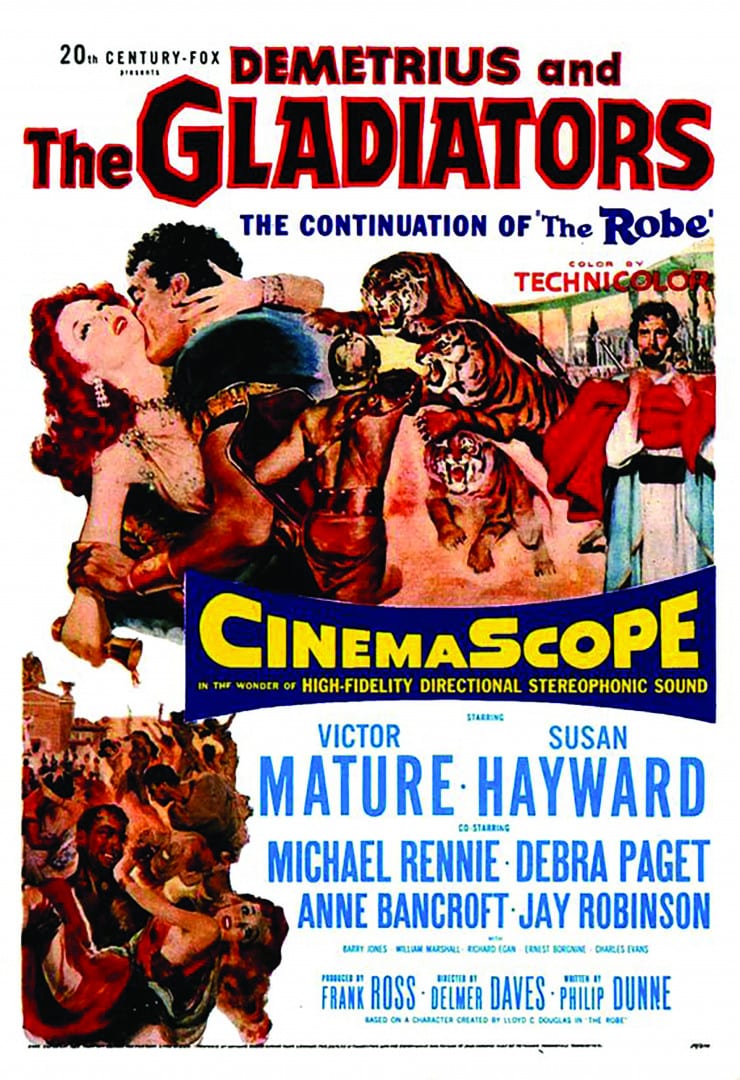
The sequel to The Robe, the film presents Victor Mature as Demetrius, a Christian slave made to fight in the Roman arena as a gladiator, and Susan Hayward as Messalina, a reprobate woman who is the wife of Claudius, the uncle of the depraved emperor Caligula. Caligula becomes interested in the robe, thinking that it has magic powers and will bring him the ‘eternal life’ that Jesus had spoken of.
The cast also features Ernest Borgnine and Anne Bancroft in one of her earlier roles. The film is in Technicolor and CinemaScope.
The Ten Commandments (1956)
An epic religious drama film produced, directed, and narrated by Cecil B. DeMille, shot in VistaVision (colour by Technicolor), and released by Paramount Pictures. The Ten Commandments dramatizes the biblical story of the life of Moses, an adopted Egyptian prince who becomes the deliverer of his real brethren, the enslaved Hebrews, and therefore leads the Exodus to Mount Sinai, where he receives, from God, the Ten Commandments. The film stars Charlton Heston in the lead role, Yul Brynner as Rameses, Anne Baxter as Nefertiti and Edward G. Robinson as Dathan.
Filmed on location in Egypt, Mount Sinai and the Sinai Peninsula, the film was DeMille’s last and most successful work. It is a partial remake of his 1923 silent film of the same title, and features one of the largest sets ever created for a film. The film was released to cinemas in the United States on November 8, 1956 and, at the time of its release, was the most expensive film ever made.
In 1957, the film was nominated for seven Academy Awards, including Best Picture, winning the Academy Award for Best Visual Effects. Charlton Heston was nominated for a Golden Globe Award for Best Performance by an Actor in a Motion Picture (Drama) for his role as Moses. Yul Brynner won the National Board of Review Award for Best Actor for his role as Rameses and his other roles in Anastasia and The King and I. It is also one of the most financially successful films ever made, grossing approximately $122.7 million at the box office during its initial release; it was the most successful film of 1956 and the second-highest-grossing film of the decade.
Ben-Hur (1959)
An epic religious drama film, directed by William Wyler, produced by Sam Zimbalist for Metro-Goldwyn-Mayer and starring Charlton Heston as the title character. A remake of the 1925 silent film with a similar title, Ben-Hur was adapted from Lew Wallace‘s 1880 novel Ben-Hur: A Tale of the Christ.
Ben-Hur had the largest budget ($15.175 million), as well as the largest sets built, of any film produced at the time. Costume designer Elizabeth Haffenden oversaw a staff of 100 wardrobe fabricators to make the costumes, and a workshop employing 200 artists and workmen provided the hundreds of friezes and statues needed in the film. Filming commenced on May 18, 1958, and wrapped on January 7, 1959, with shooting lasting for 12 to 14 hours a day, six days a week. Pre-production began in Italy at Cinecittà around October 1957, and post-production took six months. Under cinematographer Robert L. Surtees, MGM executives made the decision to film the picture in a widescreen format, which Wyler strongly disliked. More than 200 camels and 2,500 horses were used in the shooting of the film, with some 10,000 extras. The sea battle was filmed using miniatures in a huge tank on the back lot at the MGM Studios in Culver City, California. The nine-minute chariot race has become one of cinema’s most famous sequences, and the film score, composed and conducted by Miklós Rózsa, is the longest ever composed for a film and was highly influential on cinema for more than 15 years.
Ben-Hur premiered at Loew’s State Theatre in New York City on November 18, 1959. It was the fastest grossing, as well as the highest-grossing film of 1959, in the process becoming the second highest-grossing film in history at the time after Gone with the Wind. It won a record 11 Academy Awards, including Best Picture, Best Director (Wyler), Best Actor in a Leading Role (Heston), Best Actor in a Supporting Role (Griffith), and Best Cinematography – Colour (Surtees). Ben-Hur also won three Golden Globe Awards, including Best Motion Picture – Drama, Best Director and Best Supporting Actor – Motion Picture for Stephen Boyd.
Today, Ben-Hur is widely regarded as one of the greatest films of all time.
Solomon and Sheba (1961)
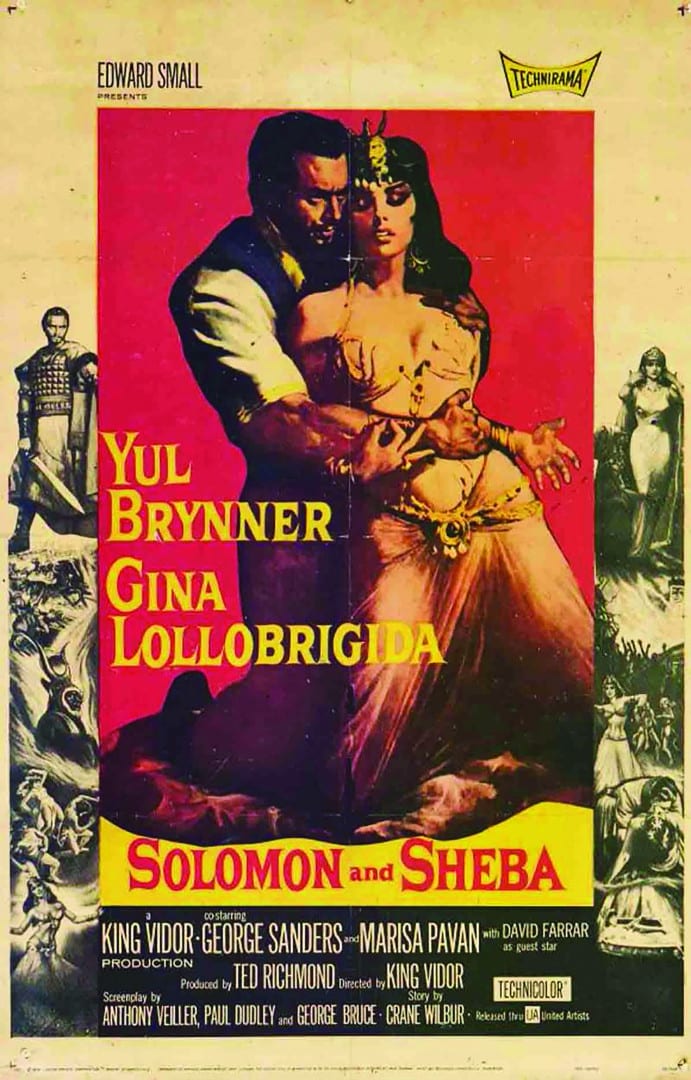
An epic historical romance film directed by King Vidor and distributed by United Artists. The film dramatizes events described in The Bible – the tenth chapter of the First Kings and the ninth chapter of Second Chronicles.
Romance, treachery, intrigue and spiritual awakenings abound in the Biblical film adaptation of Solomon and Sheba. Trouble begins between two brothers when poet Solomon (Yul Brynner) is chosen to be next in line to the throne by King David of Israel. His warrior brother Adonijah (George Sanders) is livid when Solomon becomes king. While Israel prospers under Solomon, Sheba (Gina Lollobrigida) conspires with the Egyptians to topple Israel. She is ambitious and seductive and finally gets Solomon to fall in love with her. When a pagan dance ritual turns into an orgy, the people turn against Solomon when the Temple of Jehovah is struck by lightning. After the righteous Solomon has fallen from the grace of God, Sheba renounces her pagan Gods and converts to Judaism. A cast of thousands depict the raging battle between the Israelites and the Egyptians.
The production was delayed when the original choice for the role of Solomon (Tyrone Power) died during the making of the film. Many scenes had to be redone with his replacement, Yul Brynner.
Barabbas (1961)
A religious epic film expanding on the career of Barabbas, from the Christian Passion narrative in the Gospel of Mark and other gospels. Pontius Pilate offers to release either Jesus of Nazareth or Barabbas, in keeping with the Passover custom. The crowd gathered for the pardoning chooses Barabbas, and Jesus is condemned to crucifixion. Returning to his friends, Barabbas asks for his lover, Rachel. His friends inform him that Rachel has become a follower of Christ. Rachel soon returns, but she is not happy to see Barabbas.
The film stars Anthony Quinn as Barabbas, features Ernest Borgnine and Jack Palance, and was distributed by Columbia Pictures. It was conceived as a grand Roman epic, was based on Nobel Prize-winning Pär Lagerkvist‘s 1950 novel of the same title.
The film was directed by Richard Fleischer and shot in Verona and Rome under the supervision of producer Dino De Laurentiis. It included many spectacular scenes, including a battle of gladiators in a Cinecittà film studio mock-up of the arena, and a crucifixion shot during an actual total solar eclipse.
King of Kings (1961)
Produced by legendary Samuel Bronston and directed with assurance and imagination by Nicholas Ray, the film tells of the 33 years of Jesus Christ’s life. From his birth in Bethlehem to his Crucifixion, to the Resurrection and finally the Ascension. A familiar story that is nicely spread to a movie under three hours long, takes in the Apostles selection, John The Baptist, 40 days in the desert, the miracles, Sermon on the Mount, Judas’ betrayal and of course The Last Supper.
The film contains a narration by Orson Welles, which was written by Ray Bradbury. It’s a wise move for it helps the narrative immensely, while lets face it here, Orson had a great voice, perfectly biblical and it lends a touch of class to the material. Of the cast, Jeffrey Hunter has the glory role of Christ. A relative unknown, Hunter is effective with his steely blue eyes, while Robert Ryan is first rate as the doomed John The Baptist. Also turning in good performances are Harry Guardino (Barabbas), Royal Dano (Peter) and Rip Torn (Judas).
The film has considerable scope with thousands of extras are a given of course, all captured among the Spanish locations in 70mm Technicolor. The film sets (almost 400 used) and Miklós Rózsa provides a suitably effective score. Ultimately its just real good story telling given a good technical work out. The appearance of Judas for the first time still sends a shiver down the spine and the Crucifixion instils a sadness that is hard to shake off once the credits have rolled.
The Greatest Story Ever Told (1965)
Filmmaker George Stevens chose Monument Valley, Utah for his exterior sequences for the film. This adaptation of Fulton Oursler’s best-selling book, The “Greatest Story” is, of course, the life of Jesus Christ, played herein by Max Von Sydow. The large supporting cast includes Dorothy McGuire as Mary, Claude Rains as Herod the Great, Jose Ferrer as Herod Antipas, Charlton Heston as John the Baptist, Donald Pleasence as Satan (identified only as “The Dark Hermit”), David McCallum as Judas Iscariot, Sidney Poitier as Simon of Cyrene, Telly Savalas as Pontius Pilate. The ensemble of well-known actors, many of them in brief, even cameo appearances. Some critics would later complain that the large cast distracted from the solemnity, notably in the appearance of John Wayne as the Roman centurion who comments on the Crucifixion, in his well-known voice, by stating: “Truly this man was the Son of God.”
Originally shown at 260 minutes, Greatest Story Ever Told was later available in a 195-minute version.
Source: en.wikipedia.org, www.rottentomatoes.com and www.themoviedb.org