
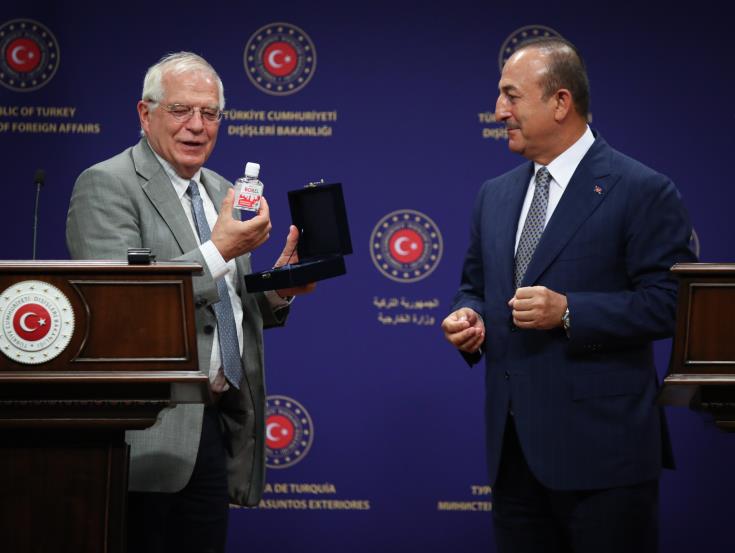

EU High Representative on Foreign Policy Josep Borrell officially informed Turkey`s Foreign Minister Melvut Cavusoglu on the outcome of the informal Foreign Ministers` Council of Friday in Berlin and the EU`s expectations for de-escalation and productive dialog for permanent solutions in the Eastern Mediterranean.
More specifically, called by CNA to elaborate on the conversation between the HRVP and M.Cavusoglu, European Commission and EEAS Spokesman Peter Stano stated the following:
“I will try to answer those questions that are for the EU to answer, so I will not be answering on how the Turkish side is assessing the results of the formal ministerial meeting in Berlin. I can confirm that HRVP Borrell spoke to the Turkish foreign minister Melvut Cavusoglu. This is part of their ongoing conversations. You know that in the past they had both phone-calls and personal meetings, and this is the way the HRVP proceeds, in order to maintain the dialog with Turkey. On this particular occasion, the main reason for the phone-call was to debrief essentially the Turkish partner on the outcome and the discussions of the foreign ministers of the EU on the relations between the EU and Turkey and on the situation in the Eastern Mediterranean in line with the messages shared with the public of Friday after the informal FAC meeting. So the Turkish side was informed both publicly through the messages of the Gymnich, and also privately and personally by the HRVP on the EU’s expectations from Turkey in order to find a peaceful and calm solution to the tensions in the Eastern Mediterranean and how the EU sees the road towards de-escalation, and measures which the EU is ready to take and is already taking in order to react to Turkey’s behavior which is, as the Ministers have clearly stated, source of concern for the whole EU.
On the elements to be contained in the dialog between Turkey – Greece, the spokesman answered to CNA that:
“the bottom line is to have the dialog going, instead of unilateral actions which increase the tensions in the area among the neighbors and among the EU and Turkey as such. The Ministers were very clear that they want to find a path towards a healthier relationship between the EU and Turkey give a serious chance to dialog. So at this stage I wouldn’t go into speculation on the agenda of the dialog but to the fact that is essential to stop unilateral actions, it is essential to stop exchanges of messages through the media, declarations and statements, that we are witnessing right now between Turkey and Greece for example, but it is essential to go into dialog, serious honest dialog, tackling all the open issues, because only in dialog and in negotiations we can pursue the path towards, de-escalations, stability and lasting solutions, that are so necessary in our relations, both as the neighbors of Turkey and as partners of Turkey and that concerns the individual members states and the EU as a whole.”
Called to comment on the “casus belli warning” by Turkey, Peter Stano noted: “as I mentioned it is not productive to comment on the public declarations and statements and exchanges of very strong words and unfortunate words, of course, but the EU Foreign Ministers were very clear in their discussions and in their informal conclusions on what we expect from Turkey. The ministers were very determined on showing solidarity with its two affected member states Cyprus and Greece and they were very clear on their call to the Turkey’s authorities to end any unilateral activities which are escalating tension in the Mediterranean and the Ministers of the EU are very clear on preferring dialog instead of confrontation, dialog as a means of de-escalation. And if it is not possible to have a dialog, if there is no de-escalation the issue has launched already steps o how to react to the situation if there is no change and take appropriate measures, already outlined after the discussion by the Ministers.”