
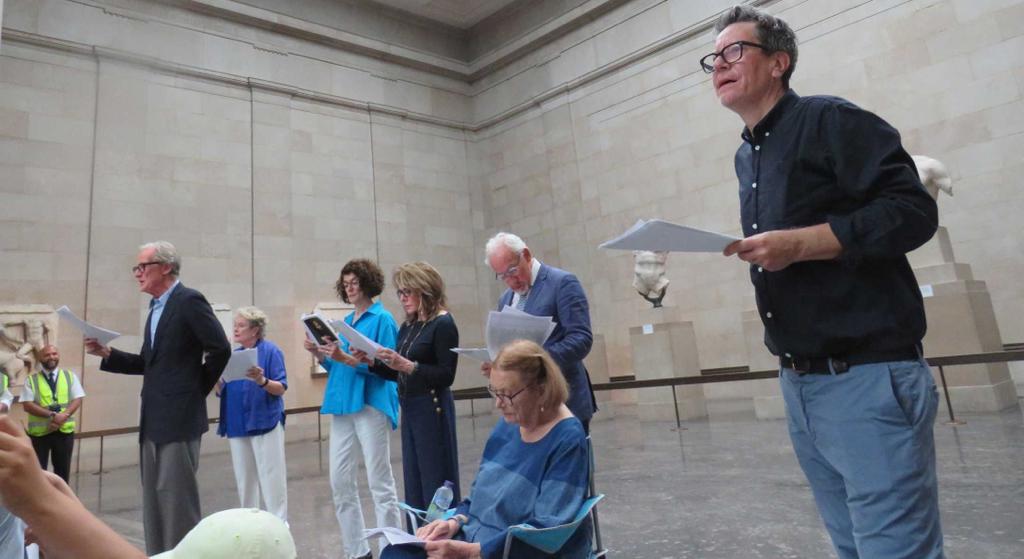

On Sunday 18 June 2023, in the Parthenon Galleries of the British Museum, acclaimed actors Bill Nighy and Simon Callow CBE; TV presenter and journalist Baroness Joan Bakewell; Stockard Channing, whose screen credits range from Grease to The West Wing; Anna Savva, the Anglo-Greek actress memorable in The Durrells, and Janet Suzman DBE, Chair of the BCRPM, added their voices for the reunification of the Parthenon Marbles.
The six voices gathered to mark the Acropolis Museum’s 14th anniversary and lamented with Byron’s words, the continued, unnecessary plight of the Parthenon Marbles.
They read Byron’s 212-year-old poem ‘The Curse of Minerva’ that furiously denounces Lord Elgin for stripping the Parthenon of fabulously beautiful sculptures and friezes and eventually selling them to the British government when they were not his to sell. It was the first time that the poem was read in the British Museum’s Room 18.
Alexi Kaye Campbell, playwright and member of the Committee, was MC and introduced the readers, paid tribute to the Acropolis Museum and reminded us that Byron’s poem continues to have relevance today.
The British Museum has housed almost half of the surviving and fragmented Parthenon Marbles for 200 years, and refuses to give them back, arguing that they were legally acquired. No express permission from the Ottoman Sultanate who occupied Greece has ever been found to corroborate this assertion.
The British Committee for the Reunification of the Parthenon Marbles (BCRPM) was founded in 1983 as a result of the visit to the UK of the Greek movie star Melina Mercouri, who, as Minister of Culture demanded that Elgin’s act of depredation be reversed. The Hellenic Republic had been asking for the Marbles since 1832. Recent polls show that a large majority of Britons support this demand.
The reading marks the latest action by the British Committee to affirm its belief that the sculptures by Lord Elgin should be reunified with their other halves in Athens at the ultra-modern Acropolis Museum, to complete the celebration of Greece’s Golden Age when the sublime Parthenon was completed in 440BC.
The Committee’s 30 members include many of Britain’s leading classical scholars as well as writers, media personalities, legal experts and human rights campaigners.
The recital took place two days before the 14th anniversary of the opening of the New Acropolis Museum, where a 50-metre stretch of the Parthenon frieze is already on superb display, awaiting the eventual addition of the 80-metre section which is now held in London.
Working closely with supporters in Greece and all over the world, the Committee has argued that the Athens museum’s success creates an overwhelming case for restitution. If London’s 80-metre section were restored to its place of origin, one of the greatest aesthetic masterworks of all time, a sculpted procession of chariots, war-horses, livestock and Athenian citizens, would be restored to near-wholeness and displayed anew under the brilliant Greek light, which inspired Lord Byron’s verses.
Minerva’s Curse was written in March 1811, shortly after the poet had seen the destruction left on the Parthenon after the violent removal of most of its surviving sculptures. It imagines the goddess Athena (also known as Minerva) arriving at the temple, which was built to honour her, and denouncing Lord Elgin for his act of desecration. Byron celebrates the beauty of Athens and the surrounding region of Attica, reflecting his belief that the genius of ancient Greece can best be understood in the landscape where it emerged.