
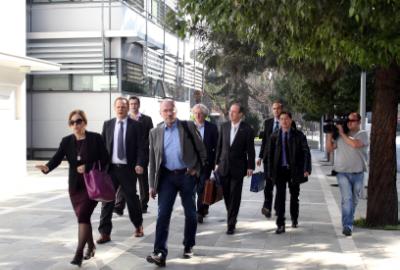

The mistakes of the past concerning the operation of the Troika (European Commission, ECB and the IMF) in formulating fiscal consolidation programs for member states should be avoided in the future, members of the European Parliament Economic and Monetary Affairs Committee (ECON) said here today.
The ECON delegation is paying a visit to Cyprus, as part of a series of visits to Euro area member states that are implementing similar programs, and had earlier today meetings at the Cyprus House of Representatives, as well as with former Cypriot Ministers of Finance. After concluding visits in Portugal, Cyprus, Ireland and Greece, the delegation will prepare a report on the operation of the Troika.
Speaking in the afternoon, during a press conference, at the EU House, in Nicosia, the members of the delegation asked for more transparency and democratic legitimacy in the decision making process and said the EP should be involved more in the future, noting the necessity for Treaty change.
French MEP of the Socialists & Democrats Liem Hoang Ngoc, who is the co-rapporteur, said during the press conference that the bail in implemented in Cyprus banks was proposed by European Commissioner for Financial Affairs Olli Rehn during a crucial Eurogroup meeting, last March.
In Spring 2013 the Eurogroup reached an agreement with the Cypriot authorities on the key elements necessary for the country’s macroeconomic adjustment program. The 10 bln euros loan agreement provided that the island’s second largest bank, Laiki splits into a “good” and a “bad” bank. The bank’s “good” assets were transferred to Bank of Cyprus, where a massive haircut was imposed on uninsured deposits of more than 100,000 euros.
Hoang Ngoc created a stir, when he stated at the press conference that the proposal to bail in banks was first discussed by the Cyprus government and later on in the European institutions. The MEP clarified later that the government of Cyprus had no prior knowledge as to which would be the final solution and said that the proposal was suggested by Rehn at a later stage, in Brussels, during the Eurogroup meeting.
Austrian rapporteur, EP Vice President and EPP MEP Othmar Karas said from his part that the delegation is not going to draft a report on Cyprus, Greece, Portugal or Ireland, but a report on the work of the Troika.
He added that challenges to the Cypriot economy were numerous, but praised Nicosia for its commitment for a precise and timely implementation of the Memorandum of Understanding.
“Errors and misjudgments should not be repeated in the future,” Karas said.
Moreover, Hoang Ngoc said that the main problem of the Troika is that it lacks democratic legitimacy.
On the reaction of the EU to the crisis, the French MEP said that the situation is evolving in the last two years concerning the guarantee of deposits and bail ins. “There is now a Banking Union” Hoang Ngoc noted and said that the public debate has opened concerning the creation of a crisis management fund and a deposit guarantee fund.
The co-rapporteur said moreover that the EP is in favor of employing the community method to deal with the crisis, by engaging European citizens and the European Parliament.
There must be more integration, but this can not be done without democracy, he said, otherwise people will perceive the EU as an anti-democratic technocratic structure.
Responding to a question, whether the EP delegation was rather conducting a “post mortem” with its report, Finish ALDE MEP Nils Torvalds said that we must ask for the reasons we are forced to do so. He pointed towards politicians, who, according to Torvalds, tried to “duck the problem”.
On the case of Cyprus, Torvalds said it was handled in a different way, because politicians could not diagnose the depth of the problem with Greece. He further said that Cyprus is paying for the “all the shortcomings” both in Greece and Cyprus.
Asked if he is in favor of the bail in process, the Finish MEP said this could be the solution, if there is a stable system. Responding to the same question Hoang Ngoc said “there is bail in and bail in” and expressed his disagreement with the haircut of uninsured deposits, under 100,000 euros.
Torvalds said moreover that he does not think Cyprus was treated as a “Guinea pig” concerning the bail in, but noted that things were handled in such a way, because there was no adequate time.
German GUE MEP Jurgen Klute said finally that the best way to solve the problem in the Euro zone is to have a fiscal and social Union. He added that he agrees with the idea to have banks and their clients pay for their mistakes, instead of taxpayers.