
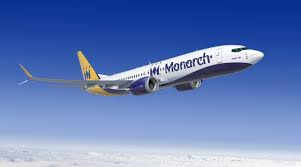

UK’s Civil Aviation Authority (CAA) said on Monday Britain’s Monarch Airlines ceased operations with immediate effect, leaving 110,000 customers stranded overseas and about 300,000 future bookings cancelled.
“We’re sorry to announce that Monarch has suspended flights and holidays,” Monarch said on Twitter.
Tough competition in the airlines sector has been putting pressure on weaker European carriers and driving consolidation, with Air Berlin and Alitalia filing for insolvency this year and seeking new investors for parts of their business.
“This is the UK’s largest ever airline to enter administration,” CAA said.
The government has asked CAA to charter more than 30 aircraft to bring back to the UK Monarch Airlines customers currently overseas, CAA said in a statement.
The government has begun the biggest ever peacetime repatriation effort to return the affected passengers, Department for Transport, Foreign and Commonwealth Office said in a statement.
Monarch said on Thursday it was talking to potential partners after a report that parts of its short-haul network would be sold.
After the collapse of UK airline Monarch arrangements have been made for those due to leave the island on Monday while details for others holidaying on the island will be announced later.
Tourists currently staying in Cyprus have been reassured, up to a point. Two flights are due to depart from Larnaca airport on Monday evening. One of them, to Luton, is scheduled at 10pm, and, according to an announcement on the web, will be flying as planned.
The other one, to Birmingham, will be three hours late. The departure time has been changed from 9.45pm to 0.55am. This flight is now operated by British Airways.
Those who are already in Cyprus and due to travel back to the UK by October 15 have been informed they will be taken home at the end of their holiday at no extra costs.
Persons who have booked a holiday to Cyprus are not so lucky. Graeme Spencer is one of them. “Is there a train to Cyprus? Monarch’s just messed up my travel plans!” he asked online.
Depending on where and when they have booked their flights, some will get their money back, but others who are not covered by the Air Travel Organisers’ Licensing (Atol), the UK Civil Aviation Authority scheme to give financial protection to people who have purchased package holidays and flights from a member tour operator will have to pay for an additional flight if they want to come to Cyprus on holiday as planned.
The UK authorities said they will still make alternative travel arrangements for those travelling from Cyprus on October 16 and after for those who are covered by Atol on an individual basis, but the others, the majority of travellers, will have to arrange their own way back to the UK.
What has gone wrong?
Monarch reported a loss of £291m for the year to October 2016, compared with a profit of £27m for the previous 12 months, after revenues slumped.
It had been in last-ditch talks with the CAA about renewing its licence to sell package holidays, but failed to reach a deal
Blair Nimmo, from administrator KPMG, said its collapse was a result of “depressed prices” in the short-haul travel market, alongside increased fuel costs and handling charges as a result of a weak pound.
The transport secretary said it was a victim of a “price war in the Med”.
However, Monarch chief executive Andrew Swaffield said the “root cause” was terrorism in Egypt and Tunisia, as well as the collapse of the market in Turkey.
He said it had been carrying 14% more passengers than last year – but for £100m less revenue.
Monarch’s owner, Greybull Capital, had been trying to sell part or all of its short-haul operation so it could focus on more profitable long-haul routes, and said it was “very sorry” it had not been able to turn around its fortunes.
What have the authorities said?
The CAA said the situation was “unprecedented”.
Chairwoman Dame Deirdre Hutton said there would inevitably be some disruption as the authority was having to effectively create one of the UK’s largest airlines from scratch, adding: “It is a huge undertaking.”
Passengers from as far away as Tel Aviv will require repatriation, and two “rescue flights” from Ibiza have already landed at Gatwick, the CAA said. The vast majority of customers due to fly on Monday are expected return by the end of the day.
Mr Grayling said: “This is a hugely distressing situation for British holidaymakers abroad – and my first priority is to help them get back to the UK.”
The transport secretary said the Department for Work and Pensions would give support to those affected and other airlines had already told him they may seek to employ Monarch staff.
Mr Nimmo, from KPMG, said Monarch employees had not been told before the firm went into administration and advised them to go to work as usual on Monday.
Where are Monarch holidaymakers?
Last year, Monarch carried 6.3 million passengers to 40 destinations from Gatwick, Luton, Birmingham, Leeds-Bradford and Manchester airports.
According to the CAA, the 110,000 holidaymakers currently overseas are in at least 11 countries, including Spain, Portugal, Italy and Greece.
Replacement flights are currently scheduled to fly to 33 airports.
Analysis: By Joe Lynam, BBC business correspondent
Monarch has experienced the perfect storm of challenges in recent years.
The terror attacks in Turkey and Egypt have deprived the airline of a large chunk of its annual revenues, and forced it to compete on heavily congested traditional routes to Spain and Greece.
That has forced down prices and profits on top of weaker demand from UK travellers – for whom a less valuable pound has made travelling costlier.
The short-haul market has been described as “horrendous” by senior aviation industry figures. It has already resulted in the collapse of Air Berlin and placed huge pressure on other airlines.
Put simply, there are too many seats and not enough bums to put on them to make a profit for all major carriers.