
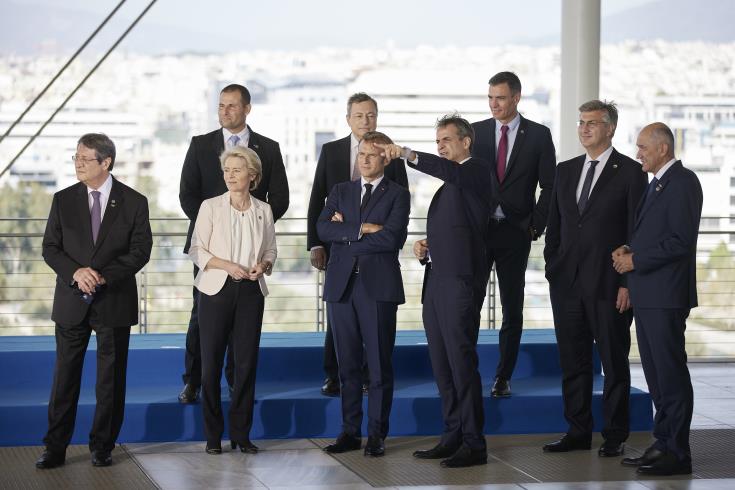

Τhe southern countries of the EU Croatia, Cyprus, France, Greece, Italy, Malta, Portugal, Slovenia and Spain underlined on Friday that they stand united in their strong conviction that urgent and ambitious global action – at national, regional and local levels, and involving all stakeholders, in particular, civil society and the private sector – is now, more than ever, necessary to tackle the escalating climate and environmental crisis and create a safe, secure prosperous, fair and sustainable future for our societies in the 21st century driven by circular economy patterns.
The nine EU southern countries, that held a meeting in Athens, at the level of Heads of State and Government, with the participation of the President of the European Commission, said, among others, in the Athens Declaration on climate change and the environment in the Mediterranean, that they agreed to intensify a multilateral cooperation through the sharing of experiences and best practices in planning and implementing the necessary adaptation policies and prevention measures to minimize risks at national, regional, and local levels, involving all relevant stakeholders, including in the main public authorities, civil society, and businesses.
Moreover they underlined the need to engage in active dialogue and promote common initiatives and responses with all Mediterranean states, taking a regional approach to the climate crisis in alignment with EU action.
The nine countries reiterated their firm commitment to the implementation of the Paris Agreement and to the target of limiting the global temperature increase to 1.5°C above preindustrial levels as well as their commitment towards reaching climate neutrality by 2050, in line with the European Climate Law and the EU target of reducing net greenhouse gas emissions by at least 55% by 2030.
They acknowledged the need for decisive adaptation and resilience policies in line with the new EU Strategy on Adaptation to Climate Change and prevention measures in all sectors – including environmental and socio-economic – likely to be significantly affected by climate change in the Mediterranean region, in a cross-sectoral manner, given that the impacts of climate change pose serious threats to the environment, society and the economy.
The nine countries agreed to work closely together to build synergies in advancing the necessary shift from fossil fuels to renewables and low carbon technologies, through meaningful public engagement in their planning and deployment with utmost care for the natural ecosystems.
They agreed to play an active role in communicating the particular climate vulnerability of the Mediterranean region, at the global level underscoring the importance of the Ocean-Climate nexus and the need to bring it to the forefront in the context of climate action.
The nine countries stressed the need for urgent action to address these long-term impacts on the region’s biodiversity and ecosystems and, thus, the need for the necessary transformative changes to put biodiversity on the path to recovery by 2030, in line with the EU Biodiversity Strategy for 2030.
They committed to take actions to widen and better manage the EU network of protected areas, contributing to the objective of protecting 30% of the EU land and sea by 2030, one third of which under strict protection, through collective action by all countries participating in this joint effort, taking into account national conditions.
The nine partners stressed the need to further promote sustainable forest management, strengthening the multifunctional role of forest ecosystems and ensuring their protection and restoration by creating effective mechanisms towards this end.
Moreover, they stressed the need to implement appropriate reforestation projects and, in this regard, commit to take actions to increase the quantity, quality and resilience of forests, including by contributing to the pledge of planting at least 3 billion additional trees in the EU by 2030 in full respect of ecological principles.
The nine EU southern countries agreed that urgent, coordinated, comprehensive and coherent policy responses are necessary towards the adaptation of forests to climate change.
They also stressed the need to tackle imported deforestation and global forest degradation at EU level through a new legislative initiative and acknowledged the role of a sustainable Blue Economy in achieving the goals of the European Green Deal in the Mediterranean, inter alia through investment in innovative green technologies and further promotion of the principles of the circular economy.
Furthermore they stressed the urgency of strengthening and deepening cooperation among Mediterranean partners, considering that the challenges related to natural disasters share a common profile, are often transboundary and call for initiatives related to the exchange of experts, lessons learned, best practices, resources and expertise.
In light of the above, while maintaining existing regional agreements, they agreed to further extend the work of the Southern Countries of the EU group by organising sectoral meetings, at all levels as necessary in a flexible and informal context, with the aim of facilitating the effective coordination and exchanges among the nine partners.